

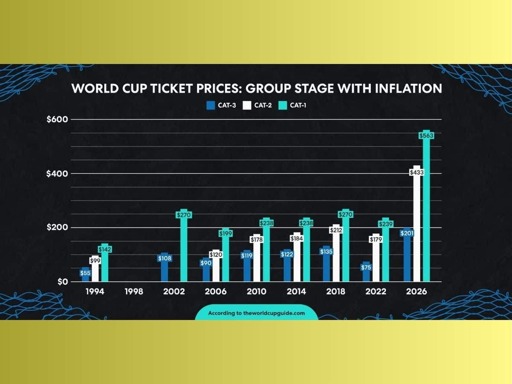

Discussing World Cup ticket prices is no longer a marginal detail in event coverage; it has become a direct entry point for understanding a deeper transformation in the tournament’s structure itself. Between the 2018 World Cup in Russia, the 2022 World Cup in Qatar, and the upcoming 2026 World Cup, the figures reveal an upward trajectory that goes beyond mere inflation, touching upon a reshaping of the relationship between fans and the event.
Through this analysis, we deconstruct the interconnected shifts in three crucial indicators: prices, demand, and revenue — and the differences that emerged between these three editions.
Price soaring
Ticket prices for the last three editions varied and followed an upward trend, especially for the final match, which represents the symbolic and economic culmination of the tournament, where the gap is most pronounced.
In the 2018 edition, the top-tier ticket category settled at around $1,100, before rising to nearly $1,600 in 2022, an increase of approximately 45%, according to Al Jazeera and FIFA data.
However, in 2026, the figures jump to a completely different range, with prices for the final match ranging from $6,700 to $11,000, according to Reuters. This effectively means a price increase several times over, not just a gradual rise.
The picture is not much different for the other categories. In the group stage, prices moved from around $100 in 2018 to $69 in 2022 (as part of a local subsidy policy), before rising again in 2026 to range between $60 and $300. In the knockout stages, ticket prices jumped from the $300-$700 range in 2018 to over $4,000 for some matches in 2026.
These figures point to a fundamental truth: ticket prices have exploded.
Exploding ticket demand
If prices have indeed risen, demand offers the most direct explanation for the escalating price increases when comparing different World Cup editions.
Between the 2018 and 2022 tournaments, total ticket applications did not exceed 50 million, according to FIFA data and media reports.
In 2026, Reuters reported that the number jumped to approximately 500 million applications, an increase of nearly 20 times.
This shift not only reflects the expanding fan base but also reveals that tickets have entered the realm of a “scarce commodity,” where the gap between limited supply and enormous demand drives prices to record highs.
World Cup record revenues
On the revenue side, the picture is clearer. The 2018 tournament generated approximately $6.4 billion, rising to $7.5 billion in the 2022 edition, while FIFA estimates that the 2026 World Cup will generate around $13 billion.
Tickets and the hospitality sector alone are projected to generate nearly $3 billion, the highest revenue in the tournament’s history, according to The Guardian.
Behind these figures lie a number of interconnected factors, most notably the adoption of dynamic pricing models, which directly link price to demand, along with the expansion of the tournament to 48 teams, increasing the number of matches and boosting the event’s global appeal.
Furthermore, hosting the tournament in the United States, Canada, and Mexico introduced an economic model more akin to American sports, where major events are managed with a revenue-maximizing logic. Added to this is the significant expansion of hospitality categories, which has reshaped the pricing pyramid in favor of higher-spending segments.
What this report reveals through the comparison of the last three editions of the World Cup cannot be reduced to mere numbers. It confirms that we are witnessing a gradual transformation that will culminate in 2026, where tickets are no longer simply a means of attendance, but have become part of a complex economic system governed by market forces.
While demand has increased twentyfold, and ticket prices in some categories have jumped sixfold in a short period, the 2026 edition appears to be a historic turning point in the relationship between fans and the World Cup.
Featured image via the Canary
By Alaa Shamali
From Canary via This RSS Feed.
Pay to be locked into a concentration camp! Seriously, don’t go to the USA. Don’t say I didn’t warn you.
