

The principle of “limiting power” is firmly established in military and political science, but rarely applied by an entity like Israel. This is not because decision-makers are unaware that continuing the war may be futile, but because their approach is based on a logic of dominance. In this framework, the other side is viewed as an absolute enemy in every respect.
No one in the Arab world is unaware that Israel acts according to this mentality. However, the difference between those who resisted Israel and those who remained silent about its aggression, cooperated with it, or refused to resist it, also stems from the same concept of power.
The resistance fighters do not require explanations of their position, which is based on the belief that occupation can only be ended through force. In contrast, critics of the resistance argue that the enemy is too powerful to confront and that resistance is therefore suicidal. This view often leads to the conclusion that accommodation or compromise is the only alternative, where the weaker side effectively pays the price for its security.
Those Arabs who chose this path have shown us their own ineffectiveness, from Egypt, which began, popularly and then officially, to regain the position of actual adversary to Israel, to Jordan and the Ramallah Authority, where those in power derive their positions from the occupation itself.
The sons of Zayed in Abu Dhabi: volunteer partners with Israel
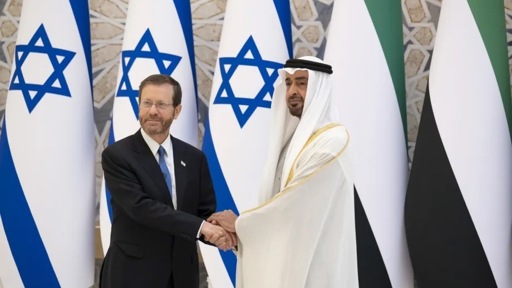
In the Arab world today, a new model is emerging of those who seek to build a relationship beyond mere alliance with Israel, embodied by the sons of Zayed in Abu Dhabi. They reflect a conviction that, at first glance, seems ideological: the necessity of a strategic alliance with Israel. The concept of “interests” here is not limited to seeking protection, as some Gulf states have done when justifying the US occupation of parts of their territories as a reflection of the balance of power in the world and the region. Rather, Abu Dhabi acts as if it were a partner with Israel in a broader project of political, economic, military, and security hegemony across a vast area stretching from West Asia to East and North Africa, passing through the Arabian Peninsula, Iraq, and the Levant.
In this sense, Abu Dhabi’s role in the conflict with Iran, and with the resistance forces in Lebanon, Palestine, and Iraq, transcends traditional alignment, representing a volunteer effort by the sons of Zayed to play an exceptional role. They act from the conviction that their financial resources enable them to perform roles far exceeding their human capabilities. They live in a country that could not survive a single day if all non-Emiratis (expatriates make up 90% of the population and labor force) departed: no functioning security apparatus, no functioning government offices, no organized trade, no functioning banks, no garbage collection, and no production in factories.
In the case of Abu Dhabi, a handful of madmen who control the wealth and decision-making power staged a coup that surpassed even the dreams of their father, who had imposed himself as the permanent ruler of the alliance formed with the other emirates. They brought in every kind of tyrant imaginable, not only to consolidate their rule within the country but also to expand their financial, political, economic, and security influence throughout the region. These same individuals selected tens of thousands of their men to lead the operation, under the complete supervision initially of Britain and then the US, before Israel took over in its entirety.
While the kingdoms and emirates of the Arabian Peninsula share many commonalities, what distinguishes the rulers of Abu Dhabi from others is not exceptional shrewdness or intelligence, but rather a willingness to become deeply subservient to the US, Israel, and the West, and an even greater readiness to assume all manner of dirty political, media, and security roles in numerous countries around the world. Indeed, evidence suggests that they have even begun to cover the expenses of a portion of the Israeli lobby’s activities in the United States and the rest of the West, spending billions to support any group of mercenaries willing to engage in the Israeli project at the expense of their own countries and peoples.
Silence and submission are the price of entry into Abu Dhabi
In contrast, Abu Dhabi imposes strict rules governing its operations domestically and sets precise conditions for all those who deal with it.
First, there is a model of governance through submission. Anyone wishing to benefit from the “Emirati paradise” must accept the rules as they are, without objection or review. Those working there are now required to convey this logic even to their families: we live and work here according to the laws of this country, and we must abide by them without question.
This submission doesn’t mean, for example, not breaking traffic laws, or refraining from discussing educational curricula, financial market regulations, or market pricing. Rather, it means complying with everything the state administration wants. Upon closer examination, it becomes clear that the primary condition is the guest’s abstention from discussing any of these matters. The state only needs their opinion when it finds them a willing implementer of its policies, thus ensuring that those working with them are responsible for disseminating all harmful ideas and oppressive elements in order to be accepted into higher positions by the ruler.
Secondly, submission here means excluding any space for alternative ideas or parallel discussions. There is no room for the exchange of different intellectual theories, political sensitivities, or even independent perspectives on issues of social justice and human rights. The “guest” is required to leave his intellectual framework in his home country, and upon arrival, he will receive a sheet of instructions at the airport dictating how he eats, speaks, and sleeps. This has resulted in the continuous failure of all the political, media, and cultural programs that the sons of Zayed have attempted to implement in their country. They spent hundreds of billions to no avail, destroying the history of long-established Arab media institutions after subjecting them to their laws.
Look at what happened to the Lebanese newspaper “An-Nahar” since it came under the management of the Emirati financier, and consider the caliber of journalists, researchers, and commentators working in their media, intellectual, and research institutions. Examine the qualifications and capabilities of those who work for them as university professors, judges, or researchers in the humanities … All of these individuals were effectively undermined the moment they entered these countries and are now useless.
Third, there is an ongoing expectation that residents cannot be involved in the affairs of the country in which they live. A resident of this country cannot talk about an earthquake, or a dispute in his company, or about someone being arrested for reciting verses of poetry that the security officer did not understand and considered hostile ideas, or about an activist being expelled for liking a post on social media that contradicted the ruler’s mood.
Voices have begun to rise in Sharjah, Ras Al Khaimah, and Dubai, but the country’s rulers do not see themselves outside the American-Israeli project to control the region and its resources.
Even more appalling is that the rulers of this country expect their residents to breathe life into the desert sands, to invent an identity and history for it that suits their tastes, and to present its leaders in the way the rulers want, not based on their own understanding or experiences. Furthermore, residents are expected to recite a daily ode praising this nation of prosperity, happiness, progress, and development, fostering the idea that success is synonymous with the UAE.
Illusion, development, and control from Lebanon to the Gulf
In Lebanon, there is a situation that has gone largely unnoticed. Solidere, the company that was built at the expense of the people of the capital and their rights to their land, employed dozens of workers to sweep the dust off the traffic lights in its streets daily, and to clean the sidewalks and roads. A visitor would praise the polished, surface-level image of this usurped part of Lebanon’s land, without understanding how it was built. These visitors don’t see the damage underneath, or the amount of embezzled funds spent on cosmetics that can never hide the ugliness of wealth’s creation.
Similarly, in the UAE, no one is allowed to enter the neighborhoods where workers from India, Pakistan, and Bangladesh live. Photography and scrutiny of their living conditions, health facilities, and public services are prohibited. Questions about the high walls surrounding these small buildings, where human flesh is crammed together, are also forbidden. And, of course, no one can obtain statistics on those who have died from disease, oppression, or torture.
Today, the UAE, ruled by the sons of Zayed, stands at the forefront of the few engaged in the war against Iran and the resistance front. It is heading towards further involvement and will employ all forms of internal repression, not against residents this time, but against the citizens of the other emirates who have begun to raise their voices, from Dubai to Ras Al Khaimah and Sharjah, and who have not been spared the humiliation inflicted by the sons of Zayed. They now watch their country burn as a result of the policies adopted since the passing of Zayed the father.
Many citizens of these emirates find themselves in a very difficult position. They are neither able to rise up against a handful of criminals, nor are they able to immediately break free from a forced unity that has made them mere appendages.
Moreover, there is a broader sense of concern among the neighbors of this reckless state, from the Sultanate of Oman, which has remained silent about the injustice it has historically suffered but today feels the flames, to Saudi Arabia, which is no less involved than the sons of Zayed, but thinks of itself as a state capable of living without guardianship, passing through the rest of the Gulf states, which are suffering greatly and do not have the courage to ask the real question about how to manage their future after this war into which the United States has dragged them, and which Israel seeks to exploit to impose its control over the wealth of this region of the world…
This article was first published in Arabic on Al Akhbar.
The post The UAE and Israel: a full partnership in crime and bloodshed appeared first on Peoples Dispatch.
From Peoples Dispatch via This RSS Feed.