

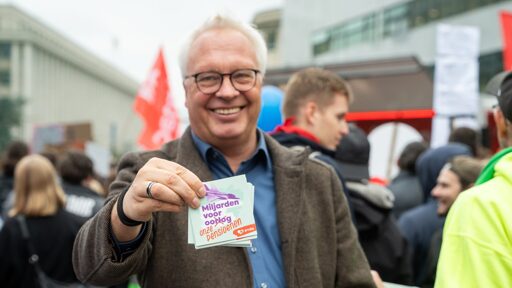
In a recent interview with German Foreign Policy, Peter Mertens talks about the wave of protests in Belgium against the erosion of workers’ rights and social standards, which has been ongoing for more than a year. Mertens is an author and General Secretary of the Workers’ Party of Belgium (PVDA-PTB), which has participated in the trade union-led demonstrations and strikes from the outset and is currently the strongest party in the capital region of Brussels, polling at more than a quarter of the vote. Mertens argues that the link between social protests and the fight against militarization is obvious: “It is the same people who are footing the bill for both”; this is “impossible to ignore”. The protests are, not least, about restoring “people’s confidence in their collective strength”. Mertens points out that in 1945, even in the West, the power of huge corporations was regarded as one of the main causes of militarization and war. His book “The Last Days of the Old Normal” is due to be published shortly. His most recent work is “Mutiny”.
German Foreign Policy: Since the beginning of last year, Belgium has seen a wave of massive protests against the government. What have they been about?
Peter Mertens: In fact, this wave of very big and profound nationwide protests started already in 2024, 16 months ago, when the negotiations on forming the current government were still ongoing. 100,000 people took to the streets. This had never happened before. In the 16 months since then, we have seen 14 nationwide mobilizations, the last one on 12 March with again 100,000 people marching in protest. There will be another national strike soon, on 12 May. In between, there will be a nationwide day of action on 1 May. It is one of the longest action campaigns that the Belgian trade unions have ever set up, and it is exceptional in its depth as well.
Basically, the protests are about bread-and-butter issues, pensions being at the core. The government wants to introduce a “pension malus”, a sanction for those who take up their pension before the age of 67. If you do so you could lose as much as 20 per cent of your pension. The pensions in Belgium are already very low. Germany has the lowest pensions in Western Europe, Belgium has the second lowest. If you look at the pension malus – it’s mainly women who will be hit by it. There will also be a wage freeze even in sectors which make a lot of profit, and there will be many more cuts. There is a huge anger about it amongst the people. The protests, basically a trade unionist movement, run very deep.
By the way, there is little coverage of the protest movement in the Belgian press. When there were nationwide strikes in 2014, more than a decade ago, they were covered relatively prominently in the media. Today, you may find a picture of the protests somewhere on, let’s say, page twelve or so in a newspaper. The lack of coverage of this large movement in the media is unprecedented.
GFP: Do you think the protests have been successful so far?
PM: There is always a certain dialectic at play. First of all, there’s a negation, meaning that people are angry about some measures taken by the state. The fact that people express their anger not sitting in armchairs in front of the telly throwing their slippers at it, but instead getting active, doing something collectively on the streets, that’s very important, it’s a significant step forward which is often underestimated. The art of organizing, of getting people into a movement is crucial.
Look, in every outburst of anger there are two aspects. There is bitterness, the feeling of being powerless individually. The far right is very adept at exploiting this. We are trying to transform the anger and the class hatred – the negation to put it that way – into something positive. It starts at a very basic level: you have to convince people to take to the streets, to act collectively. The system wants people to feel small and powerless. It tries to break the belief in collective strength – through intimidation, through repression. When people believe that their actions are meaningless and the opponent is invincible they give up. That is a deliberate manipulation, a deliberate distortion of the perception of the people. The message is clear: There is no alternative, nothing can be done, ‘they’ are too powerful, everything has already been decided. That is precisely what we on the left must fight against. We have to restore people’s confidence in collective strength.
Read more: May Day demonstrations in Europe: hundreds of thousands call for peace and social justice
And if you look at the socioeconomic level – each demonstration, each strike has pushed the government back a bit. The pension reform has not been pushed through yet and has already been significantly watered down on several points thanks to the pressure the movement has been exerting on the government, even if it hasn’t been abandoned entirely. Then, there are a lot of contradictions inside the government. Without the protests, these contradictions wouldn’t be that severe. For example, there are discussions going on about how to deal with the current high energy prices which are a result of the illegal wars of Trump and Netanyahu and of all those in Europe supporting these illegal wars. Obviously, life is becoming more expensive for the people. One wing of the government wants to double down on austerity. The other wing says this is impossible which in turn is a success of the large protest movement. Without the movement, there would be complete consensus in the government.
We’ll have to see whether the current Belgian government will survive to the end of 2026. It is under a lot of pressure, there is a lot of tension inside the government, and even if this was not the real aim of the protest movement it is a result though of the pressure it exerts. Certainly, those contradictions within the government also are deepened by the pressure that the socialist trade union – one of the largest in Belgium – is putting on the Flemish social democrats who are part of the government. And quite understandably so, when you look at the fact that the social democrats are at the helm of a government that is pursuing policies that go against everything socialists have ever stood for.
GFP: What role does militarization play in the welfare cuts the Belgian government is imposing on the people?
PM: I think it’s becoming more and more clear that the government is trying to sweep an elephant under the carpet. It’s quite difficult to do so because an elephant is rather big, and the elephant in the room in this case, the military budget which stood at 3.9 billion euros in 2017 became bigger and bigger and jumped to 12.7 billion euros in 2025 – more than three times as much in just eight years. That’s crazy. Now, the government has promised Mr Trump that it will increase the military budget to 22 billion euros, which would be 3.5 per cent of Belgium’s GDP. The Belgian government can’t take on debt to reach 22 billion euros as the German government does. It has to take the money from other sectors.
We can see it when we have debates in the parliament: each and every ministry is rather depressed because all of them have to apply austerity. The situation is dire. For example, the prison system is completely collapsing, the health care system is buckling under the pressure of austerity, with care workers groaning under the workload and chronic staff shortages. So, each minister is a little bit depressed except the minister of defense, who is full of joy. He can spend billions and billions in the coming years. The ministers say so themselves: if they have to choose between guns and butter, they choose the guns.
We have a very right wing minister of defense who likes to be called minister of war like Pete Hegseth – Theo Francken, a very Trumpian figure. He says: “Okay, we must apply the model of the United States in Belgium, and if that means using a chainsaw against social security then that is what we will do.” “If that means that people have to pay 1,000 euros to have dental treatment” – I am quoting him verbatim – “then they have to pay 1,000 euros.” According to him, we can not afford this “Cuban model of free medicine” anymore. So, the government itself links militarization to austerity.
Read more: Militarization is spreading through Germany’s health sector
Recently, there was a scandal in Belgium. Do you remember the drones which were spotted all over Europe last year? In Belgium it was all over the news as well, at a certain point they even closed the national airport at Zaventem because of what they called an acute threat. We were told the drones were Russian drones and that we urgently needed to purchase expensive military equipment to shoot them down and protect ourselves against Russian danger. But now, a recent investigative report by the public broadcaster has revealed two explosive facts. The images of the alleged drones over Zaventem airport turned out to show a police helicopter. And the second revelation is even more stunning: it appears that it was defense minister Theo Francken himself who leaked those images to the press. Now, people are laughing at him because it is becoming more and more clear that the government is inventing stories to create fear and to justify military spending. In a way, I should like to thank our minister of war for so bluntly lying to people.
GFP: So, it’s quite obvious that militarization is closely linked to welfare cuts. Do you think it is possible to link the respective protests, too – protests against militarization to protests against welfare cuts?
PM: It is the same people who are footing the bill for both, the wars and the austerity cuts. That connection is becoming impossible to ignore. What is added in military spending is taken away from social services – it is almost a one-to-one relationship. That has to be our starting point.
And we must not abandon the bread-and-butter struggle. I sometimes hear the question: what is the point of taking to the streets for pensions and wages if everything gets swept away in a devastating war? My answer is: it is worth it. Whether it is about pensions or wages, housing or energy prices, childcare or elderly care – why would we abandon the working class to the far-right Pied Pipers of Hamelin?
But we must connect it to the struggle against militarization and war. The contradiction between labor and capital is a systemic one, built into capitalism itself. In its drive for maximum profit, capitalism leads to crisis and war. Climate breakdown, food crises, suffocating debt, economic and military conflicts – capitalism has no way out of these challenges. Only socialism does. That is the argument I make in my new book, which will be published soon.
GFP: Does the fact that NATO has its headquarters and a large number of staff in Belgium have an impact on the political situation in your country? If it’s about NATO, Brussels is, so to speak, situated in the eye of the storm.
PM: Indeed. When it comes to militarization you can’t compare the situation in Belgium with the situation in Germany. There is the fact that NATO has its headquarters in Brussels, employing around 4,000 people. Another 1,700 people work at SHAPE in Mons. That matters. It matters militarily. It objectively makes Belgium part of the US war machine, that’s a simple fact. Wars are being planned and waged from Belgian territory, from Mons. This is often underestimated.
Besides, look at the new National Security Strategy of the United States. It contains three pages on Europe where the Trump administration describes its strategy to undermine European unity by supporting so called patriotic forces. I am just quoting the content as it can be read in the document. US embassies play a key role in this. The US embassy in Belgium is behaving very aggressively, is interfering actively in Belgian politics. This is a new kind of diplomacy, sort of an aggressive anti-diplomacy if you want to put it like that. And behind the scenes there is also the whole network of NATO and SHAPE in Brussels.
During the campaign leading up to the 2024 elections, PVDA-PTB were the only party to speak out against NATO. This wasn’t our main focus but the other parties and the media tried to weaken us by claiming we were a purely anti-NATO party. We didn’t make the topic a priority but the political adversary did so – and to be honest, it played out very well. Today, two years later, we can say: this position of questioning NATO, of recognizing that NATO is a warmongering machine – more and more people are open to it because of what has been happening recently. People felt the Greenland moment when Trump announced that he would be willing to take over Greenland from Denmark. People realized it when NATO’s secretary general Mark Rutte acknowledged that NATO is an instrument of American intervention.
We have always maintained that NATO is a US instrument, but then, we have always been accused of spreading Russian propaganda. Now, NATO’s secretary general confirms it himself. Additionally, Trump is behaving like a madman, calling NATO a paper tiger because it won’t participate officially in the illegal war against Iran. Of course, in reality, NATO members do – look at Ramstein (Air Base) and all the other American bases which are being used for waging the war. In fact, the current horror of the war in Iran couldn’t take place without Ramstein. Today, Trump and the contradictions among the imperialists reveal what NATO really is.
GFP: There have been widespread school strikes in Germany against compulsory military service, the next one being due to take place on 8 May. Will there be compulsory military service in Belgium as well?
PM: There is a voluntary military service here which was introduced by the current minister of war Theo Francken. His ministry sends a letter to each male person aged 17 years to invite them to do voluntary military service. This is just the first step to prepare people’s hearts and minds for militarization. Look, the government doesn’t send a letter to each adult person to inform them that there is a lack of nurses, a lack of engineers and so on, asking people to step in. Of course, they don’t do that. The letter regarding voluntary military service is clearly aimed at preparing people’s hearts and minds for militarization and war.
Read more: Second school strike takes place in Germany: “The rich want war, the youth want a future”
The two strikes that young people in Germany staged against compulsory military service – I would like to express my respect. We support them. Our youth organizations try to learn from them. We are inspired by what they are doing. The fact that they organized roughly 55,000 people on a clearly anti-militarist basis is impressive. One of the chapters in my new book tells the story of the German school strikes. It’s not so much the number of people taking to the streets, it’s the act in itself which is important. Every movement starts with the act of saying “no”. This first step often is more difficult than the second, the fifth or the sixth. So, the school strikes really are a huge thing.
Two years ago, there was a survey among people aged 18 to 25 in Holland. It turned out that three quarters of them were against compulsory military service. So I think in the younger generation there is still the feeling that instinctively, people want peace. No one is born with the idea in mind: “I want to end my life at the age of 18 in a dirty trench filled with mustard gas.” That’s hardly the dream of anyone.
GFP: How dangerous do you think the current political situation is? In a recent speech, you mentioned the “five Ds” of 1945 and compared them to the current situation in the EU. That sounds quite serious.
PM: I like the idea that during the defeat of fascism, there was a discussion amongst the allies in Yalta about how to deal with the roots of fascism. Of course, the main root of fascism is capitalism, and it was only the German Democratic Republic which tried to eradicate it. But the fact is very important that there was a discussion on the roots of fascism amongst the Western allies as well. In the end, the allies identified demilitarization, denazification, democratization, decentralization and demonopolization as the way to address the main roots of fascism. Demilitarization was very important for Germany. What is almost completely forgotten today is that demonopolization took place as well. The allies split up IG Farben into BASF, Bayer and Hoechst, among others.
Why? Well, back then there was agreement on the fact that the concentrated economic power of the big monopolies was one of the main causes of militarization and war, simply because monopolies always strive for even greater profits. There is a drive for expansion in the monopolies that tends to lead to imperialist intervention, to war. The knowledge that there is a link between huge concentrated economic power – back then like the power of Thyssen, of Krupp and so on – and militarization and war was present in 1945 and the years immediately thereafter. When I was writing my book I learned that in the Christian Democratic Union’s Ahlener Programm of 1947 there was a demand to put an end to capitalist pursuit of profit and power.
Today, the European Union is doing exactly the opposite on all “five Ds”. That’s stunning, the more so as there was unity on the “five Ds” in 1945. Alright, let’s not be naïve, there was agreement on this issue only because of the countervailing power of the USSR; but it was there anyway. Now, the EU is promoting militarization instead of demilitarization, authoritarianism instead of democratization, centralization instead of decentralization, big monopolies instead of demonopolization – you know, the talk about so called European champions. And then, of course, there is normalization of the far right. The anti-Yalta course of European capitalism is rather stunning.
GFP: Is there any hope that we can stop this disastrous development?
PM: Currently, many people are asking: do we live in a madhouse? Has the world become completely crazy? Every day when you wake up you don’t know what is going to happen, especially what Trump is going to do. European leaders claim they want their countries to become autonomous but at the same time they continue to provide the military bases for the illegal wars in the Middle East. On the one hand they speak out against Trump, on the other hand they are applauding Marco Rubio’s speech at the Munich Security Conference, and it goes on and on like that. Nobody knows where we stand, what the goal is. Why can’t we have a diplomatic agreement – at least tentatively – with Russia to stop the war in Ukraine, why do we continue supporting Israel even as they are extending the destruction they have wrought in Gaza to Lebanon?
Read more: US urges Europe to embrace colonial legacy to protect Western world domination
I think we need to advance on two levels. It’s very important to continue to take up the bread-and-butter issues; we definitely shouldn’t leave them to the far right, but instead try to best defend workers’ rights in a broad sense. But we also need to call into question the whole economic system like was done in 1945 and immediately thereafter. We need an end to monopoly capitalism because it always contains a drive towards expansion and war. What we need is socialism. What’s the point of an autonomous Europe if this autonomous Europe simply is a small copy of a Trumpian US? What’s the point of sending frigates to the Asia-Pacific region, what’s the point of selling German submarines to Israel? Why on earth should we copy this kind of imperialism? We’ve been there already: when Europe was a colonial power it set the whole world ablaze.
The true future of Europe is not to be an imperialist power, it’s to be a socialist continent where, finally, normal things are normal again, like health care, education, things like that. It’s difficult to call the system into question, but I think people don’t want to struggle for everyday issues all the time, they want a proper solution for their problems, they want a goal worth fighting for, not just a minor amendment in Parliament, adding a comma to a new law to avoid the worst. We don’t need crumbs, we don’t need a single loaf of bread, we need a whole bakery.
GFP: You’ve just finished writing a new book which is due to be published soon. What is it about?
PM: It’s called “The last days of the old normal”, and it is about the militarization of Europe on one hand and on the relations between Europe and the United States on the other hand. I try to develop the thesis that we have to break with US imperialism but not to, let’s say, liberate European imperialism. What we need instead is a socialist Europe. That’s the goal. Let’s have some clarity in a very fast changing, a very confusing, a very dangerous world.
This interview was originally published at german-foreign-policy.com on April 29, 2026.
The post Peter Mertens: “We have to restore people’s confidence in collective strength” appeared first on Peoples Dispatch.
From Peoples Dispatch via This RSS Feed.