


Amelia SchaferICT
RAPID CITY, S.D. – It took 30 years for a second-degree murder conviction in the death of 23-month-old Kamisha Nyvold, Sisseton Wahpeton Dakota. What her family didn’t know is that 25 years prior, they’d lost their chance to seek justice for her killer.
For all deaths on federal land, which includes tribal lands and national park lands, there’s a five-year statute of limitations for second-degree murder or manslaughter charges. Second-degree murder charges refer to “heat of the moment” killings, whereas first-degree murder charges are given for planned killings and are not subject to a statute of limitations.
A congressional bill in Nyvold’s name, called “Kamisha’s Law,” seeks to eliminate the statute of limitations on second-degree murder – an act that could help bring justice to countless families across Indian Country.

Kamisha Nyvold was a Dakota girl killed at her family’s home in 1992. (Photo by Amelia Schafer, ICT)
Nyvold’s family had no idea that a statute of limitations existed for second-degree murder on federal lands until it became a problem they had to work around, her mother Christine Irwin said. This experience has led her mother and father Roger Irwin to become advocates for the removal of the statute of limitations, aiming to help victims across Indian Country.
American Indian and Alaska Native people face rates of violence far higher than the national average, according to data from the Centers for Disease Control and Prevention. Cold cases are also extremely common across Indian Country, with hundreds of deaths spanning decades still waiting for answers.
TELLING THEIR STORIES: MMIP IN SOUTH DAKOTA
South Dakota Searchlight and ICT have partnered on a long-term project, funded in part by a grant from the Fund for Investigative Journalism, that aims to provide a snapshot of Missing and Murdered Indigenous People cases by combining multiple sources of data.
The publications have also **created a form**for people to share a tip about their missing loved one, for possible inclusion in the project.
“So what happens when we start to figure it out,” said Daniel Orr, a retired FBI agent who investigated Nyvold’s death. “We shouldn’t lose truth and evidence and the opportunity to prosecute or hold somebody accountable.”
Orr served 26 years as an agent at the Aberdeen, S.D., field office. Before his retirement, a crucial tip came regarding the 1992 murder of Nyvold, who death investigators for years had tried to pin on her mother, to no avail. An inmate at the local tribal jail came forward with information regarding Jay Adams Jr., and it eventually would lead to his conviction.
Adams was working as a dispatcher for the Sisseton Wahpeton Tribal Police Department when Nyvold was killed, a factor Orr said played a major role in investigators’ neglect of his potential involvement in the case. Adams was Irwin’s boyfriend at the time, and the two were living together when Nyvold was killed. He had previously been physically violent with the toddler.
Orr said during the investigation process he found out that Adams had been interviewed right at his desk at the police station by an officer who sat beside him.
Due to the extreme length of time between Nyvold’s death and the new investigation in 2022, investigators had to jump through hoops to bring forth charges.
With so much time having passed, federal investigators had no choice but to charge Adams with first-degree murder for the toddler’s death on the Lake Traverse Reservation in South Dakota in 1992, Orr said.
That was a huge risk, Orr said.
“He could have taken the stand and said, ‘Yeah, I did it, but it was an impulsive reaction,’” Orr said. “Then you’ve taken away the intent, and we might’ve lost it all.”

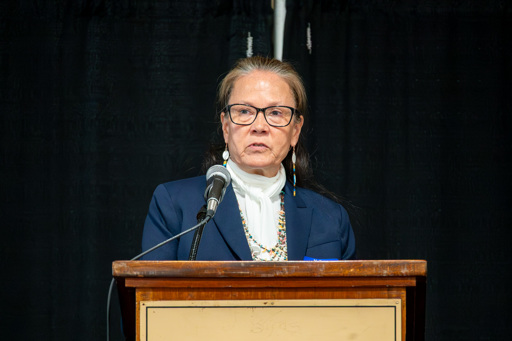
Daniel Orr speaks at the 2026 South Dakota MMIP conference in Rapid City on May 1. (Photo by Amelia Schafer)
Ultimately, Adams waived the statute of limitations and pleaded guilty to second-degree murder in exchange for agreeing to describe to Nyvold’s mother Christine Irwin exactly what happened and accepting only 10 years in federal prison. If he had been convicted of first-degree murder, Adams would’ve been subject to life in prison.
“Any crime that involves the killing of a person should never have a statute of limitations associated with it,” Orr said.
It’s common in Indian Country for cases to stall. In South Dakota alone there are dozens of instances of cold cases on tribal land, particularly involving hit-and-run deaths.
Instances of pedestrian hit-and-run deaths are higher within Indian Country than anywhere else in the United States, many of which have gone unsolved for decades. Hit-and-run deaths, when charged and convicted, are typically prosecuted as second-degree murder or manslaughter. With the current statute of limitations in place, it’s highly unlikely for any case older than five years to result in a conviction, Orr said.
South Dakota Sen. Mike Rounds, Republican, introduced Kamisha’s Law in July 2025 with an identical version re-introduced in the House by South Dakota Congressman Dusty Johnson, Republican, on Feb. 4, 2026.
“Prosecution for murder should not have an expiration date,” said Rounds in a Sept. 30, 2025, press release.
He cited the removal of the statutes of limitations on both first-degree murder and sexual abuse in the early 2000s as evidence that this should be the natural next step in ensuring violent perpetrators are held accountable.
Kamisha’s Law would eliminate the statute of limitations on second-degree murder and allow for the prosecution of cases that otherwise would have stalled, but more support is needed from federal legislators and tribes alike to help get the bill passed, said Kamisha’s father Roger Irwin.
The family has attempted to reach out to all 575 federally recognized tribes. However, many publicly listed emails for tribal council members are inactive or outdated.
So far, only three tribes have signed on in support of Kamisha’s Law – the Sisseton Wahpeton Oyate, Yankton Sioux Tribe and Catawba Nation. However, following the family’s presentation at the Missing and Murdered Indigenous People’s conference in Rapid City on May 1, representatives in attendance from the Oglala Sioux Tribe and Rosebud Sioux Tribe pledged their support.
Additionally, legislators outside of South Dakota have expressed concern that they’d be more willing to support it if the request came from inside of their districts, Roger Irwin said. The hope is for concerned citizens to help reach out to their respective lawmakers and push for support.
And Kamisha’s Law wouldn’t only help Indian Country, Roger Irwin said. It would apply to investigations on all federal lands, which include national parks.
The deadline for Kamisha’s Law to be passed in this current legislative season is January 2027, Roger Irwin said, and it’s approaching quicker than anyone realizes.
“We’re not going to give up on this,” he said. “It’s something we’re going to do for the rest of our lives to help communities.”
The post Slain infant’s family seeks end to statute of limitations on second-degree murder appeared first on ICT.
From ICT via This RSS Feed.