

Photo: Darryl Dyck / The Canadian Press
Summary
- B.C.’s Declaration on the Rights of Indigenous Peoples Act has been a point of tension for the provincial government and First Nations leaders since December 2025.
- After months of vowing to change the law by June, Premier David Eby now says amendments will wait until at least October.
- In the meantime, the province and First Nations leaders will try to find a solution that both sides can agree on.
The showdown over B.C.’s Declaration on the Rights of Indigenous Peoples Act is not over, but the future of the landmark law is now on hold until the fall.
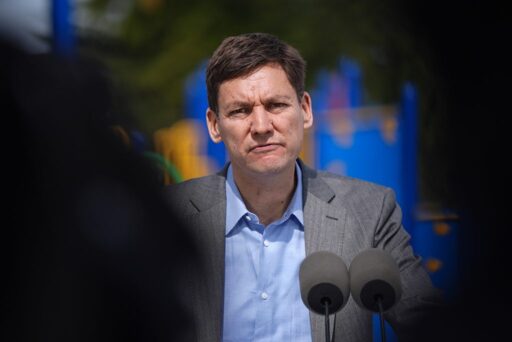
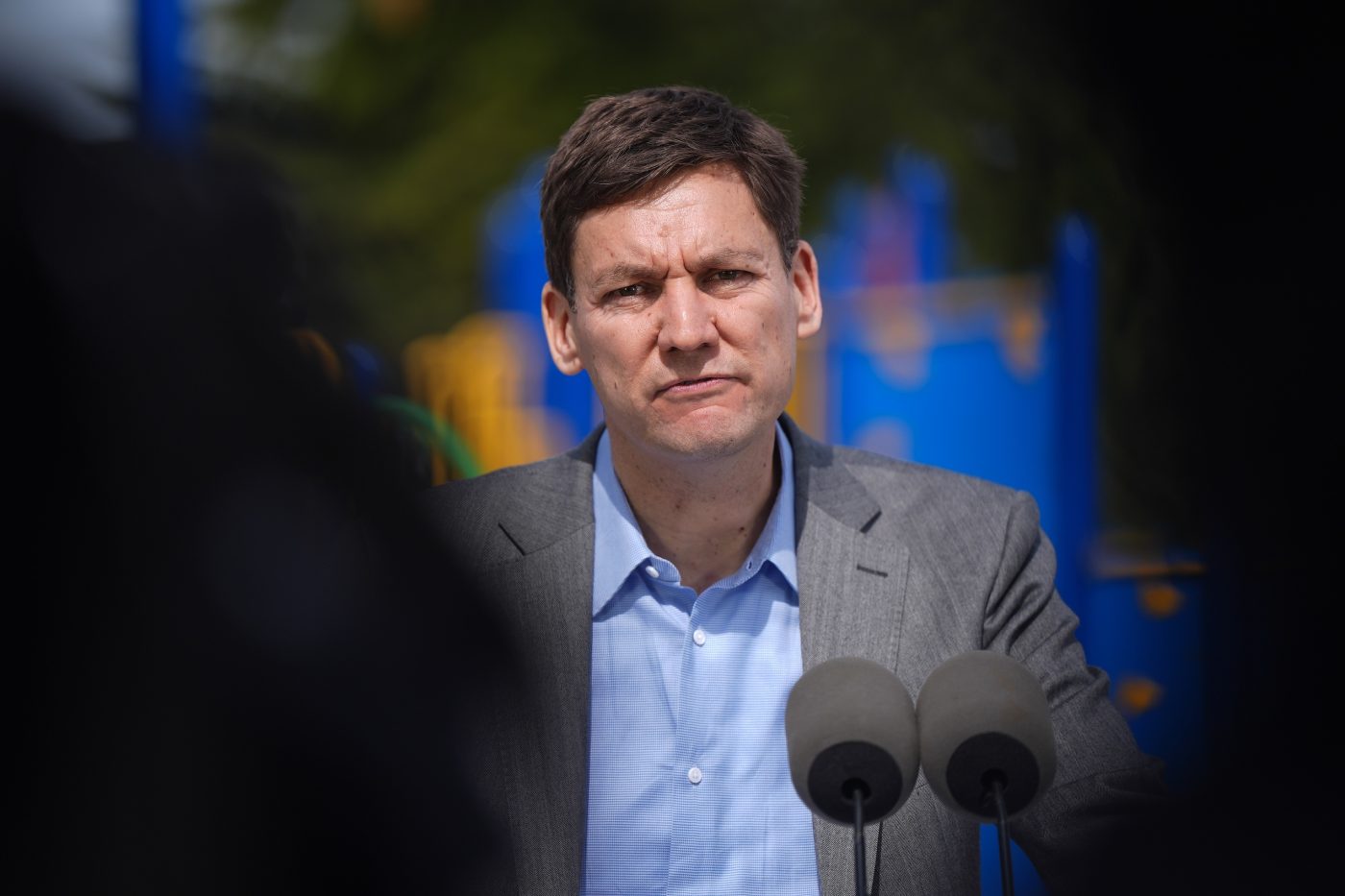
For several months, B.C. Premier David Eby claimed the Declaration Act — also known as DRIPA — had to be changed, and quickly. First he said the law would be amended, then paused, and now he’s said legislation to change the law can wait until the fall session.
“It is absolutely possible, as a leader, to move off confidently in the wrong direction,” Eby told reporters at the legislature on April 20.
Eby has moved in many directions on DRIPA this year. Initially, he maintained that changing the law was non-negotiable because of legal liability, and something that had to be done before the legislature’s summer break.
Then — after First Nations leaders told him his “approach was totally unacceptable” — the premier proposed suspending DRIPA for up to three years. That, according to Eby, would allow the province’s appeal of a recent court decision to be heard by the Supreme Court of Canada.“This will be a confidence vote,” Eby said at the time, raising the possibility that DRIPA could trigger a provincial election.While the premier said he was confident the “strong and united” NDP caucus would back his plan, that turned out not to be the case. Two weeks later, Eby said no changes to DRIPA would be made this spring.
Instead, the B.C. government and First Nations leaders have committed to spend the summer seeking a solution that can address “the government’s stated legal concerns, while upholding the title and rights and human rights of First Nations,” according to an April 20 joint statement from the premier’s office and the First Nations Leadership Council.
Whether the discussions will result in legislation that both the government and First Nations support is far from certain.
“There is no guarantee, simply because we reached this agreement that come fall legislative session, that we will have that agreement, but I’m certainly hopeful that we will,” Eby told reporters.
So … what is going on with DRIPA?
Why does the government want to change DRIPA?
Let’s go back to December 2025. That’s when the B.C. Appeal Court determined the government’s obligations under DRIPA are legally enforceable. This created “unlimited legal liability” for the province, according to Eby.
The appeal court’s ruling was the result of a challenge to part of a 2023 B.C. Supreme Court ruling launched by the Gitxaała and Ehattesaht First Nations. That ruling agreed with the nations’ claim that B.C.’s mineral claim-staking regime did not fulfill the government’s obligations to consult with First Nations.The 2023 decision also concluded that DRIPA was not legally enforceable. The nations appealed that part of the ruling and, in December 2025, the court agreed with their arguments.
According to the premier, the legal threat the province faces is twofold.In ruling that the government’s obligations under DRIPA — to align provincial laws with the principles of the United Nations Declaration on the Rights of Indigenous Peoples — are legally enforceable, the court has opened the door to further challenges of any provincial law on the grounds that it does not align with DRIPA.That’s not the incremental approach the province was prepared to take when DRIPA was introduced, Eby said.“Instead of eating the elephant one bite at a time, the court has invited us to do it all at once and that is just not possible,” he told reporters on April 2.
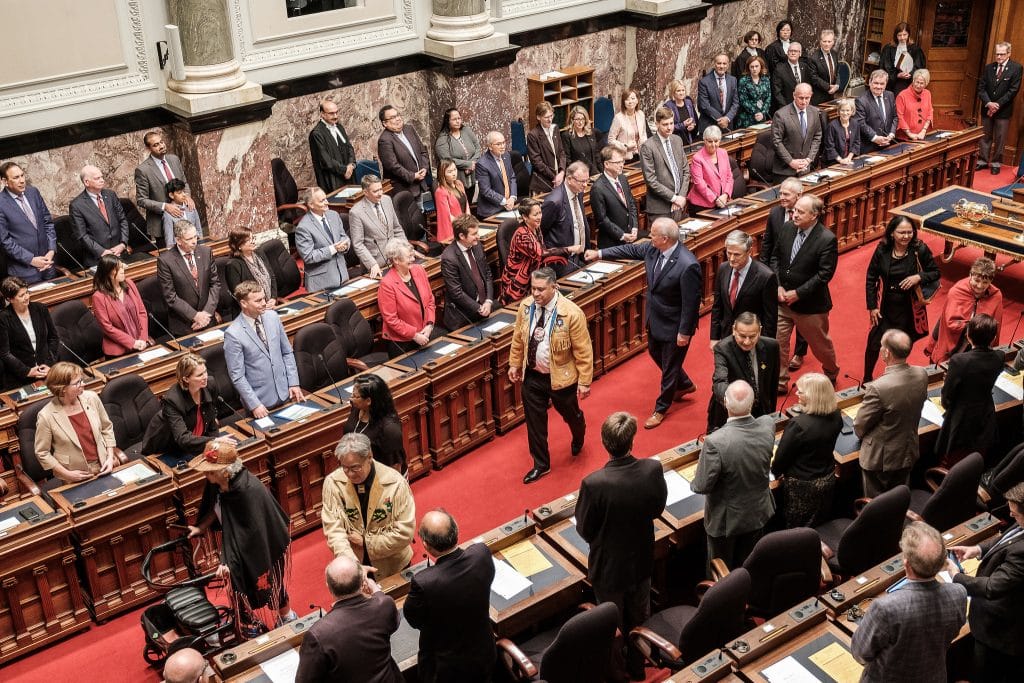
The unanimous passage of B.C.’s Declaration on the Rights of Indigenous Peoples Act was heralded as a step forward for reconciliation in 2019. Now, Premier David Eby wants to amend the law after a provincial court ruled it was legally enforceable. Photo: Province of B.C. / Flicker
Secondly, the appeal court’s December decision can now be used in other court cases, which often refer to existing court rulings. According to Eby, more than 20 lawsuits involving the province have been launched or amended since the Gitxaala decision was released.
In an open letter to B.C. MLAs released on April 19, the First Nations Leadership Council described Eby’s arguments as “not only misleading but … also inherently wrong.”
“We are dismayed at the degree to which the court cases and DRIPA are being misrepresented, mischaracterized and conflated as rhetoric and fearmongering,” the council wrote. “The risk before the legislators and all British Columbians is not created by DRIPA — it is created by the decisions to undermine it through unilateral action.”
Why do First Nations leaders oppose those changes?
First Nations leaders have called Eby’s plans for DRIPA “a unilateral betrayal and an abandonment of the province’s commitment to principled reconciliation, as well as serving to create a climate of uncertainty.”
Altering, suspending or repealing DRIPA — as the B.C. Conservative opposition has proposed — will not eliminate B.C.’s obligations to consult with First Nations on issues related to Indigenous Rights and title. And it will not prevent First Nations from seeking to exert those rights in the courts, a more expensive and time-consuming option and one where First Nations have seen victories time and again.
“I think that we have an obligation and a responsibility to remember that no one is giving First Nations anything,” Huy’wu’qw Shana Thomas, Hereditary Chief of Lyackson First Nation, said during an April 10 press conference. “First Nations people continue to assert their inherent rights and title and prefer reconciliation, prefer negotiations.”
What does DRIPA have to do with the Cowichan decision?
B.C.’s back and forth on DRIPA is being connected by some with the Cowichan decision.
In 2014, the Cowichan Tribesfiled a case with the B.C. Supreme Court, asserting Aboriginal Title over lands along the Fraser River, in what is now known as Richmond, B.C. The lands claimed included a traditional summer village site, known as Tl’uqtinus, and the tribes’ suit also asserted rights to fish and gather food in the claimed area.In its August 2025 ruling, B.C.’s Supreme Court affirmed the Cowichan Tribes’ Aboriginal Title. All of the defendants in the case, including B.C. and the federal government, are appealing the decision, which has been at the centre of a national — and often misinformed — debate about property rights.
The Cowichan case only named governments and government agencies, and the tribes have repeatedly said they have no intent of trying to take away any private property as a result of the court ruling.
Since announcing the province’s appeal of the ruling, Eby has said his government will “go to the wall” to protect the rights of private property owners.
The premier has also linked the Cowichan Tribes and Gitxaala cases, calling them “dramatic, overreaching and unhelpful court decisions.”
But DRIPA and the Cowichan decision actually have little to do with each other, besides being related to Indigenous Rights. The case was launched prior to DRIPA becoming law and turned on Section 35 of the Canadian Constitution, not provincial law.
Does DRIPA ‘create uncertainty’ for industry?
Short answer: it depends on who you ask.
Section 7 of the law allows for joint decision-making agreements with First Nations regarding industrial projects on their traditional territories. DRIPA’s goal is to “provide certainty and stability” about how projects can move toward approval by clearly defining the responsibilities of the provincial government and First Nations.
That Section 7 agreements enabled by DRIPA have helped advance some natural resource projects is a point on which Eby and First Nations leaders actually agree.Take the plan to reopen the Eskay Creek mine on Tahltan Nation territory.
In 2022, the B.C. government and the Tahltan Nation signed an agreement under Section 7 of the Declaration Act. The section allows the government to undertake a joint decision-making process with First Nations.
In December 2025, Tahltan Nation members voted in support of the Eskay Creek revitalization project and the province announced its approval of permits for the mine in January 2026.
The Red Chris mine and the Galore Creek mine have also advanced under Section 7 agreements and, on Vancouver Island, another agreement involving forestry tenures on ‘Namgis Nation territory is in the works.
Continuing to deliver these types of agreements is evidently a high priority for the province. Eby’s proposal to suspend DRIPA would not have affected the sections of the law that enable these agreements.
What happens now?
Well, the legislature will shut down for the summer on May 28. MLAs aren’t scheduled to return until October. In the meantime, the government will continue to discuss the future of DRIPA with First Nations leaders and try to find a solution that both sides can support.
Attorney General Niki Sharma, who Eby credited with convincing him not to pursue a legislated solution this spring, has expressed confidence that a mutually agreeable solution is achievable.
“I have faith in partnership and the fact that when we come to the table to sort out challenging issues, that we can come to solutions that last,” she told reporters at the legislature on April 21. “If we can get to sitting down and rolling up our sleeves and fixing things that are challenging in a way that lasts, then we’ve solved it for generations to come, and I see that pathway.”
If — and it remains a pretty big if — the provincial government and First Nations leaders do agree on DRIPA’s future, any changes to law could be made during the fall sitting of the legislature, which is scheduled to wrap at the end of November.
By then, things could be quite different in the legislature. The B.C. Conservative Party will have a new leader, possibly one without a seat in the legislature. The Conservatives want DRIPA repealed and all candidates running the leadership race have backed that position, so it’s likely Conservative MLAs will vote against whatever changes the government eventually proposes.
The B.C. Greens have criticized the government’s proposals to change DRIPA so far, backing First Nations calls for the law to be left as is.
Currently, there are also six MLAs that do not belong to a caucus, although all were at one time B.C. Conservative members. Three of those MLAs have vocally opposed Indigenous Rights, reconciliation and DRIPA. The other three may be open to overtures from the government to support legislation to amend DRIPA.
To pass legislation without support from the opposition, Eby will need to get his entire caucus on side — something he was not able to do this spring.
The Narwhal’s reporters are telling environment stories you won’t read about anywhere else. Stay in the loop by signing up for our free weekly dose of independent journalism.
From The Narwhal | News on Climate Change, Environmental Issues in Canada via This RSS Feed.