

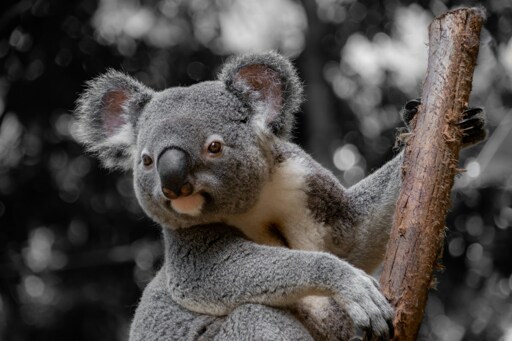
“When I was a kid, forestry was more sustainable,” Mark Graham said, leaning against a massive tree trunk. “Now 30-tonne industrial machines bulldoze everything in their path.” He’s an ecologist who’s worked for state and federal governments — and has often been at odds with the forest industry. We were walking through the Coffs Harbour Botanic Garden in New South Wales (NSW), southeastern Australia, through a remnant of subtropical coastal rainforest. Graham pointed out flooded gum (Eucalyptus grandis) trees — a fast-growing eucalyptus — as well as Bangalow palm (Archontophoenix cunninghamiana) and other trees, some hundreds of years old. Wild koalas (Phascolarctos cinereus), one of the world’s most beloved animals, also live here. This garden will be linked to the new Great Koala National Park (GKNP) by forest corridors that allow koalas to disperse into new areas. The Australian government says it will finalize designation of the new park in 2026, which it calls “a centerpiece of koala conservation [in the state of NSW],” but no one seems to know when that will be. Its creation was the culmination of a 13-year campaign led by environmental groups and grassroots organizations. One of the most outspoken figures in that struggle was Mark Graham, a veteran environmental activist who’s often been at odds with the NSW forestry industry. In 2023, the state government committed to establishing the GKNP on the mid-north coast. It announced creation of this vast new conservation area in September 2025 — and instituted a temporary moratorium on timber…This article was originally published on Mongabay
From Conservation news via This RSS Feed.