

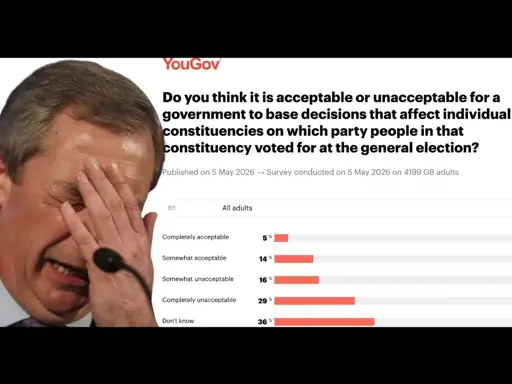

On Monday 4 May, racist bigot and Reform leader Nigel Farage announced a plan to punish voters in areas which don’t vote for his party. This seemed to go down incredibly poorly, and we now have data to confirm the general public opposes spiteful politics of this nature:
With Reform UK threatening to open migrant detention centres in Green constituencies, by 45% to 19% Britons say it is unacceptable for governments to base decisions that affect individual constituencies based on how people there voted
Results link in replies pic.twitter.com/OfzOOA40DZ
— YouGov (@YouGov) May 5, 2026
As you can see, even Reform voters lean towards the practice being unacceptable. In other words, Farage & .co have really shot themselves in the foot.
Reform: completely unacceptable
Reform’s new policy is to build migrant ‘detention centres’ (what would more accurately be called ‘concentration camps’) in areas which don’t vote Reform. The party has denied its new policy constitutes a ‘threat’. The reason it’s being interpreted as one is because Reform argued people shouldn’t want detention centres in their area. Therefore, it’s clearly a threat by the party’s own logic.
This is a perfect illustration of the problem facing Reform. No serious practical solutions. Just political posturing. Which works fine when you’re trying to make a breakthrough. But won’t cut it when you need to move to being a serious alternative government. https://t.co/szML6sTV9g
— (((Dan Hodges))) (@DPJHodges) May 4, 2026
This policy could cause bigger problems for Reform too. As we reported, if a court agrees that Reform’s policy represents a threat, that would be illegal under the Representation of the People Act 1983 (Punitive Coercion):
Believe it or not, [the UK has] had to think about this sort of thing in the past, and we realised we can’t have political parties achieving power by threatening to punish anyone who doesn’t vote for them. The reason for this is obvious; it’s because if voters feel like a party has a strong chance of getting in, they will potentially vote for them solely to avoid reprisals.
Regardless of whether its illegal or not, the YouGov polling shows the public does not like how Reform is threatening to conduct itself. Most people think it’s ‘unacceptable’ to approach politics like this:

If you count ‘don’t knows’, 70% of the people polled think that negatively targeting voters is unacceptable.
If Reform continue with this, the number of ‘don’t knows’ will decrease as more and more people learn about voter coercion and why it’s bad. Given that Reform’s actions could literally prove illegal, it’s doubtful a majority of ‘don’t knowers’ will convert into people who think the idea is ‘acceptable’.
The public has spoken
It seemed clear there would be a public backlash from the start, as even many right-wingers disagreed with the proposal. Those same right-wingers are now saying things like this:
Unsurprisingly, punitive politics are unpopular with the electorate. https://t.co/8GrGOEc6qw
— Carl Benjamin
(@Sargon_of_Akkad) May 5, 2026
There’s a deeper problem beyond where Reform plans to build these centres, though. Said problem is that Reform is proposing concentration camps for migrants and asylum seekers.
The constant demonisation of foreign-born individuals isn’t about keeping Britons safe; it’s about distracting from the mass-transfer of wealth which the political establishment is overseeing. It’s not for nothing that most of us get poorer every year while the rich get richer.
The Green Party, meanwhile, is pursuing a more humane policy platform. As the party states:
We welcome the contributions that migrants and refugees make to British society. We want to be welcoming, promote social cohesion and support migrants to put down roots.
Green MPs will push for:
- An end to the hostile environment.
- An end to the minimum income requirements for spouses of those holding work visas.
- Safe routes to sanctuary for those fleeing persecution.
- The dysfunctional Home Office to be replaced with a new Department of Migration, separating this function from the criminal justice system.
- An end to immigration detention for all migrants unless they are a danger to public safety.
- Abolition of the ‘no recourse to public funds’ condition that exacerbates social, economic, and racial inequalities.
- Those seeking asylum and protection to be permitted to work while their application is being decided.
While the local elections on Thursday 7 May won’t decide immigration policy, they will shift the direction this country is on. The question is if voters want the spiteful politics of Reform or the hopeful politics of the Greens.
Featured image via YouGov
By Willem Moore
From Canary via This RSS Feed.