

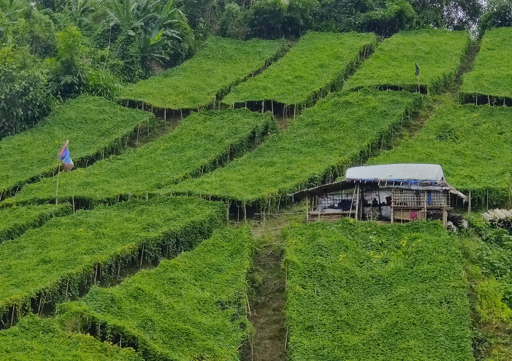
In the Chittagong Hill Tracts of southeastern Bangladesh, Indigenous farmers are increasingly abandoning jhum, a traditional method of shifting cultivation. Instead, they’re moving toward the machan method where vegetables are grown above the ground on bamboo trellises. This transition is driven by a growing scarcity of arable land and declining yields, reports Mongabay contributor Sifayet Ullah. For generations, Indigenous communities like the Chakma, Marma and Mro in the Chittagong Hill Tracts (CHT) have practiced jhum, clearing small forest patches, farming them, then leaving them fallow for up to 20 years to restore soil fertility. However, as the number of farmers in CHT districts like Bandarban has risen, the fallow cycle has plummeted to just two or three years. This constant pressure has exhausted the soil, leading to poor rice yields and increased soil erosion during heavy rains. Government data confirm this decline: land under jhum in Bandarban dropped from 9,050 hectares (22,363 acres) in 2014 to 8,270 hectares (20,436 acres) by 2025. Many farmers are now turning to the machan method, which uses bamboo trellises to grow vine crops like cucumbers, bitter gourds and beans. This system offers several advantages over traditional shifting agriculture, such as the prevention of pests and diseases. “When crops grow close to the soil, they are prone to pests, fungal infection and waterlogging during rains,” said farmer Tipu Tanchangya, from Rowangchari in Bandarban. “Machan farming raises crops like gourd, cucumber, beans 4-5 feet [1.2-1.5 meters] above the ground, which reduces the risk of disease and…This article was originally published on Mongabay
From Conservation news via This RSS Feed.