



Joanna Whaley // Run For Something
Erin In The Morning is a reader-supported publication. To receive new posts and support my work, consider becoming a subscriber.
Michigan Democrats are firing back after one of their own—a candidate in a state representative race—filed a complaint with the Wayne County Division of Elections, aiming to boot his primary opponent, Joanna Whaley, from the ballot. This is because Whaley is transgender and went through a legal name change process.
It seems that another contender for Michigan’s 2nd State House District seat, Frank Liberati falsely believed Whaley’s name change hadn’t gone through. So, last week, he accused her of running under a false name in violation of election procedures, official documents show, which were provided to Erin in the Morning by Whaley.
They also showed that Liberati went even further in his anti-trans rhetoric. The complaint invoked Whaley’s deadname (a given name a trans person no longer uses) at every turn, consistently misgendered her, or called Whaley “she/he.”
The Michigan Legislative LGBTQ+ Caucus denounced Liberati’s “transphobic tactics.”
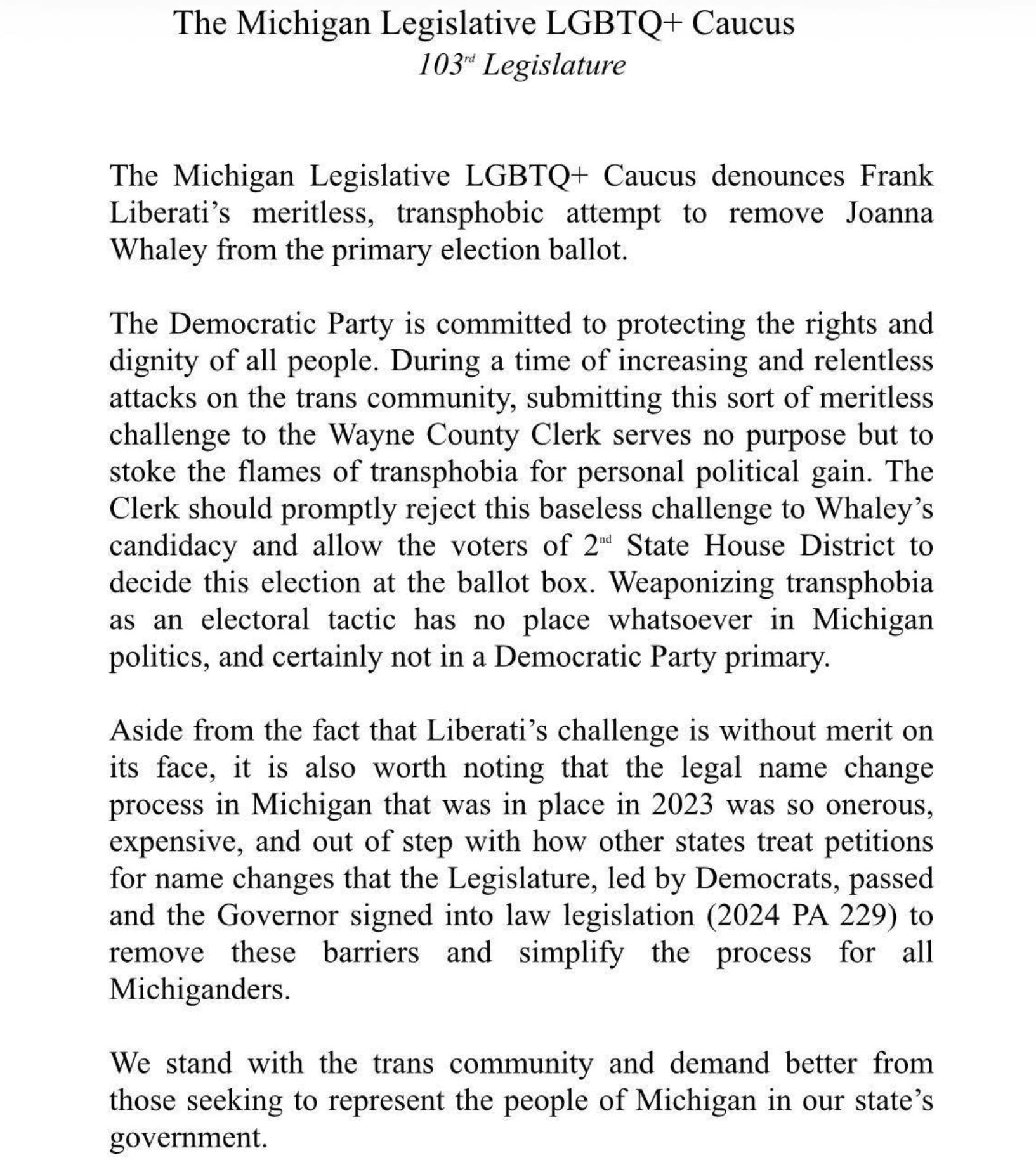
“During a time of increasing and relentless attacks on the trans community, submitting this sort of meritless challenge to the Wayne County Clerk serves no purpose but to stoke the flames of transphobia for personal political gain,” a statement from the Caucus reads.
Democratic lawmakers further called on officials to throw out the complaint. “The Clerk should promptly reject this baseless challenge to Whaley’s candidacy and allow the voters of 2nd State House District to decide this election at the ballot box. Weaponizing transphobia as an electoral tactic has no place whatsoever in Michigan politics, and certainly not in a Democratic Party primary,” the statement said.
Whaley told Erin in the Morning that she expected to encounter transphobia when running for office, but she was shocked when she learned it was from a fellow Democrat.
At the same time, she also said she has been flooded with support from voters, Party members, and leaders who were outraged by Liberati’s maneuver.
“I spoke with the chair of the Michigan Democratic Party, and we are united across the state that this is not how Democrats act,” Whaley said. “This is not what we represent.”
Whaley said Liberati’s complaint was based on outdated court filings. When Whaley first came out, excessive state fees ended up delaying aspects of her legal transition. Since then, the state legislature has passed laws to make name changes less burdensome. Whaley filed again, got her name successfully updated, and has been going by Joanna ever since.
“When a candidate cannot run on their own merits, they resort to lies and distractions,” Whaley said in a public response when news of the challenge first broke. “Our campaign remains focused on the issues that matter to the residents of this district: lowering water and utility bills, expanding healthcare access, fixing our infrastructure, and protecting our freedoms.”
“While my opponent obsesses over my gender and uses cowardly tricks to try to avoid facing me, I will continue to fight for practical solutions to problems that actually impact our communities,” she continued.
This isn’t the first time that issues with name changes and state identification laws have been weaponized against trans voters and/or candidates. Gendered party seat positions, which were initially created to advance the representation of women in office, have since become a barrier for people of marginalized genders who want to run for a position.
Meanwhile, stringent voter ID policies are poised to hinder trans and gender nonconforming people’s ability to vote if their current documentation or gender expression doesn’t match their name and gender assigned at birth. (The name change issue extends beyond trans people; married women who take their husband’s last name have also reported barriers to voting.)
In addition to her candidacy, Whaley is a parent, a hospital chaplain, and a proud Democrat. She told Erin in the Morning she was in part inspired to run for office by Liberati’s brother: Sitting member Tullio Liberati, who crossed party lines last year to vote in favor of a bill that discriminated against transgender women and girls in sports.
Transphobia, it seems, runs in the family. Frank personally signed off on the complaint submitted to officials, notary and all.
Liberati did not immediately respond to a request for comment. Prior to this race, he had served for six years as a state representative in Michigan’s 13th District.
Whaley said she expects the complaint to be resolved and that she hopes to bring the conversation around her candidacy back to the issues that impact everyday voters.
“[Resorting to] this move in the first place shows that we are the campaign to beat,” Whaley said. These are tactics to “knock me out of the race, because [Liberati] can’t win on the issues.”
Erin In The Morning is a reader-supported publication. To receive new posts and support my work, consider becoming a subscriber.
From Erin In The Morning via This RSS Feed.