

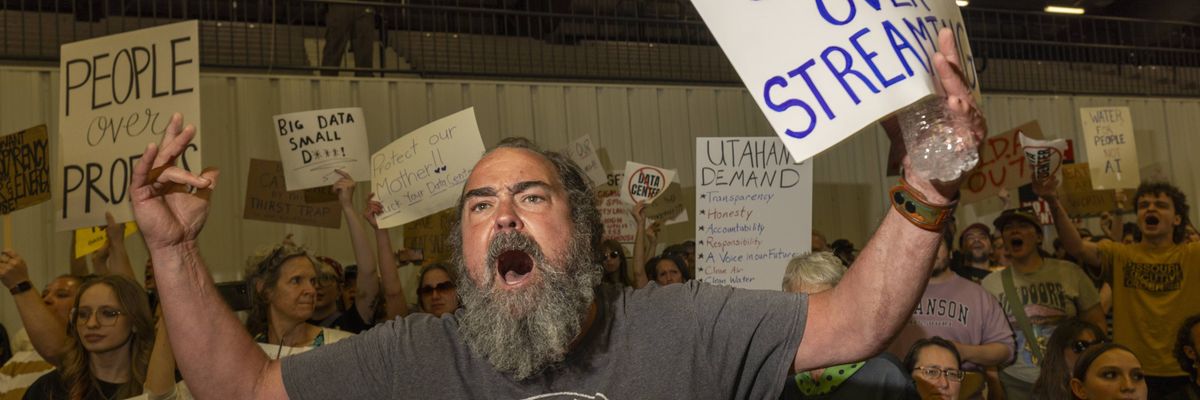
County commissioners in Box Elder County, Utah, were deluged with chants of “Shame! Shame! Shame!” from a crowd of hundreds on Monday night as they voted unanimously to move forward with a sprawling “hyperscale” artificial intelligence data center project that many residents fear will cause energy prices to soar and imperil water access.
The project, known by state officials as “Stratos,” was proposed by the celebrity venture capitalist Kevin O’Leary and has been rushed along by Utah’s Military Installation Development Authority, which recently approved a gigantic energy tax break for the program to help “lure” the billionaire “Shark Tank” investor.
The development, dubbed “Wonder Valley” after O’Leary’s “Mr. Wonderful” TV persona, would span more than 40,000 acres of northern Utah—more than two and a half times the size of Manhattan—and would consume more than twice the electricity currently used by the entire state if approved, according to Axios.
CBS 2 KUTV called it “the biggest thing in the region since the completion of the first transcontinental railroad.” And yet Utahns say they’ve been given little information about the plan and few opportunities to voice their concerns.
Residents were given short notice before Box Elder commissioners gathered at the county fairgrounds on Monday for a “special” meeting to vote on the project, but an estimated 500 still showed up to voice their displeasure.
They raised fears that they’d have to endure the same dramatic energy price spikes as other states with high concentrations of data centers. Residential utility costs have jumped 13-20% year over year in Virginia, Illinois, Ohio, and New Jersey, a trend attributed to the rollout of data centers in these states.
The developers of the Utah project have emphasized that it will be powered by an on-site natural gas plant, which they claim would limit the impact on utility bills.
However, that still leaves the massive environmental concern, especially since natural gas is almost entirely made of methane, one of the worst planet-heating pollutants.
Kevin Perry, a professor of atmospheric sciences at the University of Utah, has said that the estimated nine gigawatts of power the center would require, “would increase the carbon dioxide emissions for the state of Utah by more than 50%,” meaning "there’s a huge climate footprint associated with that proposal.”
Environmental advocates also warn that the facility will further drain water from the Great Salt Lake amid an already severe drought.
The Salt Lake Tribune has found that Utah’s dozens of other data centers consume wildly different amounts of water depending on the technology they use.
The developers of the Box Elder facility have claimed the project will use “zero water turbine” technology that allows it to recycle water, resulting in “net zero” consumption.
But Samantha Hawkins, the communications director for Grow the Flow Utah, a group dedicated to protecting the Great Salt Lake, said it’s impossible to know if the developers are telling the truth when they say their facility is designed to limit water usage.
“So far, there’s no publicly available hydrologic analysis or independent review to support those claims,” she said, “and there haven’t been any manufacturers, technologies, or contracts cited in relation to the ‘zero water turbine’ technology.”
Even if the centers limit water use, they still need to remain cool, which the Tribune said often requires more energy.
Many of the Utahns who showed up to protest Monday’s vote felt they were being kept in the dark about the facility’s potential harms and that the plans for the facility, which were not made public until last week, were being kept from them.
“I’m outraged," said Colleen Flanagan, a resident of Sandy who spoke with Fox 13 Salt Lake. “I am absolutely angry that there was no studies done—it just came up out of the community. Nobody knew about it.”
Mitchell Tousley, who drove more than an hour from Draper to protest the decision, said, “A project of this scale just absolutely requires public input, and there really hasn’t been.”
Deals to build these facilities have often been made in secret, with contract details hidden from the public by nondisclosure agreements that stifle dissent until the project has already been approved. Despite this, these projects have often drawn fearsome backlash from the communities where they are planned. In some cases—like in Virginia late last month, where a 2,100-acre center was set to be built—it has led developers to pull out.
But the commissioners in Box Elder County, who said they’d reviewed more than 2,500 public comments on the proposal, appeared unmoved by the outpouring of public concern on Monday night. They said water and air quality issues were not factors in their vote and that the water rights were held by the private landowners.
As the crowd jeered, with chants of “cowards” and “people over profits,” Commissioner Boyd Bingham, a Republican, shouted them down.
“For hell’s sakes, grow up,” he yelled. “This is beyond a joke.” The commissioners then left the room and addressed the crowd via a virtual meeting.
In a video response to Monday night’s protest, O’Leary said: “I’m the only developer of data centers on Earth that graduated from environmental studies. I’m pretty aware of what these concerns are. They are around air, water use, heat, noise pollution. So sustainability is at the heart of what we do in terms of all these proposals.”
He claimed without evidence that 90% of the opponents of the data center project were “being bused in” from out of state. He also claimed that the facility would be powered in part by “solar, wind, and batteries,” when it is actually powered entirely by natural gas.
Opponents continue to characterize Stratos as a billionaire vanity project to loot Utah’s vast natural resources with little consideration for how it will affect residents.
Utah State University physics professor Robert Davies told Fox 13 that the Great Salt Lake “is occupied by amazing living systems” and that "projects like this go into environments like this and scrape the living systems right off the face of the Earth.”
He said, “This is a private enterprise that is coming in to extract from our natural wealth and pipe it out of the state… and leave us with a few crumbs.”
From Common Dreams via This RSS Feed.
Burn it down before it can be built. Rinse and repeat.