

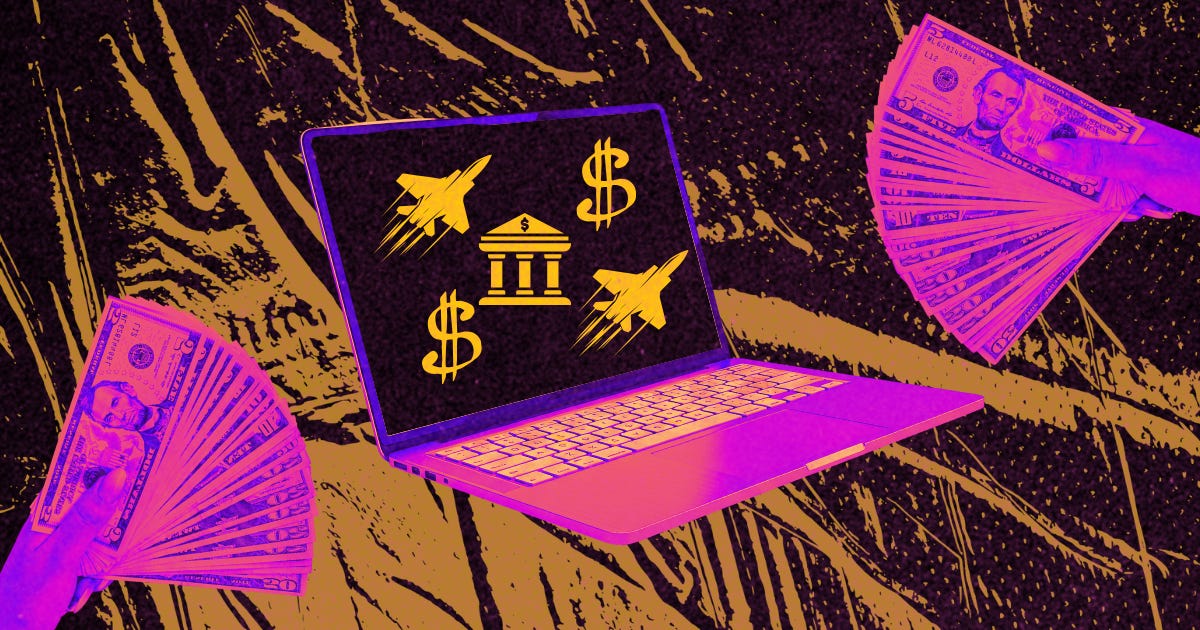
Canada is set to host the headquarters of the proposed Defence, Security and Resilience Bank (DSRB), a new multinational institution designed to mobilize tens of billions in financing for military and security projects among allied nations. In short, what we are seeing is the quiet normalization of something far more consequential: the permanent financialization of war. The structure being envisioned for DSRB closely resembles other multilateral financial institutions. It would raise capital on global markets, issue bonds, and extend loans to governments and defense companies. That means funding for military supply chains, weapons systems, and defense infrastructure would increasingly flow through financial markets rather than direct public expenditure. In doing so, war itself risks being transformed from a political decision subject to public scrutiny into a financial product embedded in portfolios.
CODEPINK Substack is a reader-supported publication. To receive new posts and support our work, consider becoming a free or paid subscriber.
And so, with remarkable efficiency, we may be arriving at a point where, whether you like it or not, you are investing in war. Not because you consciously chose to, but because modern finance rarely asks for permission. It integrates. It diffuses. It embeds. Just as complex mortgage-backed securities seeped into pension funds and retirement portfolios before the 2008 Financial Crisis, instruments tied to defense financing could quietly become part of the same financial plumbing that underpins everyday savings. Deposits in major banks, such as Royal Bank of Canada or Toronto-Dominion Bank, feed into broader lending and investment pools. If those banks help underwrite DSRB bonds or finance defense projects, then ordinary savings are, at least indirectly, part of the system. You won’t need to opt in. The system will do it for you.
Once you are in that system, try opting out. Go ahead — divest. In theory, it sounds simple. In practice, it is anything but. Large pension funds, such as the Canada Pension Plan Investment Board or the Ontario Teachers’ Pension Plan, operate within a web of financial relationships that makes complete divestment extraordinarily complex. If DSRB bonds are rated as safe, investment-grade assets, they could easily find their way into fixed-income portfolios. Even if funds choose to avoid them directly, indirect exposure remains: through banks that underwrite the bonds, through ETFs that bundle defense assets, and through lending syndicates that finance defense contractors. “All the king’s horses and all the king’s men” of global finance, institutions like JPMorgan Chase and Deutsche Bank, are already lining up behind this model. When the entire financial stack aligns like this, divestment becomes less a matter of choice and more a question of how far you are willing, or even able, to disentangle yourself from the system.
What emerges is not just a new bank, but a new layer of abstraction between citizens and the consequences of war. Traditionally, military spending is debated, however imperfectly, through parliaments and public scrutiny. A financialized model shifts that process into capital markets, where decisions are driven less by voters and more by risk assessments, yield expectations, and institutional incentives. Over time, this risks normalizing war as an investable asset class, something to be priced, traded, and held in portfolios rather than questioned in public forums.
That transformation carries consequences. One of the most immediate concerns is that such a bank could normalize or even facilitate controversial military interventions. If borrowing costs for defense spending are lowered, the financial barriers to launching military operations also fall. History offers a sobering precedent. The Iraq War was widely condemned after the central justification, claims of weapons of mass destruction, collapsed under scrutiny. Yet the war had already been financed, executed, and justified through institutional momentum. A system like DSRB could make such momentum easier to sustain, not harder. When capital is readily available, restraint becomes less likely.
Over time, this could make war financing a permanent feature of the global system. What used to be occasional becomes routine, and what was once debated becomes taken for granted. In that sense, the DSRB starts to look like a ‘World Bank for Warfare.’
Equally concerning is the question of democratic oversight. Traditional military spending must pass through national parliaments, where budgets are debated by elected representatives. A multilateral financial institution operates differently. By raising funds on global capital markets and deploying them through loans and financial instruments, DSRB could create a layer of decision-making that sits at arm’s length from voters. The result is a subtle but significant shift from public accountability to financial abstraction. Decisions about long-term military financing could become less visible, less contested, and ultimately less democratic.
What makes this shift particularly jarring is where it is happening. Canada has long cultivated an image of a country that prioritizes diplomacy, multilateralism, and peacekeeping. Yet by stepping forward to host the DSRB, it is positioning itself not just as a participant in global security, but as a financial hub for its expansion. The very country that has emphasized de-escalation is now spearheading an ecosystem designed to sustain long-term militarization.
The implications extend beyond symbolism. By helping institutionalize a system capable of mobilizing upwards of $100–135 billion in defense financing, Canada is effectively tying part of its economic future to the expansion of military spending. That alignment carries risks. When financial systems are built around a particular sector, they begin to depend on its growth. We have seen this dynamic before, most notably in the housing market prior to the 2008 Financial Crisis, when an entire economic ecosystem became reliant on ever-expanding real estate values.
Apply that same logic to the realm of defense, and the parallels become difficult to ignore. A system that depends on continuous military spending creates subtle but powerful incentives: to maintain high levels of defense budgets, to expand procurement programs, and to sustain the geopolitical tensions that justify both. Over time, what begins as risk management can evolve into dependence. A system built to finance war risks becoming a system that depends on it.
Then comes the uncomfortable question: what happens if the wars actually stop?
In a world where defense financing is deeply embedded in financial markets, peace does not simply reduce risk; it disrupts revenue. If the assumptions underpinning defense-linked investments are built on sustained spending and ongoing tension, then de-escalation could trigger a recalibration across portfolios, institutions, and markets. The consequences would not remain confined to defense companies or financiers. They would ripple outward to pension funds, public investment vehicles, and the everyday savings of millions who never consciously chose to participate in this system.
This is where the analogy to the 2008 Financial Crisis becomes more than rhetorical. Before that collapse, housing was treated as a permanently expanding asset class. Financial innovation spread exposure across the system, embedding risk in places few fully understood. When the underlying assumptions failed, the fallout was systemic. Homes were lost. Savings evaporated. Institutions faltered.
Now imagine a similar architecture built around militarization. A world in which conflict is not just a geopolitical reality, but a financial dependency. Where instability is quietly priced into the system as a driver of returns. And where, if that instability recedes, the economic consequences are felt far beyond the battlefield.
At that point, the challenge will not just be moral or political, it will be structural. Governments may find themselves trying to stabilize a system that has grown dependent on the very thing it claims to minimize: war. And there may come a moment when the system simply breaks, and it becomes impossible to put Humpty Dumpty back together again.
Shut down the war economy in your area! Join a CODEPINK Chapter TODAY!
Umer Azad is a software engineer by profession and a volunteer with CODEPINK and the Palestinian Youth Movement (PYM). He previously served as the Regional Social Media Expert for Pakistan Tehreek-e-Insaf (PTI), where he worked on digital outreach, exposing voter fraud, and documenting human rights violations.
From CODEPINK Substack via This RSS Feed.