


Janine Jackson interviewed Consumer Reports*‘ Derek Kravitz* about dynamic pricing for the May 1, 2026, episode of CounterSpin*. This is a lightly edited transcript.*
https://media.blubrry.com/counterspin/content.blubrry.com/counterspin/CounterSpin260501Kravitz.mp3
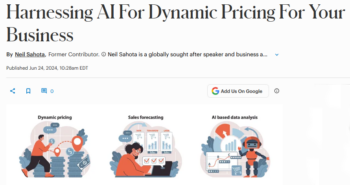
Forbes (6/24/24)
Janine Jackson: If you’re just trying to assess the way corporations view a particular development, you can learn more from how they talk among themselves than whatever narrative is crafted for general consumption. On dynamic pricing, let’s look just at headlines from Forbes Magazine.
In 2024, we have “Harnessing AI for Dynamic Pricing for Your Business,” saying “AI has emerged as a critical tool for implementing dynamic pricing strategies, enabling businesses to adjust prices in real-time based on market demand.”
In 2025, we get “Making Dynamic Pricing a C-Suite Imperative.” That declares that “in order to elevate pricing in your company, own it and ensure your leadership teams are treating pricing as the strategic lever it is.”
Some potential obstacles creep in. Later, Forbes offers “Dynamic Pricing: A Balance Between Strategy and Consumer Perception,” which tells us that “in the ever-evolving landscape of business strategies, dynamic pricing has emerged as a contentious yet fascinating approach.”
And then early this year, we have “Preparing Now for Continuous Dynamic Pricing,” which leads with, “Unfortunately, dynamic pricing isn’t a passing trend; it’s the new normal.” And it includes the telling sentence: “Consumers are increasingly being trained to accept dynamic pricing.”
Well, if only there were as much public-interest press interrogating this latest mechanism as there are owner-focused outlets talking about how to most profitably exploit it. But there is work going on, and our guest is part of it.
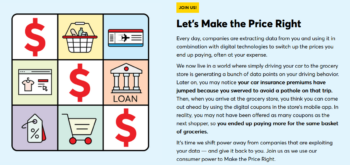
Investigative journalist Derek Kravitz is deputy editor of special projects at Consumer Reports, and a lead behind a collaborative investigation on pricing with Groundwork Collaborative and More Perfect Union. He joins us now by phone from here in town. Welcome to CounterSpin, Derek Kravitz.
Derek Kravitz: Hi, thanks for having me.
JJ: As your reporter—one of them in this series—notes early on, “Charging different amounts to different customers for the same products is not illegal or new.” So maybe let’s start with just some clarification, because folks will hear about “algorithmic pricing,” about “dynamic pricing,” about “surveillance pricing.” What is meaningful to distinguish there? There is a difference between a flight being cheaper on a Wednesday, than a can of soup costing you more than your next-door neighbor.
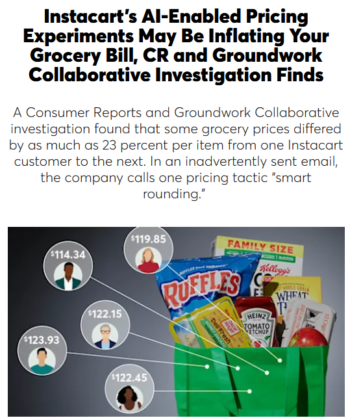
Consumer Reports (12/9/25)
DK: Yeah, so that’s a good question. We as Americans have been accustomed to price changes for things like airline tickets or hotel reservations or concert tickets for years. In fact, dynamic pricing goes back decades. It basically means charging different prices based on supply and demand. So when you are closer to a flight, a few days out from a potential trip, the price of that ticket is going to be higher than it would be weeks in advance. And so, in many ways, we’ve become accustomed to that type of dynamic or shifting price changes.
With respect to algorithmic pricing, that is new, because only in the last five to ten years have we started to use mobile apps and online shopping more and more, and to such a degree that now that has overtaken in-person and brick-and-mortar shopping. And so because of that, algorithmic and online shopping allows for really, really quick and precise price changes for customers.
And this is where you’re starting to see a groundswell of reaction to those pricing tactics, to those strategies that companies use in order to attract more money from customers. I mean, it’s Capitalism 101, but it’s supercharged now with the new technology that they have available.
JJ: And I want to ask you specifically about the Instacart research that you did some months back, because that makes it specific. What were you looking for there? How hard was it to find it? And then, what were your particular takeaways from that work?
DK: Instacart is the largest third-party grocery delivery platform in the United States, and it works with a lot of different grocery chains, some of the largest in the country, including Kroger, Albertsons, Safeway, Costco, Whole Foods. And it’s become ubiquitous, especially since the pandemic, for people ordering, including the elderly and those on SNAP benefits, and those in rural food deserts that might not have the transportation to go to a brick-and-mortar grocery store.
And so we wanted to understand how pricing worked on Instacart, because they’ve been very upfront for years that they use algorithmic pricing, and that they can rapidly change prices in order to not just respond to supply and demand, but also personalize prices—to give a different price to customer A than customer B for the same product at the same time from the same store.

Derek Kravitz: “No one really knows that this is going on, and no one can really see behind the curtain how this algorithmic pricing works in practice.”
So we designed some tests where we would bring in volunteers, Consumer Reports members, to join us online—virtual shopping trips—and price goods from the same stores at the same time. And we started to see very clear signals, where people were grouped into distinct price buckets. And because of that, we could very clearly see that for the same box of Wheat Thins, there were five different price points, and those five different price points would range from, say, $3 to $5. But then, of course, if you extrapolate that over the cost of an entire grocery basket over the cost of an entire year, that can add up to real money if you are on the losing side of that equation. And the point of all this, too, is that no one really knows that this is going on, and no one can really see behind the curtain how this algorithmic pricing works in practice. And so we basically tried to uncover that, to show how it worked in the real world.
JJ: And I’m maybe going to bring you back to transparency in a second, but I just want to say, on that work, there were results from that investigation, right?
DK: Yeah, there was a reaction. We got a lot of reaction from consumers and shoppers who were upset that they were seeing different prices for the same goods than their neighbor. And we got a lot of reaction from state and federal officials, including the FTC, which launched a probe. The attorneys general of New York and California launched their own investigations. Instacart themselves stopped the practice of testing out different prices on customers about two weeks after our story.
And there’s still now dynamic and surveillance pricing legislation moving through statehouses across the country. Maryland just recently passed the first ban on personalized grocery prices in that state.
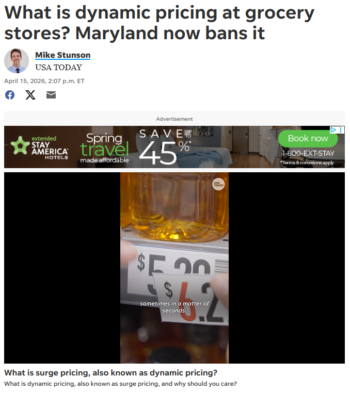
USA Today (4/15/26)
JJ: I think it’s very interesting that states are already passing bans. I think I saw a headline that was kind of like, “What Is Dynamic Pricing? Maryland Is Banning It,” and it sort of suggests a mislink. Something is galloping forward before people really understand even what it is, and that’s part of the problem, yeah?
DK: Yeah, that’s a good way of describing it. Maryland officials, when we interviewed them, said, we want to get ahead of this. We don’t quite understand how this works and what the underlying issue is for day-to-day consumers, but we can tell that this is going to be a problem if we don’t address it. And so they are trying and actually passed the law where you cannot personalize grocery prices down to the individual customer.
The problem there is that you can actually still segment customers. You can group them into really small numbers, say five, or ten, and offer those five or ten customers one price and a group of another five or ten customers a different price. In industry parlance, that’s segmentation; that’s the industry jargon for it. But the Maryland law just doesn’t address that yet.
But for them, this is a line in the sand, right? This is a first step in trying to really address this type of pricing tactic.
JJ: Well, because it seems that companies are sensitive to the problem. Certainly you can read about “managing the conception,” and “making consumers” just get used to it. So in other words, it’s not so much about selling it as just making it inevitable. And it’s funny, because we hear “if you build it, they will come,” and this seems to be “no, just build it and then make clear that there’s no other way for anybody to do anything except to work through this process.” It doesn’t match what we’re told is the idea of free enterprise, of building a better mousetrap, and people do it because they like it more.
DK: Yeah, at its core, algorithmic pricing is not capitalism at its base level, right? It’s extracting more money from individual shoppers for the same product or service, and it’s basically trying to increase a company’s margins, margins being the profit that they make on an individual product or service.
And, of course, this is a way to eke out more margins, greater margins, for companies. Grocery stores don’t make a lot of money. Their margins are low. It’s about 1 to 3%, for the most part, according to different trade groups. For them, this makes a lot of sense, to extract even very small percentages in additional margin, because it adds a ton of value to these companies.
Tennessean (3/10/26)
JJ: There was at least one direct response to this Instacart work that you did, which was an op-ed that I saw that said that the Instacart experiments were actually testing “market elasticity, not targeted profiling.” And you teased out how, during the pandemic, folks were relying on Instacart, particularly people with disabilities, people on SNAP benefits, people who couldn’t get out. And this person is saying, well, you’re saying that’s malice, and “we must distinguish economic reality from malice,” it said, which kind of gave me a chill.
But anyway, the point of this piece was–so don’t use the Instacart app, just go to the brick-and-mortar store and you can solve the whole problem. And that seems to me to be skipping over something important here.
DK: Just to demystify this a bit, we’ve actually investigated grocery chains themselves, too, in addition to Instacart and other retailers, and grocery chains have their own e-commerce platforms, their own mobile apps, their own online shopping, and they employ the same pricing strategies that Instacart does.
Consumer Reports (5/21/25)
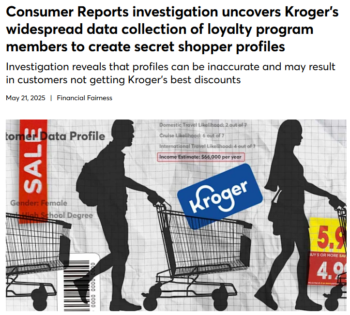
We did a full investigation of the second-largest grocery chain in the United States, Kroger, which has a free “loyalty” program with 62 million consumer profiles, that you can access if you live in a state that has a law that allows for that direct access to personal company profiles, but, in essence, groups you into a particular segment for Kroger, and gives you personalized promotions and discounts. When half the store is discounted, that means that there’s no one true price, and that promotions and discounts end up being the ultimate true final price for a lot of products sold there.
So that’s all to say that, just because Instacart was caught or flagged in this particular instance, doesn’t mean that other retailers are not doing this. In fact, every retailer is doing this. It just depends on the amount and the gravity and the scale.
And one additional point: I’ve read all the op-eds, I’ve seen all the responses to this. I’ve read Instacart’s blog posts. We actually engaged with Instacart over the course of four months, four rounds of questions with about, I’d say, 50 questions. And they answered the vast majority of them. We shared all of our underlying data and all of our methodology, and they actually weighed in on that, and we incorporated that into our story.
That’s sort of Journalism 101. It’s actually the scientific method. We didn’t go in with a theory or a thesis that we had to prove or disprove. We were asking basic questions and then trying to figure out, is this a problem, or is this an issue? And clearly, the story speaks for itself, and Instacart’s response in that story speaks for itself.
So I really stress to people when they have an instinctual, sort of gut reaction to a company’s defending itself, or saying X, Y, Z, if a piece of journalism, or a piece of academic research, is fully reported out and actually looks and talks to the other side, and incorporates that into the work product, that means they’re doing due diligence. And it means you can actually take all of the information there at face value, as being a good-faith representation of what’s actually happening.
JJ: And start with transparency. I mean, transparency is the beginning and end, right? If you are making very clear your methods, and putting forward that back and forth, then folks can read it. I get tripped up when media trips into ideology, like, for example, in, and I’m going to unfortunately quote from this same person, but I think it’s important, this column, in opposing this Instacart research, says, “By forcing price uniformity and ‘parity’”—which is in scare quotes, “’parity’”:
we break the feedback loops that make these complex networks work. This likely forces companies to raise baseline prices for everyone or bake costs into higher service fees.
Now, there’s a lot going on there, but I love how companies are “forced” to raise prices for everyone. There’s never any other option. There’s never lower CEO pay. There’s never lower shareholder profits; they’re not an option. It’s always that capitalism works in a subtle way that you, dummy, don’t understand, and you’re breaking “feedback loops,” and that’s going to backfire, and it’s going to raise prices for everyone. I guess I object most vehemently to the patronizing of this kind of coverage.
DK: Without directly characterizing the messaging there, right, one thing I think we can confidently say, from a purely independent journalistic perspective, is that these systems, while the architecture of them, the tech, is complex, the end result is not. When you have five different prices for the same product, sold at the same time from the same store, that is price manipulation, that is profit maximization. That means that some customers win and some customers lose. And you don’t know if you are on the winning side of that equation or on the losing side of that equation. And that is the net result.
These systems, this tech, and especially things that involve large language models or AI—yes, they are incredibly sophisticated. They are incredibly complex, but the end result is not.
And that’s why I think customers and regulators are really responding to this, because they see the practical import, and the impact on real-life Americans, and they want to have a first-order conversation: “Do we want this? Is this something that we should allow, or should we structure things in a different way, where we address it before we let the tech set prices and do what it wants?”
And so I think that’s a really important thing to stress, is to just sort of step back, 30,000-foot view. Do we want this? And is this something that affects people? And the answer, clearly, on the latter point is yes. It is a huge impact on people’s pocketbooks, and it’s something that really affects Americans every single day in their financial lives.
PC World (3/28/25)
JJ: And just finally, in terms of our media, the space to have that conversation about, do we want this? Because what I’m now seeing is a wave of coverage that’s kind of like, “Here’s how you can take steps to counter algorithms.” So it seems like media are going to sell us the disease and then sell us the cure. So now I don’t need to just work 60 hours a week. I have to come home and puzzle out how to outsmart the supermarket so I can make my wages pay for food.
At a certain point, what do we ask of journalism, in terms of who they’re representing, who they’re speaking for, and whether they will provide the space to have that conversation that you’re talking about, about is this something we want?
DK: Yeah, and I’m glad you asked that last question, because when experts speak to what should consumers do, or how should they react with this information in hand: There’s differential pricing happening at the grocery store, or at a retailer or with a travel booking company; how should you respond? In a lot of cases, it means basically a prescription for a more Luddite existence, which is, again, not necessarily a salve for many people that rely on these services and that really have no other option.
But really, when you speak to experts and ask them: What should people do? a lot of them say: Go to a store, maybe a company or a brand, that doesn’t practice this type of surveillance or dynamic pricing en masse. Buy in bulk, because academic, peer-reviewed research shows that buying in bulk does reduce prices. Look at price labeling, and that’s required, usually, by weights and measures departments at the state level. Look at per-unit pricing. So when you want to compare prices, hopefully in a brick-and-mortar store, you can actually see the per-unit pricing and compare products, and shop accordingly. And go slow and have a shopping list and be deliberate about your interactions with companies.
Those are not really artful, sort of cool solutions, with an app you can download, or a browser extension you can download. But those are the things that actually, meaningfully help when you’re navigating this.
JJ: Well, thank you very much. We’ve been speaking with Derek Kravitz. He’s an investigative journalist with Consumer Reports. You can find their work on this and many other issues on ConsumerReports.org. Derek Kravitz, thank you so much for joining us this week on CounterSpin.
DK: Thank you.
From FAIR via This RSS Feed.
Only 5 prices? Wait until you see health care pricing.
