

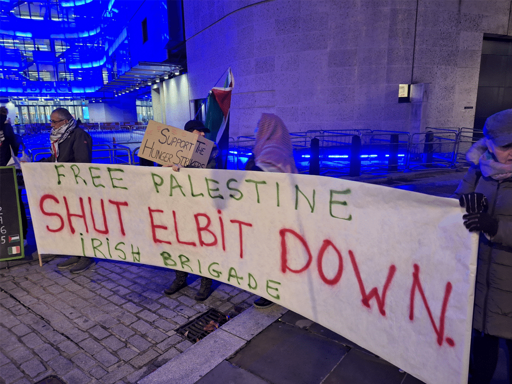

A jury has agreed that ‘Filton 24‘ Palestine Action activists had no intent to injure anyone during direct action against an Israeli arms factory. However, after fourteen hours of deliberations jurors [returned](https://www.bbc.co.uk/news/articles/cm2p99rxr5po @Steve W please - but let’s wait a couple hours for more details to emerge) guilty verdicts on lesser charges against some of the defendants.
The court had banned mention of ‘jury equity’. This refers to jurors’ legal right to acquit according to conscience regardless of evidence. Furthermore, several protesters were arrested for holding signs trying to remind them of this absolute right. This happened despite a judge already ruling that it could not be an offence.
Samuel Corner, 23, Charlotte Head, 30, Leona Kamio, 30, and Fatema Rajwani, 21, were found guilty of criminal damage. Corner was found guilty of grievous bodily harm (GBH) for lightly injuring a police officer. This occurred while he was trying to protect one of the female activists. However, despite some ‘mainstream’ media reporting to the contrary, he was acquitted of the much more serious charge of GBH with intent.

Zoe Rogers, 22, and Jordan Devlin, 31, were acquitted.
The judge’s decision to bar politics from closing arguments and prevent the mention of jury equity forced the activists to represent themselves during the final part of the case. Charlotte Head told the jury:
Sadly, despite how unbelievably kind and smart and wise my barristers are, after some decisions made by the court, I no longer feel like they are permitted to represent me in a way that does us all justice. So I’ve had to represent myself.
I recently found out that it wasn’t until 1898 that a person who was charged with a crime in the UK could speak to the jury under oath during their trial…
Under those conditions, me and my co-defendants would have had to sit quietly in the dock and await our fate, unable to tell you in our own words who we were and why we were sitting before you.
I was unsurprised to learn that, in 1898, when the first person was allowed to answer the charges they faced from the witness box and testify to their own defence, many people, including prosecutors and judges, were worried about what would happen.
Not because they feared that the defendants would lie but because they feared the jury sympathising more with normal people than the elites of the legal profession.
A long time has passed since then but it might be said that some prosecutors and judges still share that fear. A fear of the jury’s ability to be compassionate, to question the motives and integrity of the state, and to act as a barrier to the outcomes they want to achieve – namely to convict defendants…
They are frightened that you will listen to us, the defendants, when we talk to you and afraid of the power you hold as a jury. It’s entirely possible you may be one of the last juries to get to make decisions in a case like this before even that right is taken away from ordinary people.
A previous jury had refused to convict any of the defendants of any of the charges, while acquitting them of ‘aggravated burglary’, which could have led to life sentences. Desperate to record convictions, the Starmer regime demanded a retrial on the ‘no verdict’ charges. The judge also permitted police and security officers to change their sworn testimony after video footage completely contradicted the first version.
Many of the ‘Filton 24’ spent more than eighteen months in prison without trial. The High Court found Starmer’s ‘terrorist’ ban on Palestine Action unlawful. However, home secretary Shabana Mahmood is still trying to appeal against the judgement. At the demand of the Israel lobby, the Starmer regime is also in the process of preventing jury trials for many offences. Juries have repeatedly found activists not guilty. This is because they were trying to prevent a greater crime.
The regime had reportedly planned to invoke ‘terrorism’ to impose more severe sentences. This was despite no terror-related charges being in play. The court banned reporting on that fact until after the verdict. Therefore, it remains to be seen whether the jury’s rejection of the more serious charges throws a spanner in the works of that plan.
Featured image via the Canary
By Skwawkbox
From Canary via This RSS Feed.