

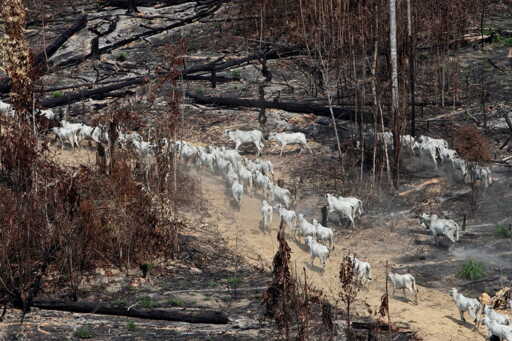
Illegal invasions in the Ituna/Itatá Indigenous territory in Brazil’s Pará state, home to isolated Igarapé Ipiaçava Indigenous people, has continued despite being protected by one of the latest land use restriction orders, in 2022, according to satellite analysis by Mongabay. This follows a series of protective orders over the years by the country’s Indigenous affairs agency, Funai, which did not halt land invasions. Between 2022 and 2025, data from Global Forest Watch show the area lost 2,211 hectares (5,463 acres) of tree cover. Cleiton Gabriel, the coordinator of the Middle Xingu Ethno-Environmental Protection Front, a specialized Funai unit, told Mongabay via WhatsApp that the forest loss in Ituna/Itatá is caused by land-grabbers who clear the forest without authorization for cattle ranching and other agricultural activities. “The deforestation in the Ituna/Itatá region historically stems from the illegal occupation of the territory,” Gabriel explained. “This is driven by land grabbing, the establishment of agricultural activities, especially intensive livestock farming, and also smaller-scale laboratory operations, mainly cocoa processing.” The land use restriction order, which prohibits unauthorized individuals from entering Ituna/Itatá, has been in place since 2011 to protect the isolated people. The precautionary measure has been renewed six times, the most recent being in 2025. Global Forest Watch data show that Ituna/Itatá was the third-most deforested area in Brazil between 2011, the year of the first land restriction order, and 2021. It was the most deforested Indigenous land in 2019. This has affected Funai’s efforts to obtain evidence of the presence of isolated…This article was originally published on Mongabay
From Conservation news via This RSS Feed.