

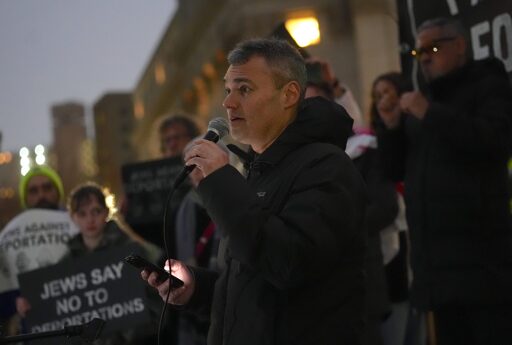
Amid Israel’s ongoing destruction of Gaza, its illegal annexation of land in the Occupied West Bank, and belligerent warmaking in Iran and Lebanon, antisemitism around the globe is rising—but so is an international chorus of anti-Zionist Jews speaking out against Israel’s crimes. In this episode of The Marc Steiner Show, Marc speaks with renowned author and commentator Peter Beinart about his new book, Being Jewish After the Destruction of Gaza, and about the “civil war” within the Jewish world over Israel.
Guests:
- Peter Beinart is a renowned author, professor, and analyst whose commentary regularly appears in The New York Times and MSNBC. Beinart is a professor of journalism and political science at the Craig Newmark Graduate School of Journalism at CUNY, and he is the editor at large of Jewish Currents. Beinart is the author of numerous books, including his most recent work, Being Jewish After the Destruction of Gaza: A Reckoning. He lives with his family in New York City and writes regularly for his Substack, The Beinart Notebook.
Credits:
- Producer: Rosette Sewali
- Studio Production: David Hebden
- Audio Post-Production: Stephen Frank
Transcript
The following is a rushed transcript and may contain errors. A proofread version will be made available as soon as possible.
Marc Steiner:
Welcome to the Marc Steiner Show here on The Real News. I’m Marc Steiner. It’s great to have you all with us. And once again, we’re joined by Peter Beinart. He’s jumped with an incredible writing recently. He’s the 2026 Pan America Literary Award for nonfiction, his atest book being Jewish after the discussion of Gaza, a reckoning, which I encourage everyone to read and wrestle with. He’s a professor of journalism, political science at the New Mark School of Journalism at University of New York, contributing opinion writer at New York Times, editor at large of the Jewish currents, MSMDC, political commentator and non-resident fellow of the Foundation of the Middle East. And you can see his work at Beinart Notebook on Substack. So without further ado, welcome, Peter. Good to have you with us.
Peter Beinart:
Nice to be here.
Marc Steiner:
I was thinking many ways how to start this, but this is a very difficult time for Palestinians to survive. It’s also a very difficult time for Jews to stand up saying, “Not in our name.” And you are one of the most prominent people out there saying that and not being anti-Israeli or anti-Jewish about it. So talk a bit about that for a minute, just your whole way of approaching what we face.
Peter Beinart:
Well, Judaism is an ancient tradition, which speaks in many, many voices. But for me, when I think about what it means to be a Jew, and I start with the belief that Torah begins with the creation of human beings who are not of any religion or race or ethnicity. The first human beings that we encounter in Torah are not Jews or proto-Jews or Israelites or proto-Israelites. Adam and Eve and Noah, generation of the Tower of Babel, Cain and Abel, they’re universal human beings. And I think the lesson to that for me is that all human beings have incalculable value and that we must never lose sight of the value of all human life. And so what we see in the discourse in Israel and in many Jewish communities around the world is a support for the state of Israel that essentially trumps the value of the lives of all the people who live within that state.
And that seems to me actually something akin to idolatry. It’s essentially the worship of something human made, the creation of a state, and the elevation of it over the lives of the human beings, human beings created in the image of God who live within that state, 50% of whom are Palestinian. And so to me, I think what’s incumbent upon us as Jews is to recenter the value of all human life, including Palestinian life at the center of how we think about what it means to be Jewish.
Marc Steiner:
So one of the things in what you’ve just said and what you’ve been writing, let me just throw this one thing out and maybe you’ll disagree or maybe you’ll agree, we’ll see. Antisemitism in this world runs very deep and it has for millennia. But what I’ve been talking and writing about recently is that for the first time in the history of the Jewish people, we’re unleashing it. We’re unleashing what’s dormant. We’re unleashing what’s active because of what’s happening in Israel, because of what Israelis are doing in our name to the Palestinians. And it doesn’t take much for hatred of Jews to explode. And I think it’s exploding because of ourprisian and Palestinians. Does that fit at all with you?
Peter Beinart:
I would put it somewhat differently. I mean, I agree with you that antisemitism is rising. I think it’s rising for two different reasons. Okay. The first is it’s rising in the same way that Islamophobia and anti-black racism and anti- LGBT and anti-immigrant. All of these things I think are rising because liberal democracy is faltering because we have these forces in America and you see them also in other parts of the world that basically are ethnonationalists. They basically want their country to be the province, to be dominated by one tribe, and everybody else is subordinate. I mean, what does Trump mean by make America great again? He means that there was a time in America where everybody knew their place, white Christian, straight men were on top and everybody else was below them. And these people want to reassert that America. And that process means devaluing the lives and the rights of everyone who doesn’t fit within that identity.
And Jews are part of that, but we’re only one part of that. And so the people who have white Christian supremacists are going to be likely to be antisemitic and they’re also likely to be anti-black and anti-Muslim, et cetera. The second kind of reason antisemitism is rising, I think, is the one that you’re getting at, which is to say there are a lot of people who are very angry at Israel, often for very, very good reason. The problem is that Israel speaks in the name of the Jewish people and American Jewish and other diaspora Jewish organizations essentially say that to be Jewish means you support Israel, that Judaism and Zionism are essentially inseparable. And I think that is very dangerous because it basically says to people, “If you’re angry at Israel, you should also be angry at Jews.” And we have to fight against that conflation.
But in fact, the Israeli government and establishment American Jewish organizations, they make exactly that conflation, which is the one that we should oppose. What we should say to people is, “You can think whatever you want about Israel, but it should not influence the way you think about American Jews.” Just like you can think however you want about the people’s Republic of China, you can hate the people’s Republic of China and you shouldn’t take out your hostility on Chinese Americans. We should make exactly that same argument vis-a-vis Jews in Israel. But unfortunately, groups like the Anti-Defamation League say essentially the opposite.
Marc Steiner:
I was thinking about what you just said and the piece around what Tucker Carlson talks about when he talks about Israel and how that criticism from often the right and the religious right is a condemnation of Jews as almost satanic. I’ve been to a couple of churches where I actually have heard something like that from the pulpit when people told me about these ministers. So I went in to see and listen. I mean, it seems to me that we’re on a precipice in terms of our survival as a people and how we define ourselves, who we are as a people.
Peter Beinart:
I think the problem with someone like Tarfor Carlson is not that all of his criticisms of Israel are wrong. Some of his criticisms are very valid and his criticisms of this war are very valid. And I will even give him credit. He’s interviewed a lot of Palestinians. He’s given Palestinians more of a platform than they get in a lot of the media. The problem is that Tucker Carlson is still at his core an ethnonationalist, kind of an American Christian ethno nationalist. And so instead of saying, Israel is committing crimes of the same kind that countries of any racial or religious or ethnic group, including Americas, have committed settler colonialism. What is Israel doing to the Palestinians? In a lot of ways, it’s very similar to what America did to Native Americans, pushing people off of their land into smaller and smaller enclaves. Because Carlson wants to maintain the idea of American Christian moral superiority, he tends to often suggest that there’s something peculiarly Jewish about what Israel is doing.
And that’s where I think the conversation becomes dangerous.
Marc Steiner:
So where do you think this reality goes in terms of the Jewish people in our country? I mean, when you see the debates inside of the Jewish world, the growing movement of not in our name.
Peter Beinart:
And so
Marc Steiner:
You’ve been covering this, watching it, writing about it. I really want to hear what your thoughts are about where you think this takes us.
Peter Beinart:
Well, I think there’s a struggle in the United States, which has to do with the idea that we should be a country that treats everybody equally under the law, irrespective of their race, religion, ethnicity, gender, and groups of people who want America to be a white Christian supremacist country, kind of ethnonationalist vision. And oftentimes those people who want America to be a white Christian supremacist nation also are comfortable with Israel’s version of ethnonationalism, with Israel being a Jewish supremacist nation as well. And so what you find among the most powerful Jewish organizations, let’s say APAC or the anti-defamation league, their number one concern is making sure that America supports Israel unconditionally, and they don’t mind if America becomes a white Christian supremacist nation as long as it supports Israel. And then you have another group of Jews who are fighting against this white Christian authoritarianism that we’re seeing in the Republican Party, and many of them are also fighting against ethnonationalism in Israel.
They’re fighting for the principle of equality under the law, both here in America and in Israel-Palestine. And this is a kind of civil war within the Jewish community. As you know, it runs through many synagogues and many families where there’s a deep divide about this question. I fundamentally believe that American Jews and Jews in general are safer in countries where everybody is treated equally under the law and that the principle of Jewish supremacy and Christian supremacy and Hindu supremacy and Islamic supremacy, all of those things are wrong and that we should oppose the idea of any states giving legal preference to people based on their religion or their ethnicity or their race. It
Marc Steiner:
Has raised a lot of contradictions. I mean, one of the things I raise often with this is that in the 1960s, doing the civil rights movement that I was a part of, 60% of all the white civil rights workers were Jews.
Peter Beinart:
Right.
Marc Steiner:
And that’s not a mistake when you come from Holocaust surviving family,
Peter Beinart:
Surviving
Marc Steiner:
The pogroms that my family did both. So I mean, but I think that something has turned, and I wonder if through organizing, through argument, if that can be turned around.
Peter Beinart:
I hope it can. I think you’re entirely right that something turned. If you look at organized American Jewish life in the middle of the 20th century, in the 50s and the 60s, civil rights was a major focus. The Jewish organizations believed that if American Jews supported Black Americans in getting the right to vote and getting equal treatment, then that would also secure the place of Jews as being treated equally in America. It’s not a coincidence that the last quotas at Ivy League universities ended in the 60s as the civil rights movement was beginning to triumph because American Jews, I think, understood that if Black Americans failed in their effort towards move towards equality, then Jews would probably also be victims of greater discrimination. But what happened after the civil rights movement is that a lot of the American Jewish organizations shifted their focus and became essentially Israel defense organizations.
There are various reasons for this, but basically starting really after the 67 war, you see this turn towards these organizations becoming Israel defense organizations. And the problem with defending Israel is first of all, it turns these organizations away from focusing on questions of justice in the United States. I mean, the most powerful American Jewish organization is now APAC. APAC has no concern whatsoever for what happens in the United States. So when APAC sees a politician like Donald Trump and they think about who should they should give money to, they don’t ask the question, “Does this person believe in American democracy? Does this person oppose bigotry in our country?” No. The only question they ask is, “Does this person support Israel enough?” And so you essentially have a kind of an abandonment by America’s most powerful Jewish organizations of their moral responsibility for what happens in the United States.
And oftentimes they’re willing to support people who tried to overthrow the 2020 election so long as those people are supporters of Israel. And I think this really undermined the kind of commitment to democracy that we saw expressed during the civil rights movement by American Jews.
Marc Steiner:
And what you’re describing, I think also unleashes antisemitism. Questions who Jews are. Who are they loyal to? Who are you loyal to and why? Which is why you hear what Tucker Carlson and those guys are saying at this moment from the right. And I don’t think people actually in the Jewish world, the majority of people do not see what’s being unleashed and the dangers we face because of it.
Peter Beinart:
I certainly think the Jewish organization leaders are not willing to grapple and acknowledge with this problem. I mean, so for instance, we have these issues here where you have protests outside synagogues because the synagogues are say selling land in the West Bank. They’re selling land to settlers. This is land largely often stolen from Palestinians. And so you would think that the response for Jewish organization should be synagogues should not be doing this, right? Synagogues are placed to pray. They’re places to study Torah. They should not be involved in acts that are blatantly immoral, that are violations of international law. Instead of responding that way, the groups like the Anti-Defamation League basically say, “You see those protesters protesting outside of synagogues? They hate Jews that otherwise, why would they be protesting outside of synagogues?” What we should be saying is, of course we don’t want people protesting outside of synagogues, God forbid, but we need to make sure the synagogues don’t do things that are fundamentally immoral.
And when they do those things, they conflate Jews and Israel’s immoral actions in ways that actually, I think really put Jews in danger and are also are just fundamentally wrong.
Marc Steiner:
I’m very curious where you think this, what we face now will take both Israelis and Balestinians and the United States. I have a poster on my wall that I got in Cuba in 1968 when I was a young radical and went down with the delegation to Cuba. And the poster I came back with was a map of all of the holy land, all of it with an Israeli flag on one side and a Palestinian flag on the other side and down the front of it over the map, the words were one state, two people, three faiths. And it’s kind of been my mantra for a long time.
Peter Beinart:
Yes.
Marc Steiner:
How realistic is that, do you think? Where the struggle goes today in terms of the growth in the Jewish population, young Jews saying, “No, not in our name.”
Peter Beinart:
It’s not realistic now, but the question is, can we make it realistic? I mean, there are lots of things. Civil rights was also not realistic in the United States in the 1920s or 30s or 40s. It was made realistic by a great movement that you were part of. Overturning apartheid was not realistic in the 1960s and 70s. In the 1980s and 90s, it became realistic because of the anti-apartheid movement. So I think we need a movement to change US policy. So the US is not complicit in Israel’s crimes. Europe needs to change its policy because Europe is very, very much connected in also its economic relationship and allowing what Israel is able to do to the Palestinians. And I think that could set in motion a different kind of political dynamic where perhaps we can move towards a just peace. Now, what exactly would it look like?
I don’t know. But to me, and it’s not my decision, it’s the decision of the people who were there, but it seems to me the fundamental principle that I would argue for, which is I think similar to what was in that poster is wherever Jews and Palestinians live alongside each other, they should be treated equally under the law. We should not have Jews and Palestinians living alongside each other in which one group has superior legal rights to the other as exists today.
Marc Steiner:
I want to come back to the book, which I’ve been reading. I don’t have a hard copy, but I read it online, and I think that it’s a really important piece. And I just want to come back to that and talk a bit about people listening to us now about what that book is saying and how we get to this place in America with everything we face, with the right wing in power and growing in power, with the liberals and left in disarray, with Israel and being Jewish at the center of that struggle.
Peter Beinart:
What I argue in the book is that we Jews are fully human and being fully human means that we are capable of doing anything that any other group of humans are doing. We are not history’s permanent victims, that in every case, we are always the ones who are in the victim role, that we have been victimized terribly in moments in history. We could be again, but we are also capable of the same kind of terrible oppression, even genocide that other groups of people are. And recognizing that can allow us to see what’s happening in Israel-Palestine in a different way than many of us were raised to believe, which is basically that Palestinian opposition to Zionism and to Israel is just the same reincarnation of the antisemitism that threatened our parents or grandparents in Europe or wherever. That after if we look at the situation plainly, we can see that there is a system of very deep and profound oppression of Palestinians that exist.
And that system, I believe, violates the core Jewish principle that all human beings are created equal in the image of God. And I also believe it puts Jews at risk. I think supremacist political systems make everybody less safe, and that the equation of Israel with Jews also makes Jews around the world less safe.
Marc Steiner:
We need to get Jew in your book to Baltimore.
Peter Beinart:
I would love to do it.
Marc Steiner:
So I’m going to write to you and I’m going to make that happen.
Peter Beinart:
Wonderful.
Marc Steiner:
Because I think people need to see this. The book, Being Jewish Yet for Destruction of Gaza, is I think a really profound book. And I didn’t know what to expect when I started, but you raise issues that need to be raised and the people need to wrestle with.
Peter Beinart:
Thank you. I really appreciate that.
Marc Steiner:
And I deeply appreciate you taking time with us today. My
Peter Beinart:
Pleasure.
Marc Steiner:
Peter Byner, always a pleasure to talk to you and we’ll get you here and we’ll talk some more.
Peter Beinart:
That’ll be great. Looking forward to it.
Marc Steiner:
All right. Take care, my friend.
Peter Beinart:
Take
Marc Steiner:
Care.
Peter Beinart:
All right. Be well.
Marc Steiner:
Once again, I want to thank Peter Beynard for joining us today. And you can see more of Peter Beynard’s work on his Substack. Peter Beinart, that’s P-E-T-E-R B-E-I-N-A-R-T at selfstack.com. And thanks to Cameron Brandino for running the program today, audio edit to Steven Frank for working his magic, Rosette Sowali for producing the Marc Steiner Show and the tireless Keller Rivera, making it all work behind the scenes, and everyone here at The Real News for making this show possible. So please let me know what you thought about what you heard today, what you’d like us to cover. Just write to me at mss@therealnews.com, and I’ll get right back to you. So once again, thank you to Peter Beinart for joining us today and for his tireless work. So for the crew here at the Real News, I’m Marc Steiner. Stay involved, keep listening, and take care.
From The Real News Network via This RSS Feed.