

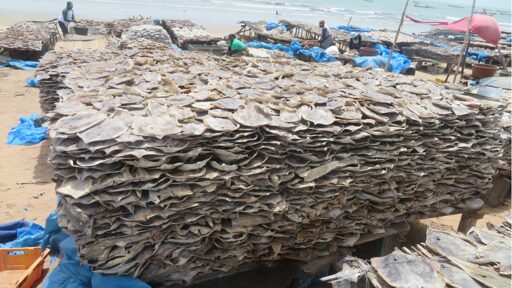
In Senegal, artisanal fishing kills a surprising number of sharks and rays, according to a new study — so many, it probably eclipses industrial fishing, which is more commonly blamed for the species’ decline. The study was published in the journal Ecology and Evolution in March. Researchers analyzed landings of sharks, rays and guitarfish at two major artisanal fishery processing sites, Kafountine and Elinkine, in southern Senegal’s Casamance region between June 2021 and July 2022. Most of the catches comprised species at risk of extinction, and many were traded abroad without obligatory export permits, the study found. While the researchers directly counted more than 100,000 harvested sharks, rays and guitarfishes, they estimated the actual number to be at least 174,000, as many were stacked or piled together and couldn’t be accurately counted. This number was surprisingly high, according to lead author Rima Jabado, chair of the Shark Specialist Group at the IUCN, the global wildlife conservation authority. Jabado is also the founder of the Elasmo Project, a United Arab Emirates-based nonprofit that focuses on shark and ray conservation. “The study should be read as evidence of a serious problem, not as a ceiling on the true scale of exploitation,” Jabado told Mongabay in an email, adding the findings are conservative. Since the researchers covered only two out of dozens of landing sites in the country, the total number of rays and sharks caught and processed annually could be 1.7 million to 3.5 million, the study estimates. Scientists and environmental organizations…This article was originally published on Mongabay
From Conservation news via This RSS Feed.