

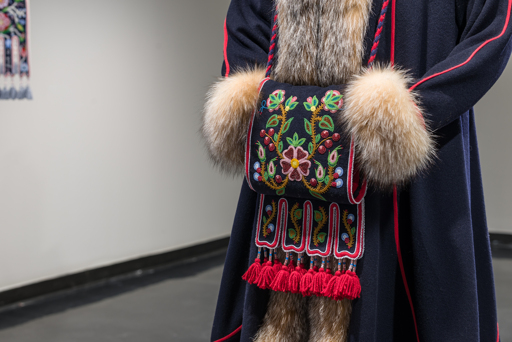
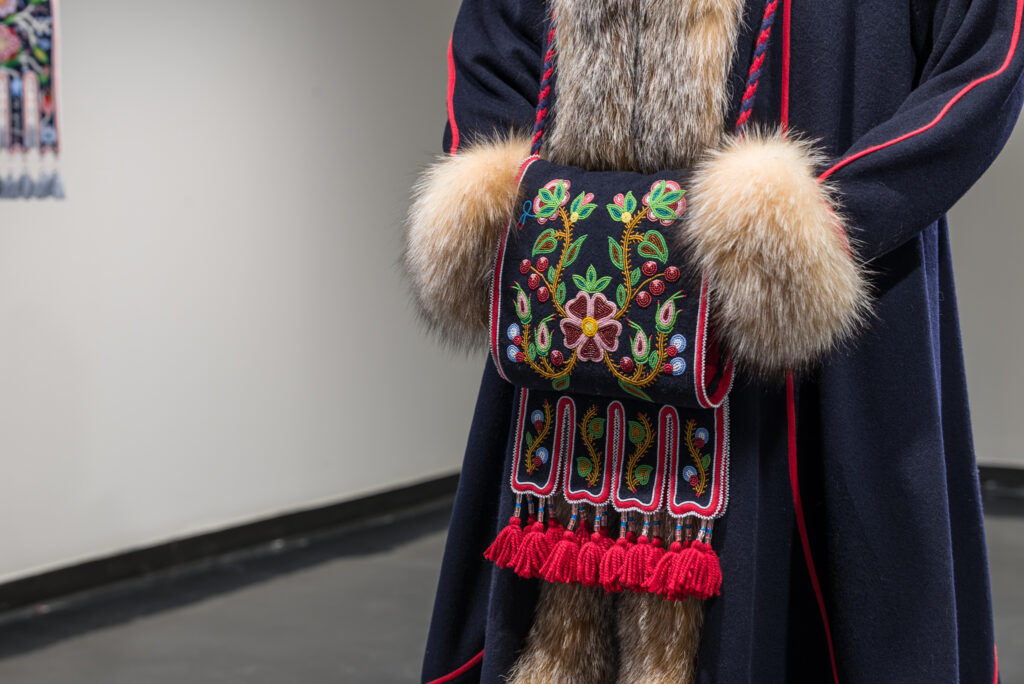
Jennine Krauchi’s The Lady — a beaded coat, muff, hat and boots — is displayed as a centerpiece of the Beading Métis Resurgence exhibition at the University of Winnipeg. Photo courtesy Sarah Fuller/Indigenous Art Collection/Crown-Indigenous Relations and Northern Affairs Canada
Jennine Krauchi was dressed in black when she sat before the crowd at Gallery 1C03, at the University of Winnipeg.
She was wearing the first piece she ever beaded: a daisy-chain necklace with a small headdress pendant.
She made it as a child in the 1960s at the Indian and Métis Friendship Centre in Winnipeg’s North End, where she learned the daisy-chain technique from Dorothy Maquabeak Francis of Waywayseecappo in Western Manitoba.
The necklace marked the beginning of a practice that would carry Krauchi from the Friendship Centre to museum collections, kitchen-table lessons and now a gallery exhibition on the resurgence of Red River Métis beadwork.
Now, she’s part of an exhibition, Beading Métis Resurgence, on view at Gallery 1C03 until July 10. The show brings together the work of Krauchi and four Red River Métis artists she has mentored.
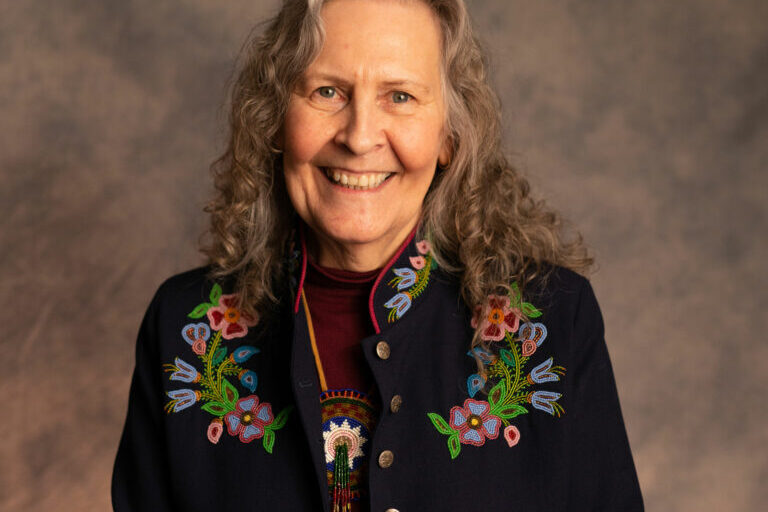
Renowned artist Jennine Krauchi. Photo supplied
The exhibition is curated by the gallery’s director and curator, Jennifer Gibson, and the University of Winnipeg history professor, Cathy Mattes.
The exhibition looks at beadwork as both contemporary art and cultural knowledge and intergenerational practice, while also tracing how a younger generation is extending the form through gender, family history, material study, and new concerns about artificial intelligence.
Gibson said the idea for the exhibition came after she saw Krauchi being honoured at a Winnipeg Art Gallery event, surrounded by younger artists she had mentored in beadwork.
“I just thought, well, wouldn’t that be a nice exhibition?” Gibson said.
She invited Mattes to co-curate the show, noting that Mattes brought a deep knowledge of Métis art and beadwork to the project.
“I never, ever thought in my lifetime I would see our beadwork represented in an art gallery, and that it was taken as an art form,” Krauchi said during a March 23 artists’ conversation.
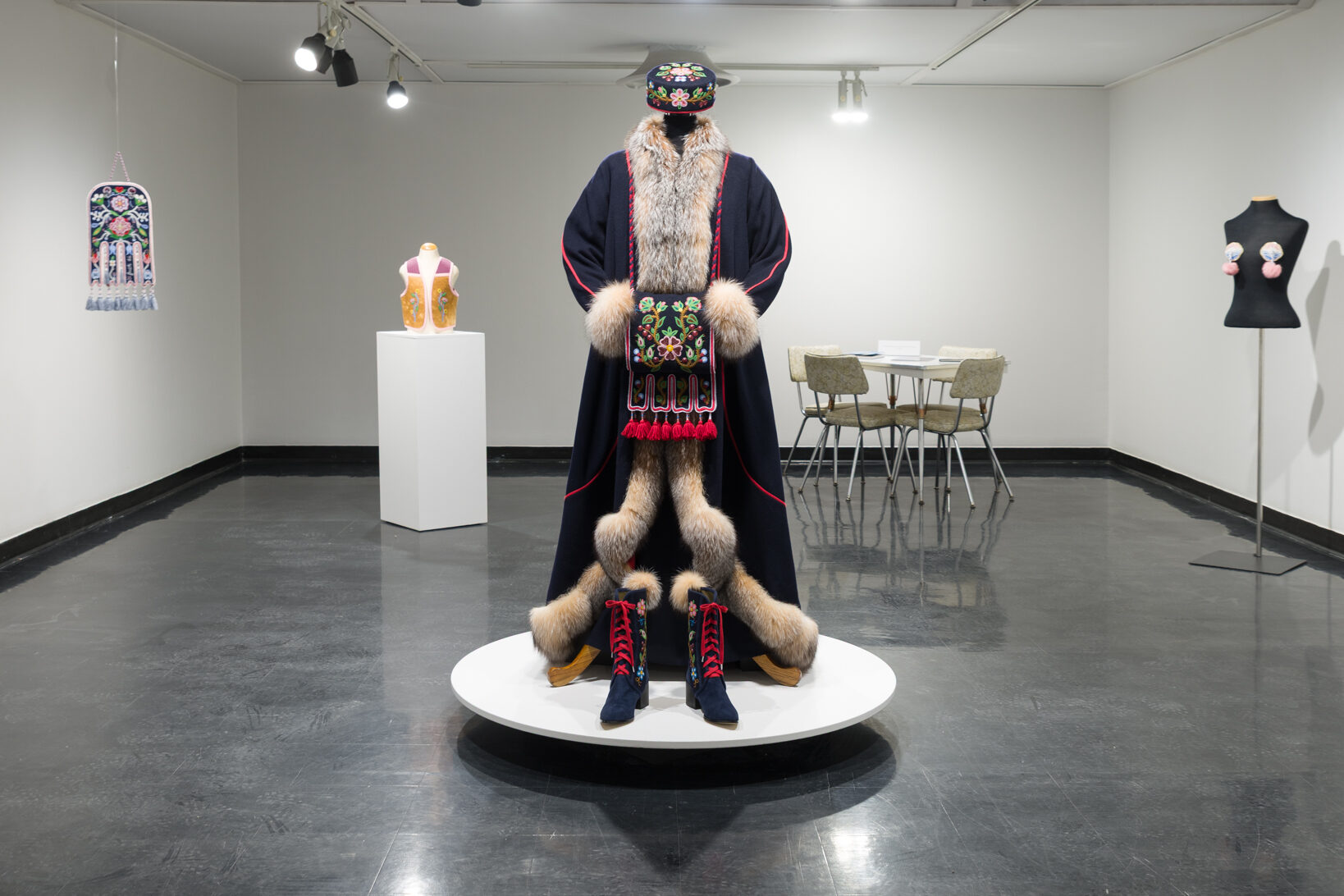
In the middle of Winnipeg’s Gallery 1C03, Jennine Krauchi’s work The Lady is surrounded by exhibits by younger Métis beadworkers she’s mentored. A table and chairs is reminiscent of their kitchen conversations. Photo courtesy Sarah Fuller/Indigenous Art Collection/Crown-Indigenous Relations and Northern Affairs Canada
The ‘Flower Beadwork People’
Métis floral beadwork became one of the most recognized visual forms of Métis culture in the 19th century, particularly around Red River.
Métis women developed a distinctive style that brought together First Nations beadwork, quillwork, European glass seed beads, and floral embroidery patterns.
It became a distinct art form so closely associated with Métis makers that they became known as the “Flower Beadwork People.”
At the centre of the exhibition is Krauchi’s The Lady, a long wool coat with fur edging, floral beadwork, a beaded pillbox hat, an octopus bag-inspired muff and laced boots with florals.

READ MORE: How woodland strap dress dancers are reviving a tradition on the powwow circuit
Krauchi’s matrilineal Métis family comes from Minnewakan, beside Lake Manitoba, where she said her relatives “lived close to the land” and “lived off of wild meat.”
Her Dutch father “absolutely loved” the look of floral Métis beadwork, she said, and encouraged Krauchi and her mother to bead.
In the 1970s, Krauchi and her parents met Katherine Pettipas of the Manitoba Museum, who asked them to make the clothing worn by Indigenous mannequins for the museum’s permanent boreal forest exhibit.
That began Krauchi’s lifelong relationship with the museum, where she has studied artifacts and reproduced beadwork inspired by the pieces she encountered there.
“Those pieces in museums are very, very important,” Krauchi said. “They have taught me an awful lot in a silent way. It’s like spending time with a really close friend.”
For Krauchi, museum collections became a place of study and relationship. They offered access to beadwork made by earlier Métis artists, even when the makers’ names were not always preserved by collecting institutions.
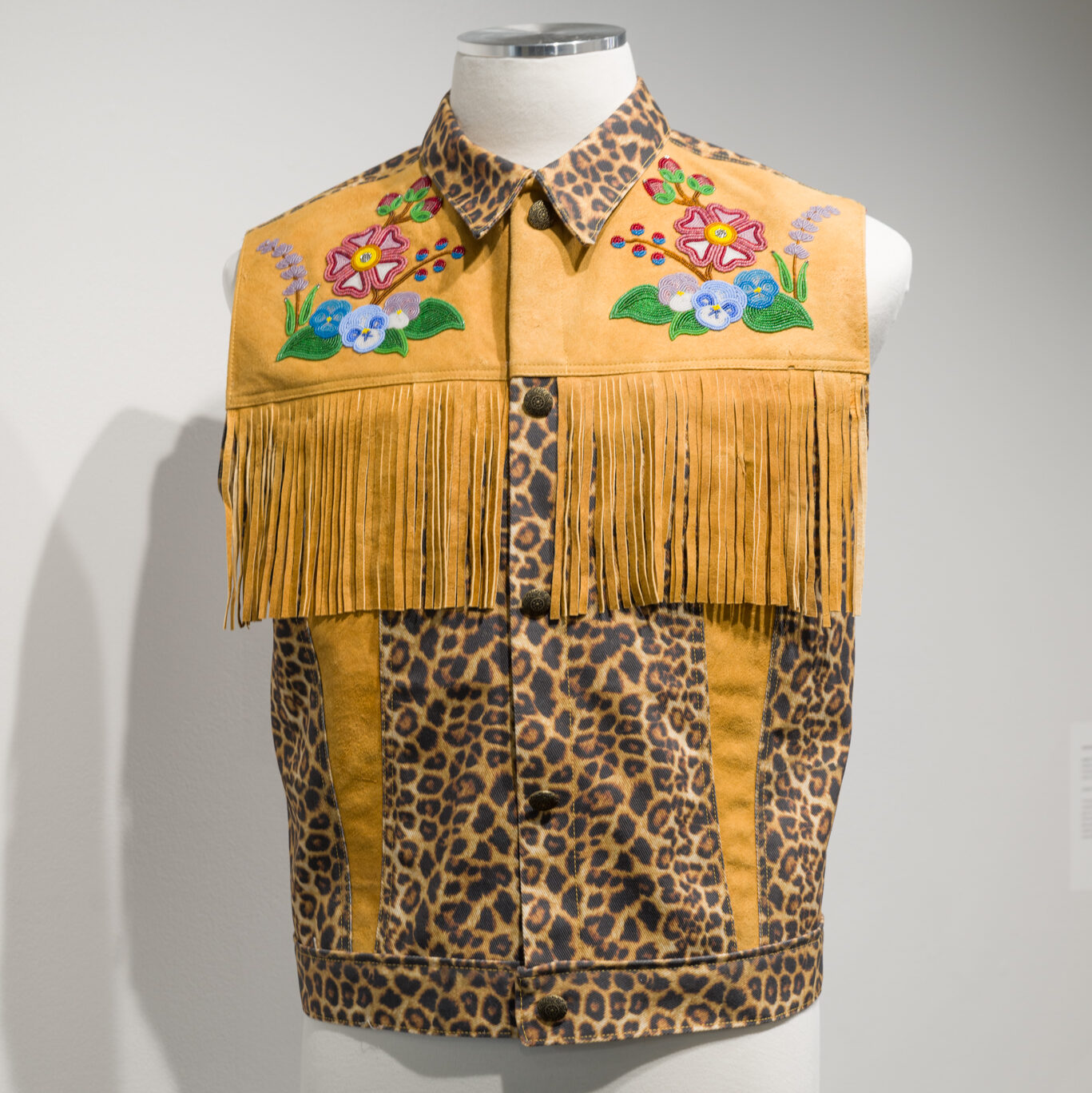
Vest, by David Heinrichs, features beadwork on brain-tanned caribou hide with denim. Photo courtesy Sarah Fuller
Krauchi said she felt good about being Métis while growing up in Winnipeg. That changed when she moved to the city of “Brandon” in Manitoba at 14.
“That’s where I really felt racism,” she said.
When she returned to Winnipeg in the 1990s, she said the move brought her back into culture “in a really good way.”
The late Lorraine Freeman, founder of the Métis Resource Centre in Winnipeg, looked for a beading instructor. She found Krauchi.
“I knew how to do it,” Krauchi said. “I didn’t do much, but I did know how to teach it.”
In the years since, she has become known for both her beadwork and her mentorship.
It was within the last eight years that she began sitting around her kitchen table with the four younger artists featured in Beading Métis Resurgence.
“When we’re all getting together,” Krauchi said, “they’re teaching me just as much, if not more, than I teach them to think outside the box.”
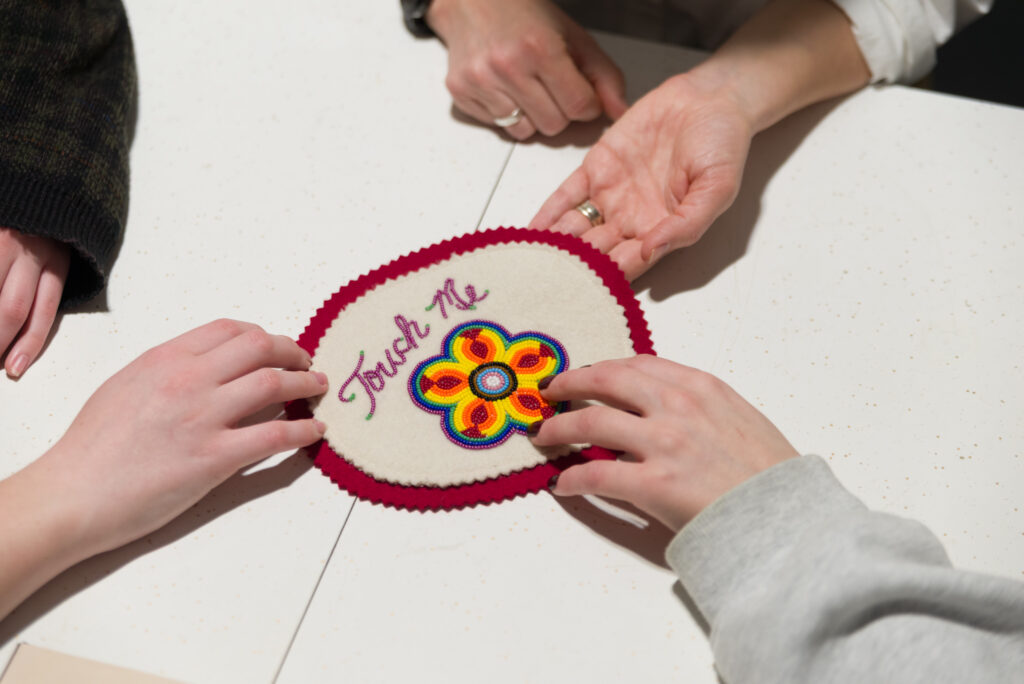
Veteran Métis beadworker Jennine Krauchi began sitting around her kitchen table several years ago with the four younger artists. Now they’re all featured in a University of Winnipeg gallery exhibition, Beading Métis Resurgence. Photo courtesy Sarah Fuller
The exhibition also speaks to a long history of undervaluing beadwork, especially work made by Indigenous women.
Krauchi recalled beading florals onto a jacket with her mother in the 1980s and being offered far less than the work was worth.
“We sold it at that time for $375,” she said, “and we thought we were doing real good.”
The artists Krauchi mentored — David Heinrichs, Vi Houssin, Claire Johnston and Brianna Oversby — told IndigiNews about how they take up that history from different directions, using beadwork to think through land, family, gender, labour and responsibility.
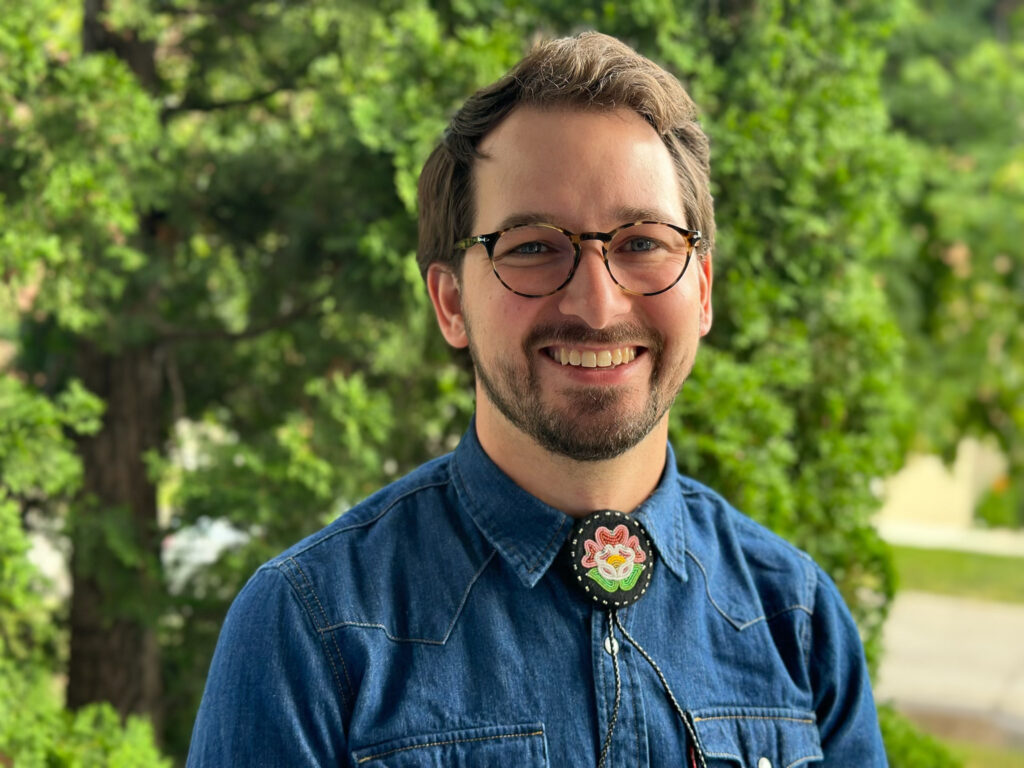
Queer Michif beadworker and school teacher David Heinrichs. Photo supplied
David Heinrichs ‘trying to do bigger things’
For Heinrichs, a school teacher and queer Michif beadworker, the art form became a way to bring together family history, identity and a lifelong attention to the natural world.
“I started beading in about 2012,” Heinrichs said. “My sister taught me first.”
Growing up, his sister was the family artist, while Heinrichs was drawn to the biological sciences.
He said it took him “a long time to feel comfortable” pursuing art.
His mother’s Métis family is connected to St. Vital and St. Boniface through the Poitras, Champagne, Fisher and Grant family names. His Mennonite father’s ancestors arrived in Manitoba in the late 1800s.
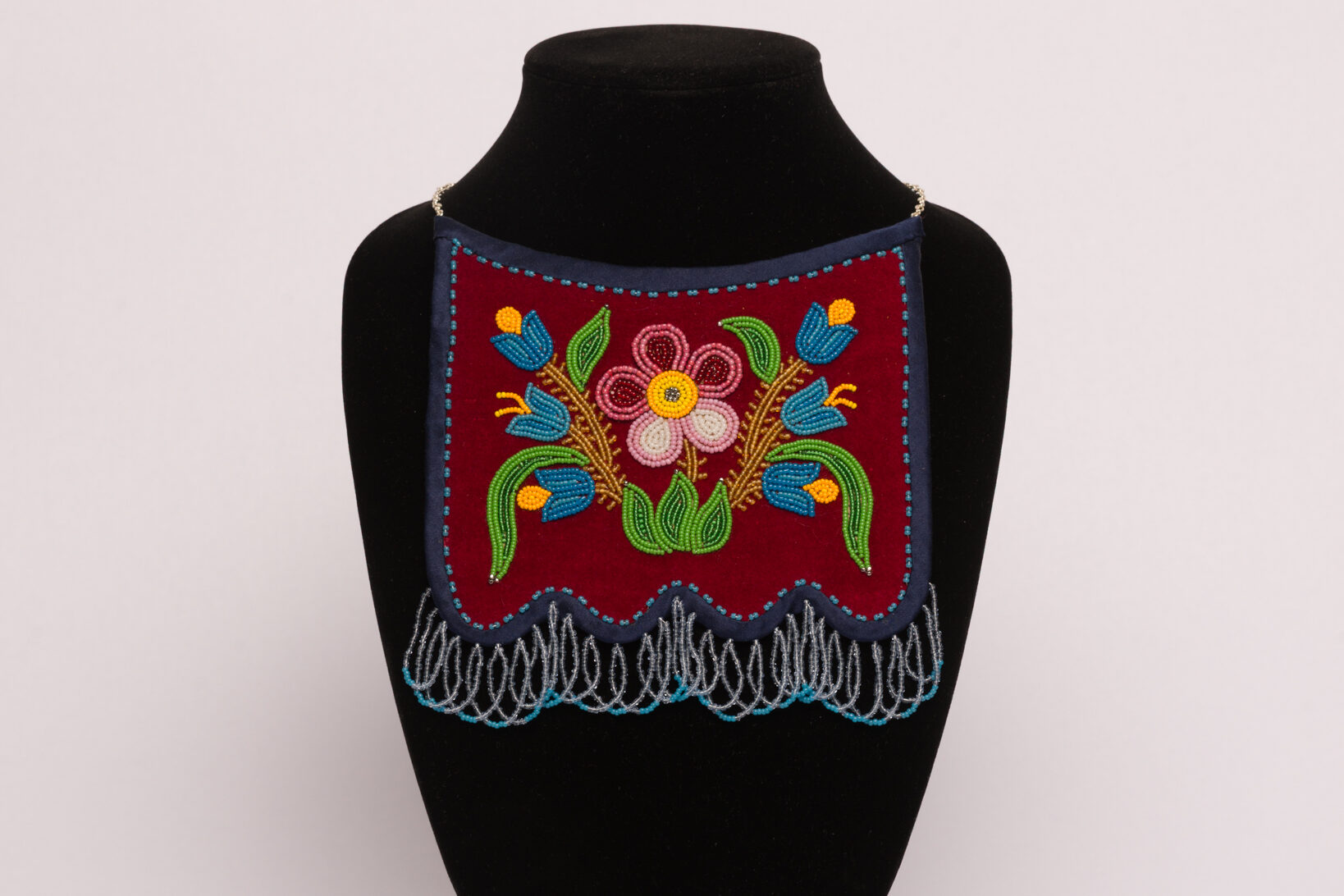
One of David Heinrich’s contributions to the Beading Métis Resurgence exhibition. Photo courtesy Sarah Fuller
Heinrichs met Krauchi at the Louis Riel Institute’s Beadwork Circle in 2017, when he was “trying to do bigger things.”
His talent struck Krauchi as she helped him make a sac de feu (fire bag), also called an octopus bag, which was used to store fire-starting tools.
Alongside other artists mentored by Krauchi, Heinrichs visited the Manitoba Museum to study beadwork.
Krauchi encouraged him to examine “ancestor pieces” that now influence his colours, techniques and style.
“I like to incorporate a lot of those older styles of florals, while also looking at the plant communities that are around here,” Heinrichs said, “and challenging myself to find ways to bead those flowers recognizably.”

Vi Houssin, a transgender beadwork artist and drag performer, is of Red River Métis and white settler ancestry. Photo by Vincent Wolfgang courtesy Vi Houssin
Vi Houssin’s ‘heirlooms that we can carry down’
For Vi Houssin, beadwork became a way to reconnect with community and create new family heirlooms.
Houssin, a trans Métis woman whose roots come from St. Vital, St. Boniface and Rooster Town, first tried beading in 2020 at a workshop hosted by Heinrichs through the Two-Spirit Michif Local.
As the COVID-19 pandemic began, Houssin went into social isolation and started experimenting with beads.
When restrictions eased, she had what she called a “wonderful opportunity” through Mentoring Artists for Women’s Art (MAWA) to learn from Krauchi, whom she described as “the Michelangelo of Métis beading.”
Houssin said she found it “wild” that beadwork had not been treated as a fine art form until recently — she believes “because of racism and misogyny.”
Her own Métis family was “disconnected” from community and from the cultural practice of beadwork.
“Our family has no ancestral pieces at all,” she said. “One way that I tried to reconnect with beadwork is by making work for my siblings.”
Each year, Houssin makes a large creative piece for one of them.
“So we have our own heirlooms that we can carry down,” she said.
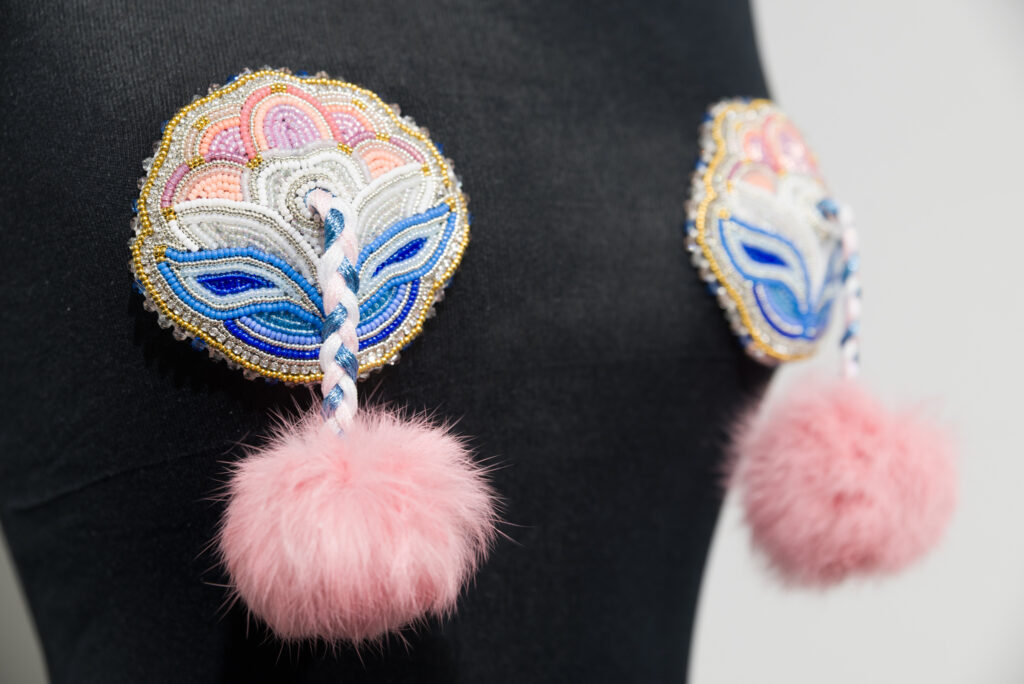
Nipple Pasties II, by beadwork artist and drag performer Vi Houssin. Photo courtesy Sarah Fuller
Claire Johnson on beadwork as ‘great teacher’
Claire Johnston, a Red River Métis artist whose family held scrip from St. Clements and St. Andrews near Winnipeg, traces her work through the beads themselves. Her Métis family names include Johnston, Brown, Richards and Thomas.
“Our ancestors here, they utilized Italian beads,” Johnston said.
Wanting to understand where those beads came from, Johnston travelled to Venice on a Canada Council for the Arts-funded fellowship to study the origins of Venetian conterie, or glass seed beads.
Traditionally, the beads were made on the island of Murano, near Venice, where glass tubes were cut into small cylinders, then heated and softened into rounded shapes.
For Johnston, the trip became a cross-cultural exchange.
In Venice, Johnston learned from Italian impiraresse, bead threaders whose labour helped prepare glass beads for trade across Europe, Turtle Island and beyond.
The work was often done communally by women, who strung tiny beads onto hanks — the name for a series of bead strings — before they moved through global trade routes.
“They’d have big boxes on their laps of beads, and all day, they would thread these beads onto hanks,” Johnston said.
She said it was profound to think about how the tiny beads were prepared before being brought to Turtle Island and around the world.
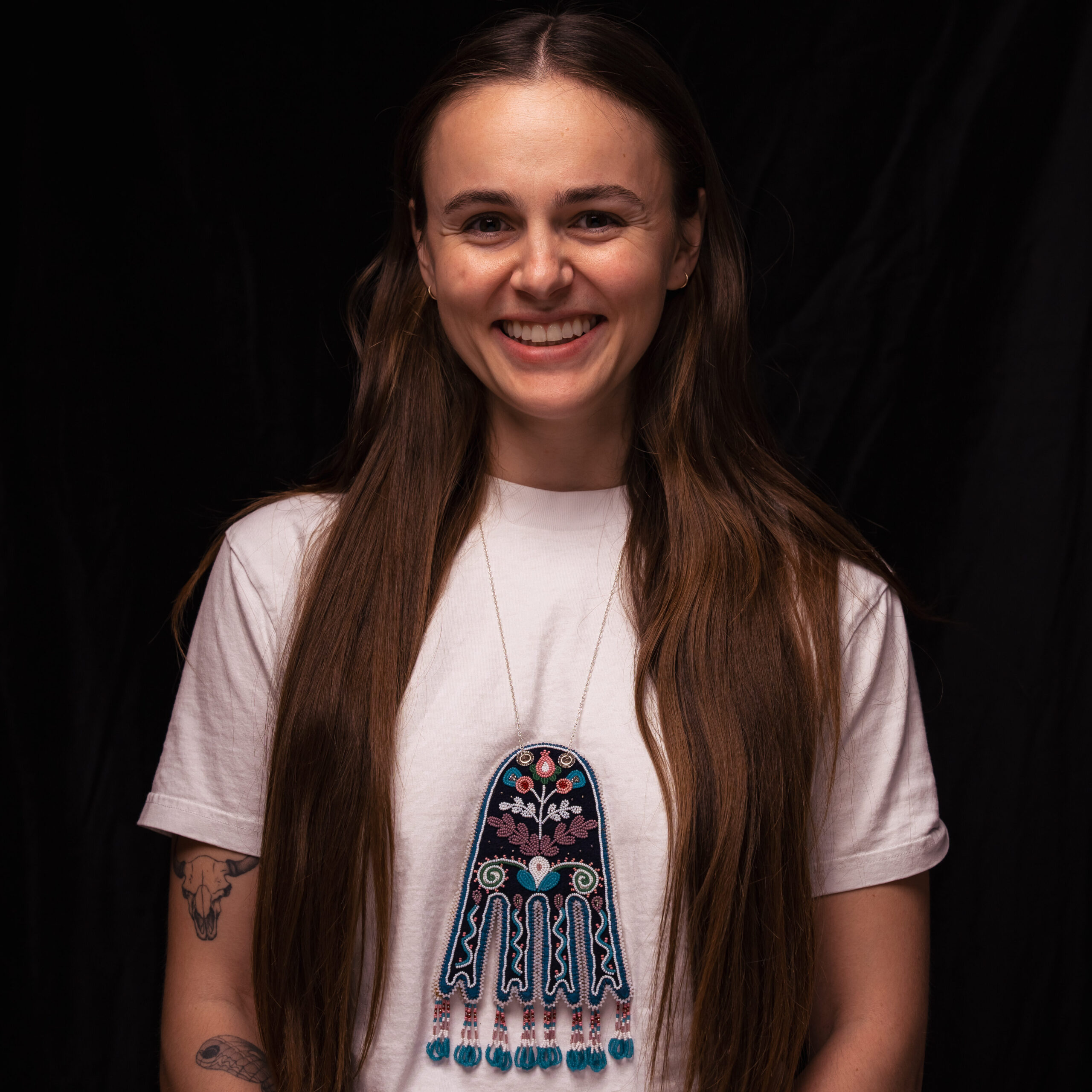
Claire Johnston is a visual artist of Red River Métis, Scottish, English and Swedish ancestry. Photo supplied
In Venice, Johnston found commonality with the threaders, who were carrying on their own ancestral tradition and shared a deep admiration for the tiny glass beads.
“What was really beautiful was learning and knowing that it had been groups of women that had gathered together always,” Johnston said, “to be stringing these beads onto the hanks.”
Although seed beads are no longer made in the region in the same way, Johnston said the threading method has continued through larger glass lampwork beads.
She returned to Winnipeg with a deeper appreciation for the Venetian hands that had handled the beads and the hundreds of hours it can take to craft large beadwork pieces.
Around the same time, Johnston became increasingly concerned about artificial intelligence and the theft of Indigenous beadwork designs.
“I have a lot of strong feelings around AI,” Johnston said, adding that overseas fashion houses have also stolen Indigenous designs.

READ MORE: AI is a double-edged sword for Indigenous stewardship, say UN experts
For Johnston, beadwork cannot be separated from labour, land and relationship.
“Somebody’s labour went into it, the land sustained it and supported it, the water, everything, and beadwork to me is a great teacher,” Johnston said.
“And so thinking about AI-generated beadwork, it just takes away all of the ethics, all of the ways of knowing that are in our beading.”
With AI in mind, she wanted to make a creative statement.
She returned to a partially finished octopus firebag, which Krauchi helped with in 2023. She blended floral tradition with a contemporary message of beaded letters, “STOP USING AI!”
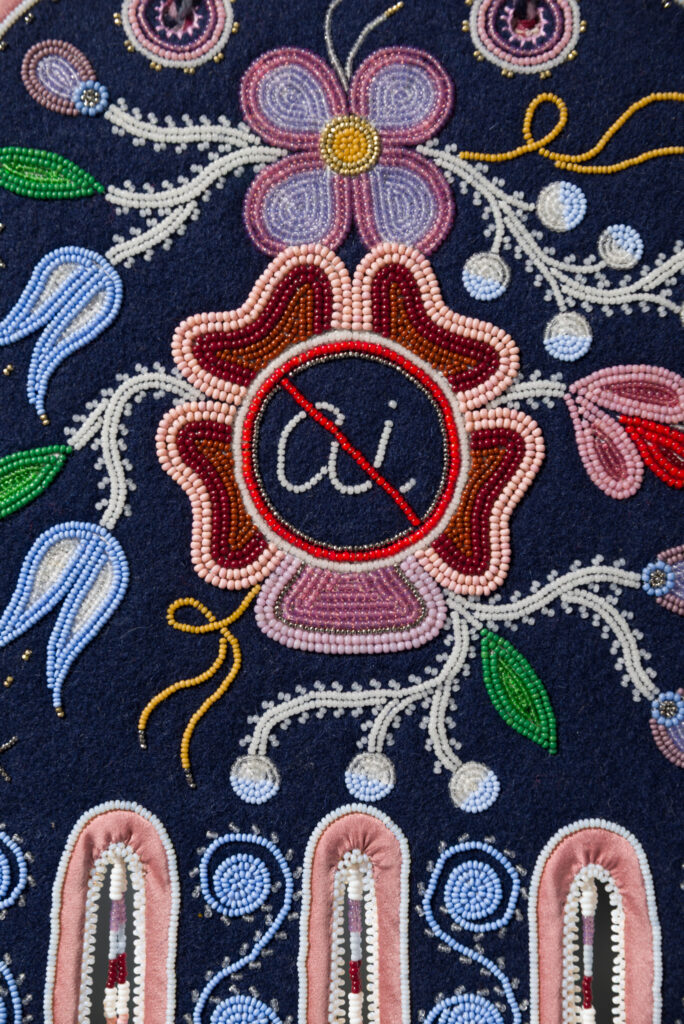
Claire Johnston’s STOP USING AI! is part of the Beading Métis Resurgence exhibition. Photo courtesy Sarah Fuller
Brianna Oversby ‘building up the skills and knowledge’
Brianna Oversby’s path to beadwork began with material they did not yet know how to care for.
Oversby, an interdisciplinary Scots-Métis artist with German, British and Irish settler ancestry, said they have been making things for as long as they can remember.
Their Métis family claimed scrip from Poplar Point, St. Paul and St. James, with family names including Wishart, Spence, Flett and Hallet.
Oversby recalled an Indigenous craft store next door to their father’s business in Ashern, Man., in the Interlake region.
“I have really early memories sitting in there and playing with a little leather lacing and beads and stuff like that,” they said.
Their father, a guide for moose hunters, had a large moose hide in the basement. When Oversby was 11, they tried to turn it into saddlebags.
“I did not have the skills to put it together,” Oversby said. “And so it ended up being put into the back of a plastic bag for a very long time.”

Brianna Oversby is an interdisciplinary artist who studied art education at Concordia University. Photo supplied
Later, Oversby moved to Montreal, where they studied art education at Concordia University and created installations using tracks, hydraulics, and paintings on animal hides.
They picked up a needle and thread again in their early 20s.
“I started playing around with beading in my early 20s, but never really learned how to do beading properly,” Oversby said.
During the pandemic, Oversby wrote about the childhood moose hide in a chapbook of poems and essays.
The piece explored what happens when people create harm without meaning to because they do not yet have the knowledge needed to care for a material properly.
“Taking the flesh of this big, strong animal, somebody had to go through all of these processes to turn that into that material,” Oversby said.
“The piece was really about the shame around cutting up this moose hide and leaving it uncared for.”
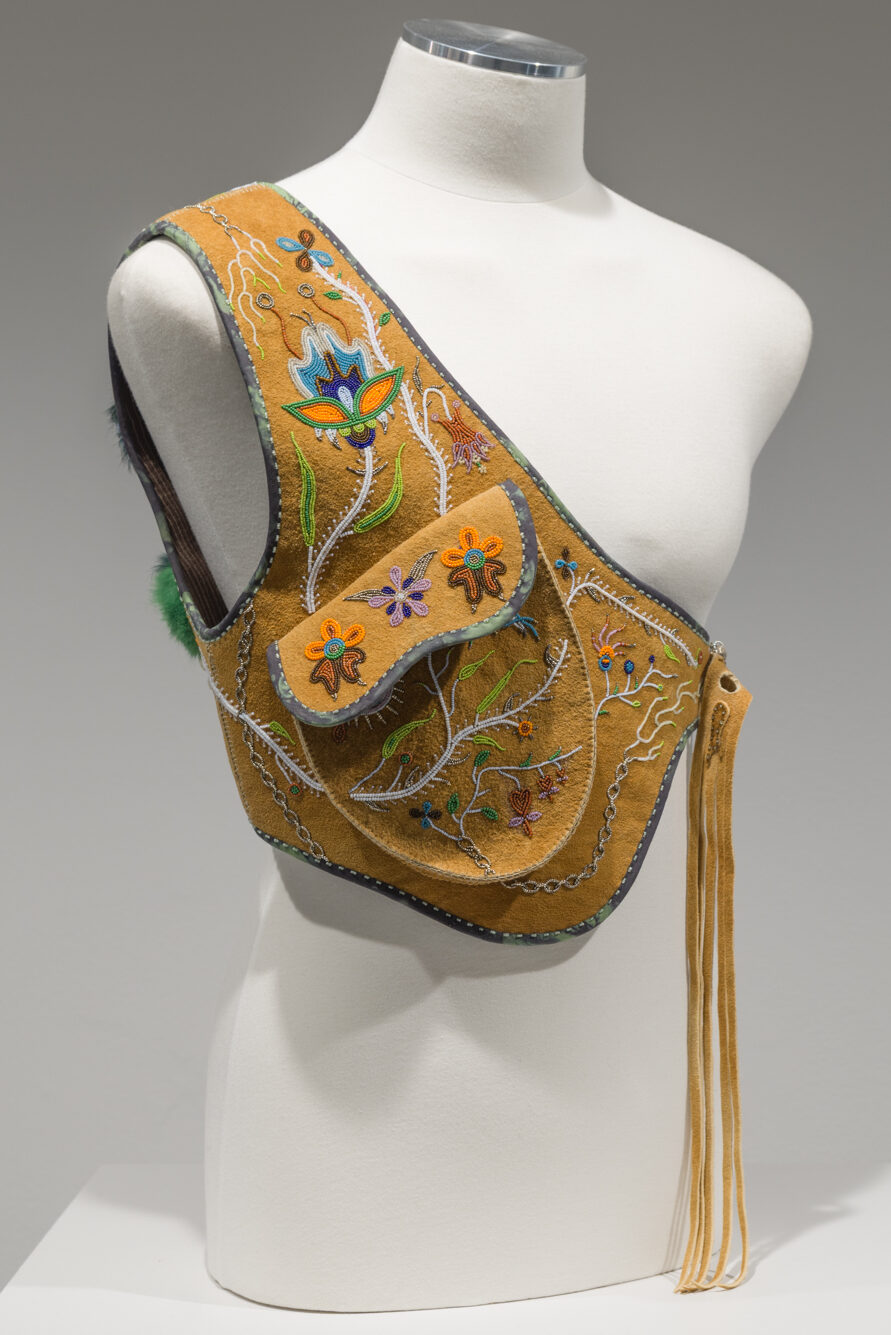
Brianna Oversby’s 2026 work Carrying includes moosehide, rabbit fur, a silver chain, glass and steel beads and linen. Photo courtesy Sarah Fuller
After Oversby’s family read the book, their stepmother gave them two circles of moose hide that she had cut up as a child. Oversby used the hide to make a beaded medicine bag.
They said it took “all these years of building up the skills and knowledge” to finally make a beaded piece from moose hide.
For Krauchi, the exhibition marks a change she once could hardly imagine.
Métis beadwork, long undervalued as craft, is being shown as contemporary art, with her own work displayed alongside pieces by artists she helped mentor.
“A lot of people along the way have brought it to this point, and now it’s up to these four, and I know they’ll pass it on,” Krauchi said.
“It will never, ever die. It’ll keep on going. And I’m so fortunate to be alive and see that happen.”
Beading Métis Resurgence is open to the public until July 10 at Gallery 1C03, on the main floor of Centennial Hall at the University of Winnipeg. The exhibition is open weekdays 1-4 p.m. and is free.
The post Winnipeg exhibition traces the revival of Red River Métis beadwork appeared first on Indiginews.
From Indiginews via This RSS Feed.