

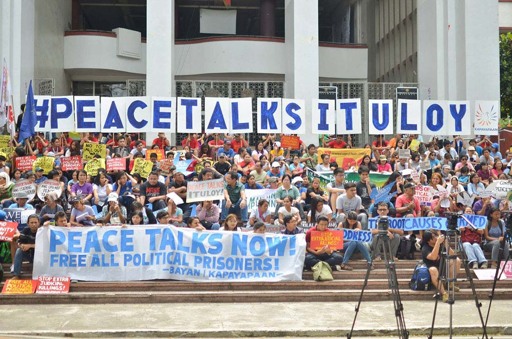
“If we are ‘at peace,’ why does the armed conflict persist?”
LAGUNA – Progressive lawmakers and human rights lawyers criticized Defense Secretary Gilberto Teodoro Jr. for rejecting renewed calls to resume formal peace negotiations between the government and the National Democratic Front of the Philippines (NDFP).
They stressed that this reflects a “war-first” policy that has failed to resolve the country’s armed conflict.
In a joint statement dated May 2, ACT Teachers Rep. Antonio Tinio, Gabriela Women’s Party Rep. Sarah Jane Elago, and Kabataan Rep. Renee Louise Co said that Teodoro’s refusal to consider peace talks, even without preconditions, reflects a “closed-minded” and anti-peace position, despite renewed appeals from former government negotiators following the killings in Toboso, Negros Occidental.
The lawmakers said that decades of counter-insurgency operations failed to defeat the armed movement. “The continued insistence on an all-out security solution has only prolonged the conflict,” they said, citing recurring reports of human rights violations, displacement, and civilian deaths.
‘Dead-end policy’
Teodoro earlier dismissed proposals to reopen negotiations between the Government of the Republic of the Philippines (GRP) and the Communist Party of the Philippines–New People’s Army–NDFP, claiming that engaging in talks would “elevate the morality” of the armed movement’s cause.
But for critics, this position ignores previous gains in the peace process. The lawmakers pointed to the 2022 Oslo Joint Statement, signed by government representatives through Special Assistant to the President Antonio Lagdameo Jr., which committed to exploring the resumption of formal negotiations.
They stressed that past talks produced substantive agreements and nearly achieved interim accords that could have reduced hostilities and addressed the roots of the conflict, including landlessness and rural poverty.
“Teodoro’s refusal signals that the Marcos administration is choosing perpetual war, not a sustainable path to peace,” they said.
Toboso killings
The controversy comes in the wake of a military operation in Toboso, Negros Occidental that left 19 people dead. Conflicting reports on whether civilians were among those killed have intensified demands for an independent investigation.
The National Union of Peoples’ Lawyers (NUPL), in a separate statement dated May 3, questioned Teodoro’s claim that the country is at peace.
“If we are ‘at peace,’ why does the armed conflict persist?” the group asked, pointing to communities that continue to experience militarization and state violence, particularly in Negros where peasants remain among the poorest sectors.
NUPL said that regardless of peace talks’ status, the government remains bound by international humanitarian law and human rights obligations. “Such obligations are legally demandable and enforceable,” it said, reiterating calls for full accountability over the Toboso killings.
‘Militarist framing’
The lawmakers criticized what they described as a “militarist framing” of the conflict, warning that incidents like the Toboso operation are being used to justify intensified repression, including red-tagging and attacks on civil society organizations.
They said that such narratives, echoed by security officials and foreign actors, undermine democratic space and make long-term peace more difficult to achieve.
Similarly, the Bagong Alyansang Makabayan (Bayan) accused the Marcos, Jr. administration of using “deceptive peace rhetoric” to mask human rights violations and deepen military ties with the United States, including expanded joint exercises like Balikatan.
Contradictions in peace policy
Critics flagged what they said were contradictions in the administration’s foreign and domestic posture. While the government seeks a seat in the United Nations Security Council on a platform of promoting peace, its defense chief has effectively shut down avenues for negotiated settlement at home.
For the lawmakers and rights advocates, the path forward requires addressing the roots of armed conflict through socio-economic and political reforms, not intensified militarization.
“It is time to end the cycle of war-first policy,” they said. “A just and lasting peace can only be achieved by addressing the conditions that give rise to armed struggle.”
They called for the immediate resumption of substantive peace negotiations and urged the public to support efforts toward a peace based on justice, democracy, and national sovereignty. (AMU, DAA)
The post Lawmakers, rights lawyers slam DND’s rejection of peace talks appeared first on Bulatlat.
From Bulatlat via This RSS Feed.