

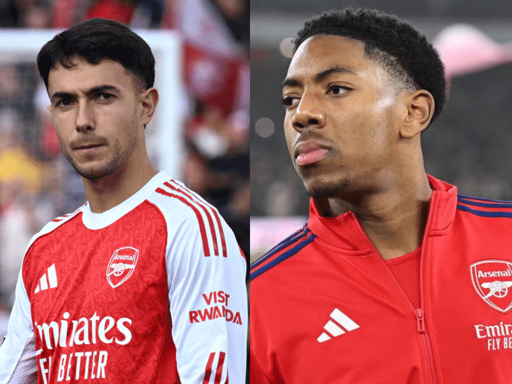

Thierry Henry believes Myles Lewis‑Skelly’s long‑term future is in midfield after the 19‑year‑old’s first senior start in that role against Fulham, a performance the former Arsenal striker described as “outstanding”.
Lewis‑Skelly’s composure on the ball, alertness in reading play and willingness to drive forward, has pushed the youngster into serious contention for a start in tonight’s Champions League semi‑final second leg with Atlético Madrid.
Arsenal’s Lewis‑Skelly brings a lot to the table
Lewis‑Skelly’s strengths are clear and complementary. He progresses the ball with confidence, times his interceptions well and shows a willingness to carry into the final third. These traits make him more than a makeshift option.
He also arrives at the Emirates with freshness. Unlike some senior team mates, he has not been burdened with the heaviest minutes this season. Those attributes suit a side that wants to press and move the ball quickly through midfield.
Why Zubimendi remains the safe pick
Martín Zubimendi offers a different, more conservative profile, positional discipline, defensive security and experience in tight European fixtures. He has been a steady presence for Arsenal and, despite a patchy run of form in the second half of the season, his understanding of the role in high‑stakes matches is a known quantity. For a manager weighing the risk of a semi‑final, that reliability carries weight.
The Rice variable
Declan Rice’s recent shift into a deeper no. 6 role changes the selection calculus. Rice has produced dominant displays when asked to sit and recycle play, bringing dynamism and quicker passing from the base of midfield.
Jamie Carragher argued on Sky Sports that Rice’s presence at no. 6 gives Arsenal more tempo and makes the idea of starting Lewis‑Skelly less risky, because Rice can cover and stabilise the midfield if the youngster pushes on. That tactical flexibility is the key lever for Mikel Arteta.
Tactical trade‑offs for Arteta
This is a classic managerial trade‑off between control and invention. Start Zubimendi and you prioritise defensive structure and experience. Start Lewis‑Skelly and you inject energy, ball progression and a different kind of unpredictability.
Against Atlético, a team that defends deep and hits on the break, the choice is not purely stylistic. It is also about mitigating counter‑attacking risk and maintaining balance when Arsenal push numbers forward.
Arteta can tilt the balance without a wholesale gamble. Keeping Rice at no. 6 and pairing him with Lewis‑Skelly would preserve a defensive spine while unlocking the youngster’s forward instincts. Alternatively, Zubimendi’s inclusion would be a conservative, defensively minded selection aimed at minimising mistakes in a knockout tie.
The pragmatic verdict
Henry’s endorsement is meaningful. It signals that Arsenal’s coaching and former player network sees a midfield future for Lewis‑Skelly. But endorsements do not decide line-ups, context does and for a one‑off, high‑pressure semi‑final, many managers lean toward experience.
For a coach confident in his system and in Rice’s ability to shield, Lewis‑Skelly is a legitimate and exciting option.
Arteta’s decision will reveal more about his appetite for risk than about either player’s quality. Either way, the Fulham performance has done what good auditions should — it has widened the manager’s choices and sharpened a selection headache that, for Arsenal, is a sign of depth rather than weakness.
Featured image via Arsenal
By Faz Ali
From Canary via This RSS Feed.