

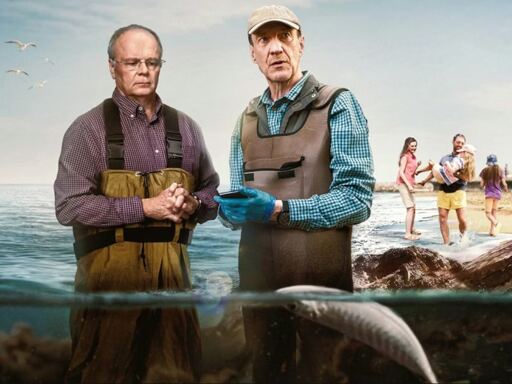

The public responded to the Channel 4 docudrama series Dirty Business – which exposed the damage done by the sewage scandal – with “widespread praise”, whereas their discussions about water companies, the regulator and public bodies was “overwhelmingly negative”, according to the government’s own analysis.
The analysis was produced by the Department for Environment, Food and Rural Affairs (Defra) in the aftermath of the series being aired and was released after a Freedom of Information Act (FOIA) request from the Canary.
A ‘shocking real-life drama’
Channel 4 describes the series on its website, saying:
In an idyllic Oxfordshire hamlet, the fish in the river keep dying. Why? David Thewlis and Jason Watkins lead this shocking real-life drama of victims, whistleblowers and England’s water companies.
Thewlis and Watkins play Ashley Smith and Prof Peter Hammond, respectively. Smith and Hammond lead a real-life campaign group called Windrush Against Sewage Pollution (WASP). Windrush, in this context, refers to the river in their local area.
The series was anchored around the campaigning work of WASP, and it also featured storylines showing the impact of sewage pollution on families across the country. This included the death of 8-year-old Heather Preen, who contracted E. coli on a Devon beach after accidentally walking through water coming from a combined sewage outlet, which was spread across a footpath.
The series also tracked developments within the Environment Agency, which is responsible for monitoring the water companies’ performance, for inspecting their assets, and investigating pollution incidents. The power of the agency is eroded by governments seeking to deregulate the privatised water sector.
Public anger at sewage scandal analysed in detail by government
Now the Canary can reveal that the full extent of the public’s anger, expressed over a wide range of social media platforms, has been analysed by Defra.
On 24 March 2026 at 17:22, an email was sent from an official Defra email address to redacted recipients. One section of the long email, subtitled “Social listening summary”, opened by saying:
conversation around Channel 4’s Dirty Business has grown substantially across X, Bluesky, online news, Reddit, Facebook and Instagram public, blogs, LinkedIn, and Tumblr.
It added that the programme had been mentioned 15,082 since the day before.
The analysis continues:
The programme has generated 1.14M impressions on X so far and mentions of key organisations have increased across the board. Thames Water remains the most mentioned entity at 1,303, followed by Ofwat at 838.
The Environment Agency has grown to 688 mentions from 504 unique authors, and Defra to 530 mentions from 479 unique authors. The high ratio of unique authors to mentions for both suggests the criticism is coming from a broad range of voices rather than a small number of highly active accounts.
The tone across the mentions is overwhelmingly negative and directed at water companies, regulators, and the government rather than at the programme itself, which is attracting widespread praise. Alongside the outrage, there’s a strong mobilisation thread running through the conversation.
A significant proportion of posts are templated 38 Degrees campaign messages directing people to sign a petition, suggesting coordinated campaign activity is inflating raw mention volumes. Posts from We Own it are also directing people to attend protests in High Wycombe or write to Ofwat.
Ofwat is the regulator of the water industry.
Key themes of the analysis
A subsection within the “social listening” analysis drew out what Defra identified as “key themes” from posts on social media:
Water privatisation and public ownership remain the single biggest theme, with calls for nationalisation appearing repeatedly and with growing urgency. Several posts cite the claim that England is ‘pretty much the only country in the world whose entire water industry is fully privatised’ as a rallying point.
An emerging and more confrontational narrative is now also visible, with calls for a water bill payment strike.
Corporate debt continues to feature, with specific figures cited. Yorkshire Water is named alongside Thames Water.
Online commentators are concerned that Thames Water creditors are seeking permission to continue illegal pollution until 2040, with 24 MPs referenced as having written to Ofwat and Emma Reynolds to oppose this.
Emma Reynolds has been the Defra secretary of state – the most senior minister at the department – since 5 September 2025.
Further analysis said:
The Environment Agency is taking significant reputational heat. There are continued calls for the agency to be dissolved, with named references to former EA chief Sir James Bevan and Dr Toby Willison.
Defra and the government’s position are being scrutinised with increasing sharpness.
Several posts reference Steve Reed by name, and Keir Starmer features directly in the conversation, with cross-party blame now a consistent thread, targeting Conservatives for privatisation and Labour for inaction. One widely shared post compares the scandal to the Post Office and contaminated blood cases.
Steve Reed was the Defra secretary of state between 5 July 2024 and 5 September 2025.
The Canary approached Defra, Ofwat, Thames Water and Yorkshire Water to offer them the opportunity to comment on the analysis. None chose to respond.
Defra’s press office is responsible for media relations for both Defra and the Environment Agency.
‘Privatisation is an overpriced, money-hungry, failure and is intrinsically flawed’ – sewage campaigner
The Canary shared Defra’s analysis with WASP founder and chair of trustees Ashley Smith to get his reaction.
Smith is described on WASP’s website as having “served for 30 years with Thames Valley Police, retiring as Detective Superintendent in 2010”:
A former angler, scuba diver, and general outdoors person, he has spent a lifetime in and around waters at home and abroad. He has a lifelong love for the natural world and contempt for injustice. He has been investigating the sewage scandal since 2016 and is the author of several exposés of regulatory capture and failure.
Smith told the Canary:
Defra is the government department that is ultimately responsible for the current water and sewage scandal. It blames the regulators while controlling the regulators and probably has the most to lose if the serious scandals exposed by Dirty Business were to be properly investigated, as they surely must be at some point soon.
The response to the three episodes is all about assessing reputational damage and the pretence that everything is different now, while nothing has been done [to] investigate the obvious corruption issues identified in the Environment Agency and the appalling behaviour of water companies.
The Defra response reeks of ‘Can we get away with it without doing anything?’ That seems to be its approach to most things we have seen, regardless of how scandalous. Our exposure of even more criminality continues.
The government is beginning to get an idea about public anger and is trying to quell it with a series of misleading statements, which are getting steadily binned as campaigners prove they are not true and known to be not true – also known as lies.
Smith said that the lies included statements that £104bn of private investment has been secured, “which turned out to be billpayers money”, and that:
it would cost taxpayers over £100bn to take the privatised water sector back into public ownership – a figure first exposed as a discredited number from a think tank paid for by the water industry and then rehashed as a number from Ofwat, which was also exposed as fanciful by specialist academics.
He continued:
Now we have the fake news that new regulation is coming to the rescue when, in reality, it is being specifically designed to protect the interests of water company owners who have [the] government’s ear – groups like BlackRock, whose CEO supported Keir Starmer’s election campaign…
The government is tricking voters into thinking that a lack of regulation is the problem when all along it has been Defra’s refusal to use existing law effectively, because that would soon expose that privatisation is an overpriced, money-hungry failure and is intrinsically flawed and destined to forever feed off captive customers and cost far more than the non-profit public alternative.
The lying has extended to the response given to our petition to call for a referendum for the water industry to be taken into public ownership, which we are contesting as a deliberate attempt to trick people out of signing…
But we have still raced past 100,000 signatures. We want a million to wake the government and potential governments up and out of complicity with a scam.
Smith’s petition, titled “Hold a referendum to bring the water industry into public ownership”, has received 114,845 signatures at the time of writing and can be found here.
A response by the government to Smith’s petition said:
Some campaigners have called for a binding referendum on returning the water industry to public ownership. However, the government has no intention of nationalising the water sector currently and does not believe that a national referendum would deliver faster improvements for customers or the environment.
Any move to nationalisation would take many years to implement, involve significant legal and operational complexity, and risk prolonged uncertainty and disruption across the sector. That would divert time, energy and attention away from the urgent work needed now to tackle sewage pollution, protect public health and improve water quality.
‘Defra know exactly what the public wants, and now they must act’ – renationalisation campaigner
In response to the analysis, We Own It lead campaigner Sophie Conquest told the Canary:
These discussions are yet another piece of evidence demonstrating the intensity of public fury at our broken water system, and the ever-growing demand to end the failed experiment of privatisation.
Over 100,000 people have just signed a petition calling for a referendum on public ownership of the water sector. 80 MPs (and counting) have signed an open letter calling for Thames Water to be brought into Special Administration. 8 in 10 of us want to see water in public hands. These demands for change will not simply go away.
In the midst of a cost-of-living crisis, people are being asked to pay more and more for a broken service and sewage-filled rivers. They have rightly had enough.
Regulation has been an abysmal failure. The new Water White Paper is a gift to privatised water. A new, single regulator will be ripe for corporate capture. A ‘tailored approach’ for each water company and ‘constrained discretion’ offer water companies even more scope to bend and break the rules without consequence.
Defra know exactly what the public wants, and now they must act. In order to address the water crisis, we must bring our water system into public ownership, starting with the collapsing Thames Water.
A Channel 4 spokesperson told the Canary:
Channel 4 is proud to be the home of searing, truth-seeking programmes that hold power to account.
Dirty Business is part of a long and rich history of such programming, and we hope that its demonstrable impact on national conversation around the failure of water companies, and their regulation, has helped elevate awareness of this important issue.
The widespread anger against the water companies, the regulator and politicians that the government has articulated in its internal analysis adds pressure on the government to do more to tackle the sewage scandal. However, it is unclear whether that will result in renationalisation.
Featured image via Channel 4
By Tom Pashby
From Canary via This RSS Feed.