

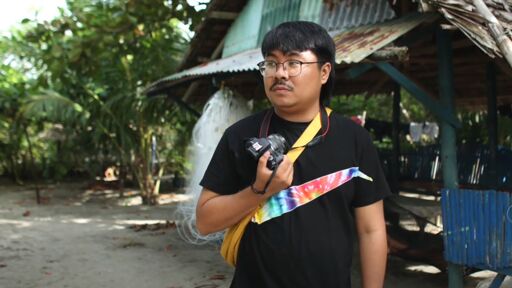
But, in the same breath, there is also a strength in the symbols that our comrades become and live on to be—symbols of inertia but also movement, of loss but also triumph. Symbols of truth and freedom.
By Claire Michaela Obejas
I have turned to fixating on outings with my friends to cope with the grief, perhaps in the juvenile hope that the escapist nature of my petty bourgeois life would ease the pain. I initially pushed myself into political work, writing for new and old campaigns my comrades were killed for advancing. But because of my limited capacity as a blind person, I still found myself in the center of lulls with only my spiraling thoughts and fraught emotions to accompany me.
My thoughts constantly turn to RJ Ledesma, one of the 19 individuals killed in the Negros 19 massacre on April 19 in Toboso, Negros Occidental.
The Armed Forces of the Philippines (AFP) claimed that RJ and the 8 other civilians, including a farmer, a student leader, minors, peasant organizers, and Filipino-American activists, were guerrilla fighters of the revolutionary New People’s Army (NPA), a claim that the Communist Party of the Philippines (CPP) has since debunked with the confirmation that only a small unit of the NPA Red fighters were involved. This was also independently verified by human rights organizations who stated that the nine civilians were conducting field work, community immersion, and research into the conditions of farmworkers in the area and in Negros Island as a whole. For decades, peasants and farmworkers in Negros have been suffering under exploitative working conditions, extreme hunger, poverty, and land grabbing in the hands of private corporations, big landlords, and land monopolies.
But even without the confirmation from the CPP, we can come to the conclusion that the AFP would target unarmed civilians by paying enough attention to their inconsistencies. With the fascist state ramping up its counterinsurgency programs, violations to the international humanitarian law have become the norm in the countryside.
RJ was a journalist who dedicated his life to documenting these violations, keeping the oppressed and marginalized in the headlines. As a child of Negros Occidental, this was the backdrop of the environment he grew up in.
I do not claim to have known him at a personal level, but we were colleagues in Altermidya, a network of alternative and independent media organizations that the fascist state has been targeting for our critical reporting. He was an editor of Paghimutad, the media outfit covering Negros Island, and I was the editor for Aninaw Productions reporting about Central Visayas. We each represented our regions during online meetings and workshops. The pandemic was in full swing and everything was online. There was a level of kinship and, most importantly, comradeship in working with your counterpart, however minimally.
But more than the shock of his death was the surprise of discovering the person that he was all that time—someone with so many parallels to my own life.
I only found out after his passing that RJ was a psychology graduate like me, though a few years older and from a different school. He was a poet and a brilliant creative writer, a part of the literary community like I was. He was even a fellow at the prestigious Silliman University Creative Writers’ Workshop, a notoriously hard workshop to be accepted in. I don’t have such a distinguished background in creative writing, but I was involved in literary spaces as a creative non-fiction writer, joining workshops of my own in Cebu. We were also both editors in our respective student publications in college.
Then, of course, we were both activists in the anti-imperialist, anti-fascist mass movement. He even served as the seventh nominee of Kabataan Partylist during one election. The highest position I served while in the youth sector was as vice president for Visayas of the tertiary student publication alliance College Editors Guild of the Philippines (CEGP).
I read in one of the tributes about him that he was a writer for cause-oriented organizations, a journalist, a cultural worker, a community organizer, and the occasional mass leader, all roles I have also filled.
We were similar in so many ways, except that he was brave enough to take the chances I didn’t.
RJ overcame his contradictions and went into full-time organizing. We petty bourgeois activists are always pulled between choosing the comfortable life and the road less traveled, the road that leads to one giving all their time to serving the people. A decision like that must not have come lightly with all the opportunities I imagine he had in life.
I wish that I had known him and had known him enough to have asked him how he overcame the resistance that must have come from his family regarding his activism. Maybe if I had known the answer to this, I wouldn’t have been such a coward and actually struggled with my family about my work.
This was always my weakness. My political will weakened in the face of my parents’ disapproval, which created a tenuous and strained relationship with them for a long while, arguing constantly about my choices. I knew it came from a place of love and concern for my safety, but I still turned somewhat bitter from all my attempts at struggling with them and instead of being productive and trying to sincerely connect with them, I folded in on myself and shut them out. I became too prideful and made an effort to keep my family away from my work, an inextricable part of my life, just as much a part of me as they were.
I still continued my work despite this, just in secrecy, the burden of my subterfuge constantly weighing me down. I was so effective in hiding this entire part of my life that my family never met any of my comrades in Cebu until the different organizations and communities I’ve been a part of over the years, alongside my friends, came together to launch a fundraising campaign for me when I was fighting for my life in the ICU in 2023.
One of the fundraising efforts was a benefit gig that my brother, my aunts, and my uncles attended. The many attendees who either performed a song or a poem and the solidarity speeches from different organizations and sectors had been a surprise for them. The Claire Obejas they were hearing about in those moments seemed an entirely different person from the Kakay they raised.
I want to believe I’ve done a lot despite these restrictions, but I wasn’t in a position to truly go all the way in my work, having been organized as a student still under my family’s care and even more so as a lupus patient who couldn’t do much over the course of the pandemic. I threw myself into everything I could do online instead, acting as the go-to support person for many organizations and providing necessary logistics and liaison work for ground organizers.
I don’t mean to discredit all that I’ve done. In the seven years I was actively organizing before I went blind in 2023, including the time I went digital, I had reestablished a provincial chapter of a student publication alliance, revived a magazine of a labor advocacy organization, became head editor of an alternative media outfit, produced eight news packages for our bi-weekly broadcast, helped reconvene a chapter of a national organization of Filipino journalists, and wrote materials for countless campaigns.
I did many things that I was told were invaluable contributions, but there was always that guilt of only being behind a computer screen and not actually present as an additional warm body at a strike or a barricade, or a visitor to the hundreds of political prisoners, many of whom were my own friends. Or even just as a delegate to a humanitarian mission to militarized communities. Instead, I was the guy in the back. There’s relative safety in being far from the frontlines.
I often think of the kind of contradictions RJ must have grappled with. To some degree, I know what it takes to overcome them.
After I graduated in 2019, I’d made a genuine attempt to become a full-time organizer in the labor sector. I was still limited because of my illness and all that came with it, but I persevered and was truly on the way. It was not an easy road, especially as community organizing is not at all a lucrative undertaking, but I chose it and kept choosing it.
But then I was stuck in the pandemic and eventually had to leave Cebu to live with my parents in their hometown. I tried to keep going as much as I could with what little capacity I had, but it never felt enough for me.
I was gone from Cebu for a long time. And now I’m thinking of RJ and wondering: if we were on the same path and walked the same roads, at which point had I turned right instead of the left he took? And if I had taken that left, would I have been half as good as he was?
I don’t mean to make his death all about me, but I think that this is what’s haunting me, the reason I’ve been tearing up during the day while my newborn niece cries in my arms. Sometimes sitting alone at the dining table, staring unseeingly through the cup of cooling chai,the silence around the house severe.
There is a regret in never having met him in person because I wasn’t brave enough to overcome my limitations, wasn’t brave enough to even just travel outside Cebu to work with those in other nearby regions.
There is also some kind of survivor’s guilt in being the one to only write about his death and not have stood with him reporting the marginalized on-ground, covering the stories that corporate media has historically left unreported or underreported.
There is a kind of guilt in feeling like you were not brave enough. It is not the dialectical approach to such a sentiment and very much contrary to the Marxist philosophy that we’re all trying to live by, but still entirely human. One more contradiction to grapple with.
And I think this is a sensation that many activists feel upon the state-perpetrated killings of our comrades—to be the ones who survived, standing in the rubble. The thread of solidarity breaks and the feeling of having abandoned them lingers, however illogical that feeling may be.
There is a sensation like a phantom limb when we bury our comrades, our friends. There is a weight, a grief, that we will carry for the rest of our lives. These are undeniable realities.
But, in the same breath, there is also a strength in the symbols that our comrades become and live on to be—symbols of inertia but also movement, of loss but also triumph. Symbols of truth and freedom.
Our comrades, even in their deaths, show us the possibilities that come with finding the strength to overcome our contradictions and choosing to fight every single day. There is power in waking up each day and taking on the path to dismantle an oppressive system and building a world where injustices like the Negros 19 massacre don’t happen, where the government is not corrupt, and where the Filipino masses can live a dignified life with a living wage, land, affordable healthcare, and accessible education.
There is strength in remembering our martyrs. There is victory in continuing on in their name.
Despite the grief and depression of losing my vision, I began writing again for labor campaigns in the second half of 2025, and I’m writing again now on the anti-imperialist front. I still struggle with many contradictions, with my family and my health, especially now deafblind as I am.
But I think of RJ and the vibrant, passionate life he lived parallel to mine, a life that, in many ways, he continues to live now through me and all who fight alongside the oppressed. We carry our dead with us wherever we go and in whatever we do. And in order for us to truly keep them alive in the struggle for liberation, we must continue the work they left behind, pick up where they left off, and seek justice for them by advancing the national democratic aspirations of the people, even through whatever limitations there may be.
I hope to embody the revolutionary fervor of RJ and the others, the spirit that enabled them to find themselves among the oppressed and exploited masses.
In the midst of all this mourning, I have remembered to turn to my comrades in an effort to honor the collective life we’re creating for the world we’re building.
At one point, I called a friend who was really struggling with grief. They had to leave work to cry in the parking lot while I was on the phone with them. Through tears, they lamented, “Why is it always the best people?”
We both knew the answer, of course. Our beloved martyrs wouldn’t have found themselves in areas where peace is a reality only afforded to those with power, in places shrouded in injustice, if they weren’t good people.
They wouldn’t have chosen to go where they were needed the most if they didn’t believe that with solidarity and the strength of our collective action, we would one day be free.
ABOUT THE AUTHOR: Claire Michaela Obejas is the former head editor of Cebu-based alternative media organization Aninaw Productions. Though born in Leyte, she was raised in Cebu City from the age of 7 and considers it home. She has been living with lupus since 2012.
The post Left turn appeared first on Bulatlat.
From Bulatlat via This RSS Feed.