


The works of art in this dossier are from Casa de las Américas’ Arte de Nuestra América Haydée Santamaría (Haydée Santamaría Art of Our America) collection. Since its founding in 1959 in the wake of the Cuban Revolution, Casa de las Américas has served as a key platform for anti-imperialist cultural internationalism, building close ties with renowned artists, writers, intellectuals, and political activists. Casa’s galleries have hosted exhibitions across a wide range of genres, disciplines, and techniques by generations of mainly Latin American and Caribbean artists. Many of these works were first exhibited in Casa’s galleries, won prizes in its contests, or were donated by the artists. They have since become part of the collection, forming an exceptional artistic heritage.
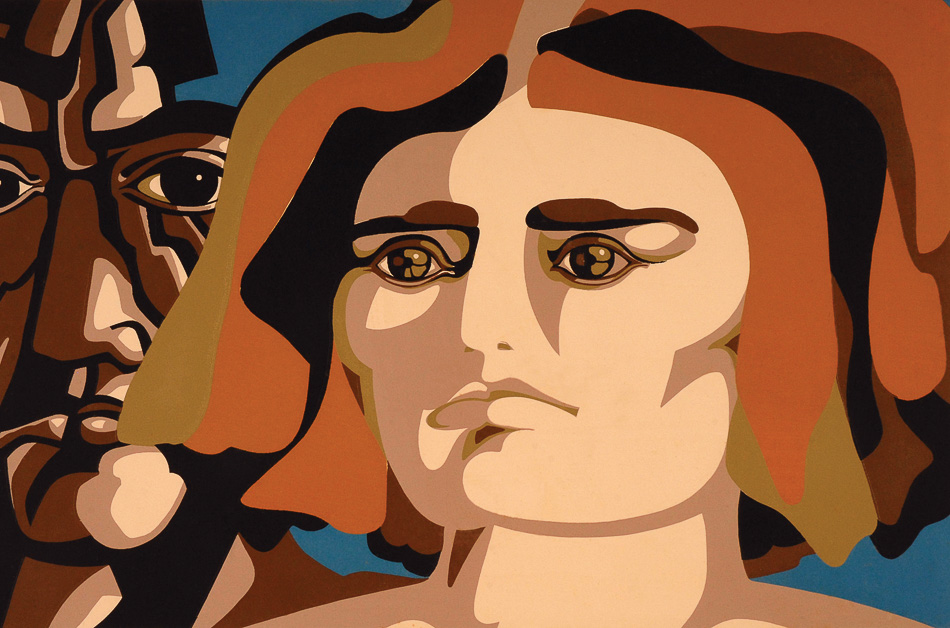
José Venturelli (Chile), Serigrafía (Serigraph), 1970, edition 15/90. 260 x 430 mm.
Each month, for the past hundred months, our team at Tricontinental: Institute for Social Research has researched, written, and designed a dossier. These dossiers – which range from histories of imperialism and national liberation to analyses of economic policy, sovereignty, war, and the changing world order – have circulated around the world in many languages, from English, Hindi, and Portuguese to Arabic, Thai, and Spanish.1 This is our 100th dossier, which is why we decided to pause and produce a historical-materialist account of a key concept at our institute: the future.
When our institute was conceptualised in 2015, we had three main lines of inquiry before us:
- To better understand contemporary capitalism and the nature of the class struggle that shapes it.
- To better understand the rise of what we call the far right of a special type.2
- To better understand the future – or what comes next.
This third line of inquiry emerged from a materialist understanding of the historical process, which sees the present not as an eternal reality but as open to transformation. In other words, the present can be shaped into a future of a different character. The capitalist system that we inhabit is not permanent: it can be transformed into a socialist system through the class struggle and the development of the productive forces.
Here, for the first time, we present a philosophical and political assessment of the future. Drawing on the tradition of national liberation Marxism, we argue that this future should be called not only socialism, the objective, but also hope, the sensibility for such a future.3
We trust that you will read this dossier as you have read the previous ninety-nine and that you will share, debate, and discuss it collectively in reading circles and other spaces of political study. We are always open to your feedback.
Every language in the world has a word for ‘future’, the time that comes after the present. For instance, in the most widely spoken languages in the world, these are some of the words for future:
English: future, the time that has not yet happened.
Mandarin Chinese: wèilái (未来), what has not yet come.
Hindi: bhavishya (भविष्य), that which is to be or become.
Spanish: futuro, the time yet to come.
French: avenir, that which is to come.
Arabic: mustaqbal (مستقبل), that which is to be faced.
Bengali: bhobishyot (ভবিষ্যৎ), that which is yet to be or become.
Portuguese: futuro, the time yet to come.
Russian: budushchee (будущее), that which will be.
Urdu: mustaqbil (مستقبل), that which is to be met or faced.
These words do not all imply the same thing; they have different cultural orientations toward change. Some of them are about the empty calendar, the idea that there is a tomorrow just as there is a today, while others are about the encounters that will take place and must be faced. It is important to recognise that even as you read a text such as this – written in one language, translated into several – the word ‘future’ carries a range of meanings that cannot be fully carried from one language into another. Even though these words have different orientations toward what comes next, there are questions we can ask in every language spoken in capitalist civilisation: does the future exist, or are we living in what capitalist realism assures us is a permanent present?4 Is there really a tomorrow that could be different from today?
Such questions are essential for our moment as we struggle to make sense of the climate catastrophe and climate apartheid, permanent war and endless genocide, and the dictatorship of finance capital and the normalisation of austerity.5 Decades of capitalist realism have befogged our consciousness, preventing us from imagining anything beyond global catastrophe.
Is there a future? Of course there is. We are fighting to build it, and we are building it now.

Emilio Pettoruti (Argentina), Pájaro rojo (Red Bird), 1959. Oil on canvas, 116 x 63 cm.
Part 1: Rupture
In the dominant language of power, the future is presented as a neutral extension of the present. It is measured in calendars, projected in growth curves, and managed through forecasts. The future, in this perspective, is not something to be fought for but something to be waited for. It arrives automatically, like the next page in a ledger. This conception of the future is profoundly conservative. It assumes that the structures of exploitation, hierarchy, and domination that define the present will simply be optimised rather than overturned. Such a view of the future is reproduced by all the major institutions of capitalist society – such as the media, schools, universities, think tanks, and philanthropic foundations – which insist on empty slogans about change but in fact preach the gospel that ‘there is no alternative’ to the capitalist system that throttles us.
In our perspective, the future is not a date on the calendar. It is a rupture with the existing order, a structural transformation of social relations, political power, and human possibility. To speak of the future in this way is not to indulge in fantasy but to reclaim a dimension of politics that has been deliberately suppressed: the capacity to imagine and build a world fundamentally different from the one that we inhabit, one that the socialist and national liberation projects of the twentieth and twenty-first centuries have sought to build and, however unevenly, began to realise. Such a view rejects the ideas of managed continuity (reformism) and unplanned breakdown (catastrophism). The ruling class produces a set of false futures: myths of entrepreneurship, green capitalism, and militarised security – but nothing that has any emancipatory content.
The ground for this idea of the future was developed by the Marxist philosopher Ernst Bloch with his notion of the ‘Not-Yet’ (Noch-Nicht).6 For Bloch, drawing directly from the writings of Marx, the future is not an abstraction deferred to tomorrow but an active force that is embedded within the present, struggling to emerge from within its constraints. For Bloch, reality is unfinished, which put him at odds with philosophical currents that treat the world as closed, completed, or already fully explained. He insisted that the present is permeated by tendencies, desires, and contradictions that point beyond it. The Not-Yet is not a utopia that floats above history but a latent potential contained within material conditions and collective struggle. This Not-Yet can be grasped in the dreams of the anti-colonial struggles that found programmatic expression in the final communiqué of the Bandung Conference (1955), the Belgrade declaration of the Non-Aligned Movement Summit (1961), the resolutions of the Tricontinental Conference (1966), and the declaration on the New International Economic Order adopted by the United Nations General Assembly (1974). It can also be seen in the revolutionary processes opened by the October Revolution (1917), the Vietnamese Revolution (1945), the Chinese Revolution (1949), and the Cuban Revolution (1959).7
In this Marxist tradition, the future is not inevitable. This view rests on two materialist propositions that emerge from the contradictions of the capitalist system.
First, the actual movement of history develops the productive forces and expands the social surplus. But because these developments remain constrained by private property, they also deepen inequality and social suffering for the vast majority. It is important to recognise that the productive forces today are not limited to factories and machinery. They also include care work, digital infrastructures, and global supply chains, for instance, all of which are organised through increasingly socialised labour. It is also key to note that capitalism both develops these forces and sabotages their potential, keeping them in check through private ownership, uberised platform monopolies, union busting, austerity, militarisation, and other forms of capitalist control.
Second, the social suffering inherent to capitalism generates indignity and anger, which can spontaneously erupt into revolt. But such struggles do not automatically move in an emancipatory direction: they are shaped by political forces either towards socialism, by advancing people’s concrete demands, or against it, by distorting those demands and turning people against each other through a toxic, anti-social agenda.8 The future, therefore, is not something that happens to us but something we must build, and we can only build it by breaking with the structures that produce and reproduce suffering. Such a view breaks with fatalism and inevitability and reminds us that history is open and that the present contains unrealised possibilities that can be activated through struggle.
Hope in this tradition is not optimism or passive expectation but a militant orientation towards the unfinished character of the world. It emerges from immiseration, oppression, and dispossession, and from the refusal to accept misery as destiny. For the movements in the Global South that guide our institute’s work, hope has never been a luxury. It has been forged in a range of movements and organisations led by peasants, workers, and women that are collective efforts to advance the cause of dignity.9 These movements do not fight for a better version of the present but for a different social order altogether. Their future is not calendrical but rooted in structural transformation. To hope is to recognise that the present is intolerable and impermanent and that the conditions of exploitation and oppression are neither natural nor final. This hope is dangerous to the ruling class because it is a material force that transforms consciousness, shifting people from enduring the present to acting for the future.
In this tradition of rupture, the future is not an individual creation: it has a collective character. Capitalist culture encourages us to imagine personal futures – a career, a home, personal security, and the endless project of ‘self-improvement’ – while foreclosing collective horizons. This culture is one of personal anxiety rather than collective responsibility or social transformation. Under capitalism, the calendrical future is treated as administrable – as something to be forecast, scheduled, priced, secured, and managed by institutions that present themselves as neutral. Their decisions are presented as technical necessities rather than political choices, as matters to be regulated on our behalf by experts, markets, states, and security apparatuses. These institutions do not offer an emancipatory horizon, only the managed continuation of catastrophe. The far right of a special type emerges in this terrain to offer a mythic future rooted in exclusion, hierarchy, and violence; it is a symptom of capitalism’s inability to generate a positive future.10 The future cannot be built by this far right; it must be reclaimed as a space of popular sovereignty. Neither catastrophe nor emancipation is inevitable. The former must be fought against, and the latter fought for. From the perspective of rupture, or structural transformation, the instrument is not personal advancement but organised forces capable of confronting entrenched power, such as political parties, trade unions, and social movements. Without these forces the Not-Yet will remain a dream without a pathway. Hope requires structure, discipline, and persistence.
The future is not something that lies outside of human history. It is already present in fragments, gestures, and struggles that prefigure another world. These include cooperative forms of labour, practices of care, experiments in popular democracy, and the unfinished and contested processes of socialist construction in states such as China and Cuba.11 These are not marginal curiosities; they are anticipations of a different social logic. To chart them is not to romanticise them but to understand their significance and their latent potential. They remind us that the world we seek to build is not an abstract horizon but a concrete possibility. The task for a Marxist is not to predict the future but to organise for it. To break with the present requires clarity, courage, and collective discipline. The future can only arrive if we force a rupture. It is therefore a terrain of struggle. To fight for it requires that we identify the forces that seek to foreclose it.
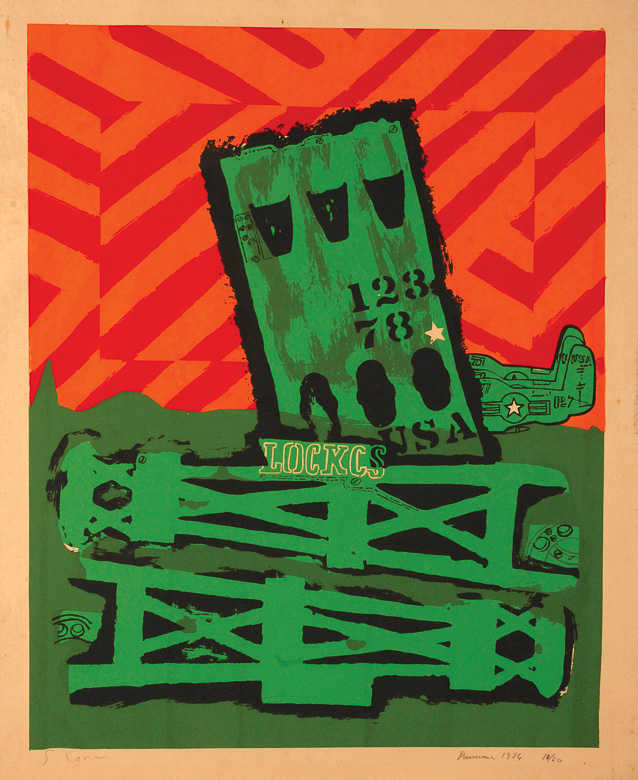
Silvano Lora (Dominican Republic), Serigrafía (Serigraph), 1976, edition 18/60. 640 x 570 mm.
The Enemies of the Future
The future is not an empty horizon that waits to be filled by human aspiration. It is actively planned, structured, and constrained by powerful forces that seek to reproduce the existing relations of domination. The enemies of the future are not abstract tendencies: they are concrete forces determined to extend the present order into the future.12 Below we look at four central enemies of the future: finance capital, platform capital, extractivism, and militarism. These forces do not merely defend the social relations of the present – they seek to colonise the future in advance.
Finance capital sits at the centre of this constellation. Through its control over the proceeds of colonialism and neocolonialism, investment flows, the magic of speculation, and the power of debt, finance capital disciplines states and societies, narrowing the range of their possible futures.13 Credit rating agencies, multilateral lenders, and private financial institutions – mostly located in the Global North – function as planners of the future for the Northern ruling class, ensuring that tomorrow remains hospitable to capital accumulation rather than to human flourishing. The dictates of the International Monetary Fund (IMF), World Bank, World Trade Organisation, and myriad other institutions become a material reality for so many debt-ridden formerly colonised countries.14
Platform capital. Capitalist technology monopolies channel innovation and efficiency into data extraction, the reorganisation of labour, and the fragmentation of social life. Algorithms manage time, attention, and desire while platform labour strips workers of stability and collective power.15
Extractivism. Despite overwhelming scientific evidence of ecological catastrophe, the conglomerates of oil, gas, coal, mining, and agribusiness continue to shape energy systems, labour markets, and state policy. Their planning horizon is brutally short: extract, profit, abandon. The climate crisis, for instance, is not a failure of foresight but the result of deliberate decisions by capitalist corporations that accept planetary destruction as an acceptable cost of accumulation.16
Militarism. The crises produced and intensified by the capitalist system – war, displacement, and climate catastrophe – are met not with social and political solutions but with a permanent war economy that enforces military solutions to political problems. In the imperial centres, militarism appears in the form of arms accumulation, border regimes, surveillance, and the normalisation of emergency rule. In the Global South, it appears as imperialist aggression, proxy warfare, occupation, and the forced diversion of scarce public resources into armies and security infrastructures, always to the benefit of the arms industry. Militarism shortens political horizons: emergencies justify authoritarian measures, suppress dissent, and normalise fear. For large sections of humanity, especially in the Global South, the future appears not as a promise but as permanent instability, displacement, and death. War becomes a mechanism to manage crises produced by capitalism itself.17
These enemies of the future do not simply block social transformation: they actively manufacture a future that secures privileges for a few while condemning the many to exhaustion, insecurity, and despair. The future cannot be reclaimed without a frontal challenge to their power.
The Social Forces Poised to Make the Rupture
Since the propertied classes insist on the permanent present, the future can only be reclaimed through collective mass struggle. The social forces capable of bringing about a rupture with the present order are already here, although they are fragmented, uneven, and often rendered invisible. They include workers in both the formal and informal economy, peasants and landless agricultural workers, women, youth, oppressed communities, and what Marx called the ‘surplus population’ – those excluded or marginalised by the cycles of capitalist accumulation but still indispensable to it as a reserve army of labour and as part of the forces of social reproduction.18
Despite all the talk of ‘post-Marxism’ and newer theories of fragmented political subjects, the working class – both urban and rural – remains central, although its composition has certainly changed. Various reports from the International Labour Organisation and World Bank suggest that the total global labour force amounts to nearly 4 billion people (including those who are employed and are actively seeking employment). A rough breakdown of global employment by broad sector is as follows:
- Agriculture / 923 million
- Industry / 800 million
- Services / 8 billion
- Transport/Logistics / 230 million
- Platform workers / 154–435 million19
Industrial workers coexist with service, transport, warehouse, care, delivery, and platform (or uberised) workers. In most of the Global South, informal labour is not an exception but the norm. These workers – whether in the factory, field, or warehouse – face extreme precarity, weak or non-existent legal protections, and the constant threat of unemployment. Yet, despite the attrition of union density, these workers possess strategic power: they produce and transport goods, work the land, mine the earth, provide care, build cities, and sustain everyday life. Their struggles – from strikes in logistics hubs to mass rebellions by landless workers to walkouts by domestic workers – reveal the continued antagonism between capital and labour.
Struggles do not always emerge straightforwardly as labour organising consciously against capital. They often appear through other structures of oppression, such as patriarchy and social hierarchy (caste, race) or are galvanised by generational experience and other social formations. For instance, women’s movements have exposed how economic systems rely on the exhaustion of bodies and time, particularly those of women in general and those of Black, migrant, and racialised working-class women in particular. Likewise, struggles for social dignity are refracted through identities that are not themselves class-based but that reveal the complex way in which capitalism reactivates old hierarchies for its own strategies of accumulation: caste and race, for instance, are mobilised by the capitalist system in the service of accumulation, and so protests for dignity also create bases for socialist struggle. The surplus population – migrants, the unemployed, landless peasants, and urban poor – are often treated as politically marginal, yet they experience the capitalist system in its most naked form. Their struggles for housing, services, and dignity are struggles to reproduce life. These many struggles show the energy available within the working class to form a historic bloc against capitalism and fight for the future.
However, many of the protests that rattle our cities and countrysides come in the form of large mobilisations that are often shaped by small organisations or driven by social media calls to individuals. Capital thrives on division: formal versus informal, urban versus rural, man versus woman and gender dissident, citizen versus migrant.20 Today, fragmented class structure and social organisation pose major challenges for political organisation and principled unity of action. There are many examples of this mobilised anger being captured by reactionary forces or dissipated into despair. A rupture requires building unity without erasing difference, forging political projects that can articulate shared interests and common horizons. Without such organisation, social forces remain reactive. With it, they become historical agents capable of making the future their own. The genuine organisational question for the left across the world is how to build the subjective platforms of struggle out of the objective conditions of suffering and survival faced by the people.
Time
Capitalism imposes its idea of time on societies – one that reflects urgency without direction, speed without purpose, crisis without resolution. There is a frenetic sense that overtakes social life, disrupting our ability to control our day and creating disorder that eats into our leisure time. Without leisure, the time for building community is not easily available (although the fraying of social policy at the state level has forced working-class women to build platforms for social reproduction that have been vital for their role in so many protest movements of the working class in our time). Without time, it is impossible to build organisational power in workplaces, neighbourhoods, and communities.
The contradictions of capitalism generate spontaneous struggles, which are often sparked by low wages and poor working conditions, but also the conditions of social reproduction such as access to water, public space, and affordable food and fuel. Such struggles are sometimes based on social networks and relationships established over time, but they can also emerge from a rapid deterioration of working and living standards that generate their own mass sentiment. These spontaneous uprisings – while often heroic – are insufficient; they can disrupt the present without disciplined organisation, but they rarely reshape the future. The examples of major revolutions are all stories of resilient revolutionary activity over long periods of time that prepared communities through struggle for the great upsurges that turned the world upside down. Spontaneous struggles reflect genuine anger and grievances. They can occupy streets and inspire hope, and they can also topple governments. Yet the historical record (such as Egypt in 2011) shows that without organisational continuity and strength, these moments are vulnerable to repression, co-optation, and exhaustion. The propertied classes understand time strategically. They plan, often by decades. Movements that operate only in the immediacy of protest surrender the long-term terrain to their enemies.
Organisation
To build beyond immediacy requires organisation, which can take many forms – from more amorphous social movements to democratic-centralist Leninist parties. The debate between these two forms is not central to this dossier. Our point here is the importance of how political organisation – in its many forms – is a vehicle through which time is structured for emancipatory ends. Parties, fronts, trade unions, peasant organisations, women’s associations, and youth movements each play distinct but interconnected roles. Parties of a Leninist type can articulate long-term programmes and contest state power. Mass organisations can anchor struggles in everyday life and provide continuity for communities. Fronts can enable unity among diverse forces without demanding ideological uniformity. Organisation allows the fragmented and harassed working class to socialise what time is available to it and to build a society that has otherwise been stolen from them.
Discipline
The advantage of a Leninist party is the centrality afforded to discipline within that tradition. Discipline does not mean obedience or bureaucratic rigidity, although it can often collapse lazily into these forms. It means building cadre who are politically educated and understand the necessity of the party form, the collective procedures required to build a common political understanding or programme, the essential structures of representational leadership within the party, and an absolute commitment to shared goals, strategies, and forms of accountability. Discipline allows organisations to conserve energy, learn from experience, and endure beyond moments of crisis. It transforms revolt into a project.
Central to this entire operation is what we call the new intellectuals, the permanent persuaders of a political project who emerge from the working class, peasantry, and popular movements.21 Their task is to clarify, synthesise, and communicate – to translate lived experience into political strategy. They help movements understand not only what they are fighting against, but what the future must entail.
Internationalism
No rupture with capitalism can be sustained within national borders alone. Capital organises itself internationally, through finance, trade, military blocs, supply chains, and ideological institutions. The forces that seek to build the future must do the same. Internationalism is not a moral add-on or a gesture of sentiment, but a practical necessity rooted in the structure of the world economy and in the shared condition of the oppressed. It means building ties across countries and struggles, learning from revolutionary processes, defending sovereignty against imperialism, and coordinating political education, campaigns, and forms of material solidarity. Without internationalism, victories remain isolated and vulnerable. With it, struggles at the local, national, and regional levels begin to acquire the scale necessary to confront a global system.
The future cannot be seized in a single moment. It must be built patiently, collectively, and consciously. Time creates the space for struggle, organisation gives it form, discipline gives it endurance, and internationalism gives it scale. Against the ruling class’s planned future of exploitation and exclusion, these tools allow the oppressed to plan their own future – one grounded in dignity, equality, and life itself.
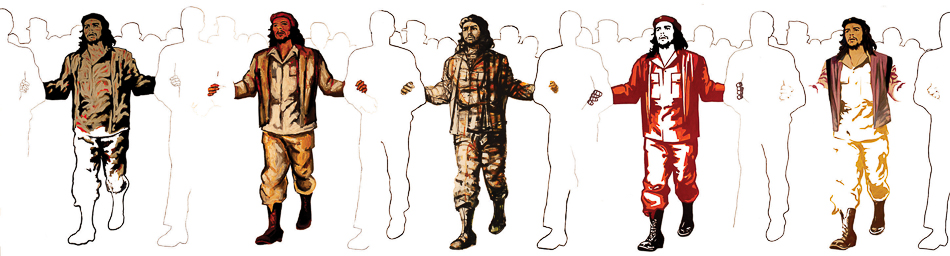
Alfredo Plank, Ignacio Colombres, Carlos Sessano, Juan Manuel Sánchez, and Nani Capurro (Argentina), Che (collective series), 1968. Oil on canvas, 195 x 150 cm each.
Part 2: Building the Future
What must be built to replace the present? The future cannot remain only a matter of struggle, organisation, and discipline; it must also take material, institutional, and international form. That means confronting the questions of ownership, planning, sovereignty, and the forms of coordination through which a different social order can be sustained.
Public Ownership and Planning
The question of the future is inseparable from the question of ownership and coordination. Under capitalism, private ownership of the means of production gives a small class the power to determine what is produced, how it is produced, and for whom it is produced. This power is exercised not in the interest of society as a whole but according to the imperatives of profit, competition, and short-term accumulation. The result is a deep contradiction: the productive forces have become profoundly socialised while control over them remains narrowly private. Labour today is already collective and international, but the technological base and economic surpluses of this collective effort are appropriated by a minority. Any serious discussion of a socialist future must therefore confront this contradiction by transforming property relations.
Public ownership is not simply a legal rearrangement of assets from private hands to the state. The state itself is a field of class struggle and must be claimed as a tool to guide the direction of development. When strategic sectors such as energy, transport, finance, land, communications, and heavy industry are publicly owned, society gains the capacity to steer production and innovation towards collective needs rather than private accumulation. Capitalism systematically misallocates resources, overproducing luxury consumption and destructive industries while underproducing care, education, health, and housing. Public ownership creates the material basis to reorient production towards social reproduction, long-term investment, and shared prosperity.
The argument for public ownership is also related to technology. Under private ownership, technological development is subordinated to profitability, intellectual property monopolies, and labour discipline. Innovation is directed towards cost-cutting, surveillance, militarisation, and the enclosure of knowledge rather than towards reducing socially necessary labour time or improving collective well-being. Democratic control over the forces of production allows technology to be deployed for the social good: to shorten the working day, generate employment, expand public services, augment human skills, and reduce ecological harm. The same digital and logistical systems that capitalism uses to intensify exploitation contain within them the potential for rational and humane production and distribution.
Capitalist ideology presents planning as inherently authoritarian and inefficient while elevating the market as a neutral and democratic mechanism of coordination. Capitalism is already highly planned – but it is planned in the interests of capitalists. Multinational corporations, financial institutions, and military alliances engage in extensive internal planning, long-term forecasting, and strategic coordination. The market does not replace planning: it fragments social decision-making, obscures responsibility, and subjects collective life to the narrow logic of accumulation. Prices transmit signals only after social and ecological damage has already occurred. Markets reward short-term profitability, not long-term social rationality.
Socialist planning is not about bureaucratic command divorced from popular life: it is about conscious, democratic coordination of social labour across time. Planning is a temporal weapon against capitalist short-termism. It allows society to set collective priorities – such as decarbonisation, industrial diversification, food sovereignty, and universal care – and mobilise resources accordingly. It makes it possible to balance regions, sectors, and social needs rather than leaving development to the uneven and destructive outcomes of market competition. Planning is the means by which society can act on the understanding that the future is not automatic but must be consciously produced.
Crucially, planning does not negate democracy; rather, it demands its expansion. For planning to be emancipatory, it must be rooted in popular participation, worker control, and mass organisations capable of articulating social needs. The socialisation of labour under capitalism already requires coordination across vast networks; socialism seeks to make this coordination transparent, accountable, and oriented toward human development. When workers, communities, and public institutions participate in setting goals and monitoring outcomes, planning becomes a collective learning process rather than a technocratic imposition. It is through such processes that the social surplus can be consciously directed toward education, health, housing, culture, and ecological restoration.22
Toward a New Internationalism
In the aftermath of the Second World War, the rise of a powerful socialist bloc and successive waves of decolonisation laid the grounds for an internationalism rooted in the rejection of imperialism and neocolonialism. It was marked by an attempt to build new economic and social models, as well as a new global architecture.23
This internationalism collapsed under the debt crisis, the assault of neoliberalism, and the fall of the Soviet Union and the socialist bloc. In its place came the spurious globalisation imposed by the IMF – the opening up of markets, withdrawal of the state from productive sectors, removal of capital controls, surrender of resources, and academic and cultural subordination – a comprehensive erosion of sovereignty.
Decades after the fall of the Soviet Union, the objective conditions are emerging for the rise of a new internationalism. The Global North is undergoing a profound crisis marked by deindustrialisation and the erosion of productive capacity, even as China and other Global South countries emerge as the engines of the global economy. The rise of BRICS, the Shanghai Cooperation Organisation, and other bilateral forums reflects these changing objective conditions.
However, the Global North retains control over the global architecture. The UN and its agencies have been rendered useless by the US and its allies as demonstrated by their escalated assaults across the world, ranging from Gaza, Venezuela, and Cuba to the Democratic Republic of the Congo and Iran. The IMF and the World Bank continue with the tyranny of structural adjustment. The climate framework has failed the people. The pandemic brought with it ‘vaccine apartheid’. Worse, many multilateral organisations of the Global South are inert or infected with the logic of neoliberalism.
Debates around a new global architecture have focused on multipolarity, which is limited and limiting as it replicates the spirit of Cold War rivalry. Instead, the new internationalism must be characterised by multilateralism. Reclaiming the United Nations and upholding the UN Charter as the common heritage of the peoples of the world are key planks here. Both the Security Council and General Assembly require reform, and the countries of the Global South must work towards a common agenda for a host of UN agencies, from the World Health Organisation and the UN Framework Convention on Climate Change to the UN Conference on Trade and Development. There is a dire need for renewed intellectual and political struggle to frame and advocate a people’s programme for each of these organisations that reflects the aspirations of the Global South.
Alongside a renewed multilateralism, left and patriotic forces must support and strengthen regional organisations that have lost their orientation in the past thirty years and, in cases where that is not possible, advocate for new ones. The economic, social, and political alliances that were formed in Latin America during the Pink Tide of the 2000s and early 2010s remain a model for what is possible. In contemporary times, the Alliance of Sahel States has captured a powerful desire across Africa for stronger integration while resisting the neocolonial logic of ECOWAS (Economic Community of West African States).24 The processes launched by BRICS across a variety of areas – from finance, trade, and infrastructure to science, technology, health, education, agriculture, climate cooperation, and research – provide another model for such regional organisations.
The new internationalism begins with a defence of sovereignty but does not end there. It must also incorporate an internationalist vision of a future based on transformed social relations. This vision cannot be realised in one country alone – nor can it be championed by states alone. It requires the mobilisation of movements across the world to transcend capitalism. Socialists must build bridgeheads to the future by elevating, learning from, and building on projects that have the potential to change the balance of forces.
Yet no programme, however necessary, can sustain itself without a social force capable of carrying it forward and a horizon capable of animating struggle. If the future must be built through institutions, ownership, planning, and international coordination, it must also be lived as a political sensibility. That sensibility is hope.

Luis González Palma (Guatemala), La Rosa (The Rose), 1991. Gelatin silver print with toning and applied colour, 47 x 48.5 cm.
Part 3: Hope
Today, capitalism is undergoing a crisis of legitimacy as its ideas and values – individualism, entrepreneurship, consumerism – no longer deliver the social mobility and material prosperity long promised by neoliberalism. At the same time, as the US-led imperialist bloc is seeing its power decline – economically and politically – it doubles down on the two arenas where that power remains largely uncontested: cultural production and military power. Though vastly different in their expressions, both serve the same purpose: to preserve the present and foreclose the future. Through military aggression, the US-led bloc seeks to discipline any country that refuses to bend to the Washington Consensus and the interests of private capital, closing off any political horizon that rejects subordination. Through its monopoly over the modes of cultural production, it seeks not only to control information – what is accepted as truth – but also to shape the culture and values of the dominated masses. In doing so, it narrows the horizon of what we dare to imagine and, ultimately, what we dare to hope. In the absence of hope, the working class is thus compelled into one of two political subjects: either pushed to the ruthless pessimism of the far right and trained to look with derision at the very idea of a different future or ruled by an escapist defeatism that believes the future is already lost.
Two Chinese concepts of ‘future’ help clarify what is at stake here. ‘未来’ (wèilái), the word for future or, literally, ‘what has not yet come’, is made up of two words: 未 (wèi) means ‘not yet’ or ‘has not’ and 来 (lái) means ‘to come’ or ‘to arrive’. Together, they emphasise the future’s essential quality of incompleteness, and pessimism and hope turn on this difference: the future is not predetermined. It is a possibility, and this is where human action comes in.
In this context, hope becomes a terrain of struggle in the battle of ideas and emotions. This is why hope must become more than a feeling, but a practice – one that is built through popular education and culture, anchored in history, and actively lived in our day-to-day lives.
The Battle of Ideas
The ruling class works to obfuscate class relations and common class interests through the promotion of its values (individualism, ruthlessness, and conservatism). This logic trains the dominated classes to reflexively reject forms of political activity as wastes of time, unrealistic, or utopian, and to treat collective action as either naïve or dangerous. In such conditions, hope cannot be expected to come about individually. It must be built as a practice that reopens the horizon of possibility and contests the everyday ‘common sense’ of the capitalist present.
Hope must therefore be organised through concrete political practices that reopen the horizon of possibility. This requires us to:
Foster political imagination. Left forces must make the future legible by building alternative forms of organised labour and social relations. Hope for the future can be mobilised when it is anchored to concrete actions that change people’s material conditions in the present, and when the working class can recognise themselves as protagonists of history rather than spectators of capitalist crises.
Read to learn, learn to do. Ho Chi Minh said, ‘You can read a thousand books, but if you don’t apply what you read, all you are is a bookshelf’.25 Reading becomes a practice of hope when it is tied to action. Study should be collective and oriented towards problems people confront in their workplaces, neighbourhoods, and organisations. The point is not accumulation of knowledge but the development of shared language, analysis, and confidence that can be tested in practice.
Develop a popular counterculture. A counter-ideology cannot be built without a counterculture. This means creating forms of popular cultural expression that break the spell of individualism and pessimism, that build dignity and make solidarity attractive while honouring working-class culture.
Communicate the future. The left must translate its programme into forms that can be conveyed didactically. Didactic does not mean to talk down to people; it means being strategic and communicating proposals clearly that are linked to people’s experiences and taught through practical examples. The aim is to move from abstraction to orientation so that people can grasp what can be done, by whom, and with what resources.26
Return to the source. Rescue revolutionary history and culture, and history and culture in general. History is a practice of hope because it breaks the idea that the present is eternal. By returning to moments of rupture, of collective struggle and transformation, people recover evidence that change is possible and learn how it was achieved. History is not nostalgia – it is a school of strategy, sacrifice, and confidence.27
Become permanent persuaders. The left must dispute all collective spaces to disseminate the ideas of the working class. It must become present wherever people gather, not as a visiting lecturer but as an organising force. Gramsci’s ‘new intellectual’ is a ‘constructor’ and ‘organiser’, a ‘permanent persuader’ rooted in practical life rather than in occasional eloquence.
The Battle of Emotions
The ruling class must continually work to channel the widespread discontent that is the rational response to the exploitation and deprivation necessary for capitalist society. Discontent is dangerous when it becomes organised, when it knows its enemy, and when it responds with solidarity. It is therefore continually redirected away from collective struggle and towards fear, resentment, cynicism, and resignation. Today, this struggle is intensified by a communications landscape in which a young working class is siphoned into virtual spaces that foster individualism, are designed to capture and monetise their attention and drain their cognitive capacity, and are controlled by forces of the far right.28 In these spaces, discontent is captured and given temporary relief through ephemeral affective participation. The result is not the disappearance of discontent but its (lucrative) management, fragmenting the working class into isolated spectators and training them to confuse reaction with politics.
In this terrain, we must turn anger and confusion into clarity, clarity into hope, and hope into collective action. This requires:
Media literacy. The left must educate the working class about the infrastructure, purposes (unintended and intended), and political economy of virtual spaces and technologies. This means making visible the gap between managed participation and power – between posting and organising – and teaching the working class to recognise how the ruling class uses their monopoly on virtual spaces to control information, amplify outrage, and normalise isolation. The goal is not withdrawal from virtual spaces but to give people the tools to read them, use them, and recognise their limits.
Actually existing politics. While leveraging virtual spaces for education and mobilisation, the left must create avenues for political participation where people can see the actuality of changing the present to build a better future. This requires organised moments of interaction without the mediation of algorithms, where people can meet, exchange ideas, organise, take decisions, carry out collective tasks, and see results. The point is to move from ephemeral interactions based on narrow interests to long-term organisation based on shared class interests.
Counter-values. The left must develop socialist values and model them with political action. This means making solidarity, care, discipline, and comradeship into realities in the world rather than mere slogans. Values become credible when they are reflected in how we organise: how we treat one another, how we work together, how we resolve disagreements, and how we relate to the communities we claim to serve. In a culture that fosters ruthless individualism and pessimism, modelling socialist values is itself a strategy in the battle of emotions: it offers a glimpse of a different sociality, and therefore a clear sense of what a future society organised around different values will look like.
Hope as Praxis
If the future is 未来 (wèilái) – the Not-Yet that is ‘to arrive’ – then hope is the sensibility that keeps that Not-Yet open and the practice that prevents it from being sealed shut by pessimism, spectacle, and resignation. The ruling class works to convert wèilái into a prison, to eternalise the present, and to turn capitalist discontent into cynicism or cruelty. Against this, our tradition insists that hope is not passive optimism or expectation but a militant orientation toward the unfinished character of the world, one forged in the struggles for dignity across the Global South. It is dangerous precisely because it is material: it raises consciousness and moves people from mere endurance to action.
This is why hope requires structure, discipline, and organisation. When the culture and ideas of a people in motion obstruct the reproduction of capitalist common sense, they can become principal and decisive, not as a denial of materialism but as its dialectical fulfilment. In that sense, 大同 (dàtóng) – the utopian state characterised by ‘universal harmony’ – is not a decorative ideal but a horizon that gives direction to strategy, while 小康 (xiǎokāng, ‘moderately prosperous society’) names the concrete steps that allow people to develop under limited resources but in conditions of dignity. Hope becomes real when it turns 将来 (jiānglái, ‘the future’), the ‘about to come’, from a promise into a plan. The task is not to dream in the abstract but to build a concrete utopia rooted in real tendencies and strengthened through practice, until the Not-Yet becomes a tangible future being built in the present.
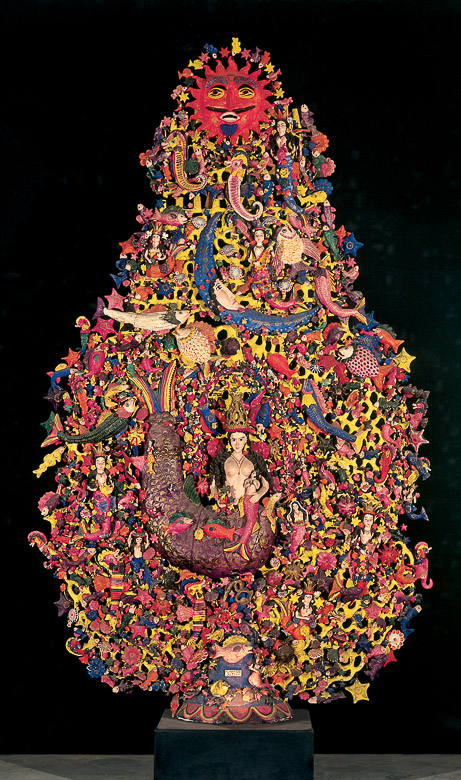
Alfonso Soteno Fernández (Metepec, State of Mexico, Mexico), Árbol de la vida (Tree of Life), 1975. Open-fired clay painted with varnished vinyl paint, 6 m.
Notes
1 Tricontinental: Institute for Social Research, The Anti-Feminist Agenda of the Latin American Far Right, dossier no. 98, 3 March 2026, https://thetricontinental.org/dossier-agenda-right-against-women/; Tricontinental: Institute for Social Research, The War on the Poor: Narcotics, Campesinos, and Capitalism, dossier no. 97, 3 February 2026, https://thetricontinental.org/dossier-war-on-the-poor/; Tricontinental: Institute for Social Research, Imperialism Will Inevitably Be Defeated: The Re-Emergence of the Tricontinental Spirit, dossier no. 95, 9 December 2025, https://thetricontinental.org/dossier-tricontinental-conference-60/; Tricontinental: Institute for Social Research, The Environmental Crisis Is a Capitalist Crisis, dossier no. 93, 14 October 2025, https://thetricontinental.org/dossier-environmental-crisis/; Tricontinental: Institute for Social Research, How the World Looks from Tricontinental, dossier no. 90, 15 July 2025, https://thetricontinental.org/dossier-tricontinental-anniversary-global-south-sovereignty/; Tricontinental: Institute for Social Research, Hyper-Imperialism: A Dangerous Decadent New Stage, Contemporary Dilemmas no. 4, 23 January 2024, https://thetricontinental.org/studies-on-contemporary-dilemmas-4-hyper-imperialism/.
2 Tricontinental: Institute for Social Research, ‘Ten Theses on the Far Right of a Special Type: The Thirty-Third Newsletter (2024)’, 15 August 2024, <https://t/