

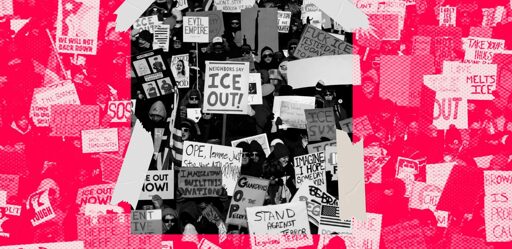
From Monday to Friday, a school bus driver makes his regular stop, picks up a kid who takes a seat among his friends and classmates, and continues the trip to school. School bus drivers carry the responsibility of making sure the kids arrive safely at school, where they are placed under the care of teachers and paraprofessionals. In Minneapolis, this exercise was upended when a massive ICE operation began in December of last year, with one violent and illegal arrest after another. Teachers, paraprofessionals, students, workers, and the community at large chose to defend immigrants and took resistance against ICE into their own hands. For several weeks, moms, dads, workers, neighbors, colleagues, and friends were on the front lines against Trump’s immigration attacks. Minneapolis, which had been at the heart of the 2020 Black Lives Matter movement, found itself once again at center stage. The fight against ICE took countless forms. Workers and community members, with teachers playing a leading role, organized patrols to monitor ICE activity, inform residents of potential arrests, set up protests, and put their bodies on the line to prevent ICE officers from taking away members of the community. On January 23, over one hundred thousand people took to the streets in the Twin Cities to demand “ICE out of Minnesota.” Schools closed, hundreds of small businesses shut down in support, and tens of thousands of workers did not go to work. Another day of action was called for January 30, and over 50 thousand marched in Minneapolis.
There was a push to unite different ranks of the working class and place the community at the center of organizing the city. On a small scale, this can be seen as a dispute over the legitimacy of the state to control the lives of denizens and as an assertion of the legitimacy of workers, immigrants and other oppressed people to direct their own futures. Minneapolis was not only the site of the most impressive fight against ICE and the Trump administration. It was the stage where the past, present, and future characteristics of class struggle came into being. It posed questions that go to the heart of the challenges of developing a political force capable of counterattacking the Far-Right, the relationship between community and the workplace, and the reorganization of a political terrain where the interests of the working class and the oppressed come to the fore. The importance of the lessons of Minneapolis to the socialist Left cannot be underestimated.
A Dividing Line Between the Workplace and the Community
Important episodes of class struggle have taken shape since the economic crisis of 2008. Imperialist countries and the “Global South” have shared the stage, from Occupy Wall Street in the United States to Tahrir Square in Egypt, the Yellow Vests in France, the June Journeys in Brazil, the Indignados movement in Spain, and BLM. Despite their differences, most of them shared a common trait: the preponderance of a dynamic in which the atomized, citizenry nature of the protests prevailed. The working class entered the scene in myriad ways, and its economic and social strength was present (as with the Yellow Vests, for example), but the emergence of the working class as a political subject remained in the shadows. In part, this is the result of high levels of working-class fragmentation, which are a legacy of decades of neoliberalism and a crucial component of the political terrain. One effect of this process is the breakdown of the relationship between the working class at the point of production, distribution, and where services are rendered and the wider community, affecting its ability to organize and act as a political force; neoliberalism undermined the organizations of the working class that helped bridge this gap… In recent years, the working class has reclaimed some level of protagonism. In 2022, workers in Sri Lanka went on a general strike against the government and in protest of the harsh economic crisis. In France, tens of thousands took to the streets and went on strike against pension reform proposals in 2023. In October 2025, a general strike brought Italy to a halt and challenged the government in support of Palestine. The fight against ICE hints at the possibilities of renewed initiative by the working class in the US.
However, overcoming the problem of the relationship between the workplace and the community remains central and has been the subject of different interpretations and prescriptions on the Left.
An important sector of the Left prescribes a strong welfare state and considers the historical German social-democracy led by figures like Karl Kautsky to be a model. This strain of social democracy rests on the presence of vibrant civic institutions (such as clubs, associations, voluntary organizations, unions, and the mass-membership character of political parties) as the foundations of broader political life, which mediate the relationship between the working class and the state. These institutions are the loci from which the working class can then emerge as a political actor. Several contemporaries thinkers on the Left, such as Jacobin founder Bhaskar Sunkara, have discussed this in various articles. They share the assessment that there is a dearth of civic institutions in contemporary American society following the neoliberal period. In this perspective, the means with which to create those institutions acquire a strategic importance. More recently, historian Anton Jäger has written about the contemporary social-political moment, using as a point of departure the lack of civic institutions.
In his most recent book, Anton Jäger describes the current sociopolitical moment as one of “hyperpolitics”: a surge of high-level political engagement that is fast-paced and heavily mediated by social media — albeit ephemeral and uncoordinated.1Jäger, Anton. Hyperpolitics: Extreme Politicization without Political Consequences. This revised english-Language edition first published by Verso. Suhrkamp, 2026. Hyperpolitics finds itself somewhat suspended in air in the absence of traditional institutions of the democratic polity. Jäger builds on Robert D. Putnam’s best-selling book Bowling Alone – The Collapse and Revival of American Community. Published in 2000, the book traces the decline in civic participation in the United States since the 1970s. The most revealing data appears in the first section, in which Putnam shows the inverse U-shaped trajectory of civic participation throughout the 20th century. Civic associations grew stronger and more widespread during World War II, peaked in the late 1950s and early 1960s, and began to decline in the mid-1970s. In the prologue to the 2020 edition, Putnam states that the situation has only worsened in the 21st Century.2Jäger acknowledges that this decline also affects the Right, with the caveat that the latter has an intrinsic relationship to the state which lessens the impact of changes to civic institutions on the Right’s ability to mobilize. While this is an important component of contemporary society, in this article I focus on some challenges of the Left.
While Bowling Alone informs Jäger’s assessment of contemporary society and the current “hyperpolitics” moment, he points to shortcomings in Putnam’s work. In particular, Jäger names the “little time [spent] investigating the structural transformation of society — the rise of NGOs as substitutes for mass-membership organizations, the proliferation of evangelical megachurches and schools, especially in the United States and Brazil, and the evolution of a newly ‘social’ internet after the dotcom crash of 2001,” as well as the concept of “social capital.”
The way out of Hyperpolitics rests on “a reinstitutionalization of political engagement,” without which “the left will remain hostage to impotent volatility, and its adversaries will continue to enjoy a decisive advantage.”3Jäger, Hyperpolitics, 94. The Belgian author traverses the barriers to “sustained, institutionally oriented political participation” and explores the potential of everyday forms of action, such as rent protests. At the same time, he adds that “spheres of production and distribution can hardly be written off that easily. The world of work remains the site where surplus value and economic interests directly clash, whereas parents and tenants can only appeal to the fiscal state, which in turn depends on the willingness of capitalist elites to redistribute.”4Jäger, Hyperpolitics, 92,93.
Jäger is correct in stressing that the workplace cannot be written off so easily. However, he doesn’t address the fact that the potential of workplaces as “spheres of production and distribution,” as well as workers’ ties to socio-political life beyond the workplace, have been severed by those leading the primary civic institution of workers: the unions. During neoliberalism — and even during the Cold War, at the hands of the labor-liberal alliance — the union bureaucracy has pushed class consciousness downward, accepting the attacks advanced by capital. In tandem with this process, a new actor has emerged in the shape of social movements and NGOs, and with them their own bureaucracies. Despite taking up broader social issues, however, the leaderships of these movements have worked within the constraints of their individual focuses, reproducing in the social movements the corporatist nature of unionist politics. They share a certain “division of labor,” in which the unions take up bread-and-butter demands related to the workplace and social movements take up single issues. During neoliberalism, some unions started taking up single-issue campaigns affecting wider swaths of the working class (as opposed to individual workplaces), but they maintained the logic of separating the arena of the workplace from the community — Joe Burns refers to this phenomenon as “liberal unionism.”5Burns, Joe. Class Struggle Unionism. Haymarket Books, 2022.
Unions in the Neoliberal Era
Unions are one central example of how civic institutions have declined in recent decades. In the 1970s, unions represented about 25 percent of workers in the United States. Because of their intrinsic relationship with the state and their obedient response to political and judicial constraints, unions have never been capable of representing the majority of the working class. At the moment, I want to stress that neither Jäger nor Putnam takes into account a decisive factor in the collapse of union membership in the last several decades. Putnam does not pay unions much attention, and Jäger instead stresses the impact of the attacks by capital in the final moments of the era of “mass politics,” 1914-1989. The latter is unequivocally the case, but it is only half the picture. Union leaderships, constrained by their acquiescence to the boundaries of the bipartisan regime — and consequently, incapable of offering any kind of alternative — with varying degrees, largely accepted the conditions imposed by the furious attacks against the working class during neoliberalism.
The threads of civil society that unraveled during neoliberalism were part of the fabric of the “Integral State,” as Gramsci described it: various forms of institutions that emerged as a result of, and alongside, the growing presence of the working class and the citizenry at large in political affairs. These institutions “foster” the hegemony of the bourgeoisie in ways different from blunt repression.
The trajectory of unions has been closely linked to the dynamics facing the working class throughout the twentieth century — and will continue to be so, in one way or another, despite current historically low levels of unionization in the country. Leon Trotsky articulated this relationship in 1940, addressing the new challenges unions faced in an epoch of crisis, wars, and revolutions. Unions could not claim neutrality on broader issues of the working class and the people. In an epoch when partial gains are constantly challenged by the bourgeoisie, a consequential defense of workers’ interests would require strategic clarity on the decisive issue of class independence – the working class’ ability to organize according to its own interests and against the interests of the ruling class. In Trotsky’s words,
the trade unions in the present epoch cannot simply be the organs of democracy as they were in the epoch of free capitalism and they cannot any longer remain politically neutral, that is, limit themselves to serving the daily needs of the working class. They cannot any longer be anarchistic, i.e. ignore the decisive influence of the state on the life of peoples and classes. They can no longer be reformist, because the objective conditions leave no room for any serious and lasting reforms. The trade unions of our time can either serve as secondary instruments of imperialist capitalism for the subordination and disciplining of workers and for obstructing the revolution, or, on the contrary, the trade unions can become the instruments of the revolutionary movement of the proletariat.6Leon Trotsky, Trade Unions in The Epoch of Imperialist Decay. https://www.marxists.org/archive/trotsky/1940/xx/tu.htm
Emilio Albamonte and Matias Maielo build on this framework to analyze the current condition of the working class since the end of the 20th century. They compare neoliberalism to the Bourbon Restoration of the nineteenth century, but among important differences, one stands out: “the ‘bourgeois restoration’ [of the late 20th century] unlike [the restoration] of 1814, was not accompanied by a military defeat like at Waterloo, but was guaranteed ‘from within’ […] during the neoliberal offensive, workers saw their own organizations turn against them.”7Emilio Albamonte, Matias Maielo, Military Art and Socialist Strategy, p. 480 (forthcoming). In other words, union leadership accepted the new terms of engagement dictated by the attacks of neoliberalism, all of which compose a larger picture of social fragmentation, isolation, and other maladies of the times poignantly described by Jäger. It also impressed upon the working class the levels of internal fragmentation.
A New Chapter in Class Struggle
The working class may not yet have taken center stage in the United States, but over the last several years there have been glimpses of it, as part of a more general uptick in the labor movement. Jäger defines the years after the economic crisis of 2008 as the “Apolitical Era,” emphasizing a growing gap between traditional parties and their constituency, accompanied by a rising appeal of different streaks of populism. They were also marked by intense processes of class struggle internationally. In the United States, there was no Tahrir Square, no massive movement of workers against austerity as in Greece, and no Yellow Vests, to name but a handful. Instead, there was Occupy Wall Street and BLM, as well as the rise of Bernie Sanders and Donald Trump in 2015. Although the data point to 2018 as a critical moment in the uptick in labor, important signs were already present in previous years, such as the Chicago Teachers’ Strike in 2013. In no coincidental terms, 2018 saw teachers in West Virginia, Oklahoma, Arizonan organize victorious strikes, going against the reluctance of the union and the legal and political apparatus of the state. As important as the uptick in labor activity, which in no way has been linear, workers have been making demands that both go beyond the limits of corporatist interests and challenge the divisions within their own ranks. In Minneapolis, “the same teachers and staff who are now defending students against ICE are the ones who went on strike in 2022 to demand better wages and class sizes at the same time that they linked their conditions and those of their students to racism in the education system, showing the deep influence of the Black Lives Matter movement.”
Eric Blanc has systematized some features of this new wave of the labor movement in his new book We Are the Union – How Worker-to-Worker Organizing is Revitalizing Labor and Winning Big. According to Blanc, the driving forces of this new moment are favorable government policy, the systematic use of digital tools, and youth radicalization. By government policy, Blanc means the Biden administration’s labor policies, but more specifically, the historically pro-labor NLRB of his administration. Most relevant to the point I want to make is Blanc’s assessment of what he calls “worker-to-worker unionization.”
The convergence of these factors has led to increased labor activity and unionization. Blanc examines unionizing efforts using different methods, highlighting a common theme: workers “initiate and/or train an organizing drive, and they play a central role in determining its major decisions.” By worker-to-worker unionism, Blanc sets out to define the main contours of a “model” that can overcome the staff-intensive method still predominant in union drives today. The critique of reliance on staff-intensive methods is an important contribution to the debate about the limits of a union strategy adapted to the political and subjective constraints of neoliberalism. The strength of the book lies in the stories it tells of the shock with which union leaders responded to workers’ initiatives: “I’ve never seen this number of workers reach out to our union before,” notes Alan Hanson, who was organizing director of United Food and Commercial Workers (UFCW) Local 400 before becoming a staff organizer for the UAW.8Blanc, We Are the Union, 14.
At the same time, Blanc highlights the new UAW leadership, under Shawn Fain, as an example of unions that have risen to the occasion and found ways to merge and bolster worker-to-worker organizing, exemplified by their national organizing campaign in the South. In sum: “From the moment of their election onwards, UAW’s new guard has given a masterclass on how to fire up previously cynical and checked-out workforce by championing accountable leadership, raising expectations, tapping into anger at corporate overlords, and showing that workers can win big through mass militancy.”9Blanc, We Are the Union, 113.
The new UAW leadership has employed more militant tactics and a more combative discourse that reclaims the opposing interests of workers and bosses. Compared to the low levels of labor combativeness among union leadership over the last several decades, UAW stands out and marks the emergence of a more classic type of union reformism. This tendency within the labor movement reflects new ways of thinking among broader sectors of the working class, but it operates in a way that ultimately ends up being bound by the limits of the bipartisan regime.
The fight against ICE and the Trump administration stands out as an example. During the most impressive fight against the Trump administration in Minneapolis earlier this year, the leadership of the UAW limited itself to tepid statements against ICE violence, refusing to defend immigrants or call for unions to contribute their resources to the fight, organize with neighborhood associations, or directly call for a strike on both January 23 and 30. The debate about a 2028 general strike is another. The idea of a general strike has become much more popular and is no longer merely part of the vernacular of radicals. However, as of now, the proposal for a general strike is limited to the goals of better contracts, is set to begin and end on the same day — May Day — and is constrained by the legal boundaries of draconian labor legislation.
The Imperative Need for Working-Class Hegemony
Several components of neoliberalism have been dismantled in this post-neoliberal moment. However, the precarization of labor is in full swing. This core feature of neoliberalism is taking new shape, building on the incredible fragmentation of the working class imposed in previous decades.
The dispersal and atomization of society have led to an inward-looking, self-reflective focus among those inhabiting the public square of politics — an important obstacle in the development of the collective action necessary for mass movements to impose their will. This is where Jäger lands. There is truth to this view, but it does not paint the whole picture. Over the last several years, there has been a deep connection between broader social issues and the labor movement. Black Lives Matter is the most significant example, but so is the spotlight essential workers shined on themselves and the working class writ large during the pandemic. It is clear that the fight against police brutality and racism has positively impacted the labor movement, emboldening workers not only to take up issues of racial oppression but also to fight for their own work-related demands.10Larry W. Isaac & Brittney Rose (2024) Movement for Black Lives at Work? Racial Justice Spillover, Labor Organization, and New Worker Militancy, The Sociological Quarterly, 65:4, 558-583, DOI: 10.1080/00380253.2024.2357549 As mentioned above, even before 2020, BLM and the pandemic, the Red State Revolt in 2018 and the Chicago teachers’ strike in 2013 saw teachers take up demands that affected the entire school community.
In Minneapolis, we saw glimpses of the future of class struggle. Workers and the community took steps to create “institutions” of their own amid this struggle, despite their fleeting character. The will to fight and defend the interests of both workers and the community at large constitutes the axis on which to build renewed “civic life,” reconnecting workers who toil side by side or isolated from one another, neighbors who are often estranged from each other, and strangers who share an impetus to take charge of their political fate. In the vast majority of cases, the leaderships of unions and social movements have been an obstacle to the flourishing of class unity.
Nevertheless, much of what took place is embedded in the tradition of the American labor movement. The relationship between the workplace and the community has been a constant theme in moments of more acute class struggle, as well as in social movements such as the fight against segregation. If unions are truly to become instruments of working-class organization, they face the predicament of doing everything in their power to break the artificial wall that separates the workplace from the community and workers from their coworkers. It is impossible to do that without finding ways to overcome the limits imposed by draconian labor laws, such as laws against public sector strikes in various states or laws like Taft-Harley that prohibit solidarity strikes. As Joe Burns writes: “To revive the labor movement in the private [and public] sector will require violating labor law and sharp confrontation with the existing order.”11Burns, Class Struggle Unionism, 52.
Minneapolis workers challenged the administration and the law, gave their lives to defend immigrants and their community, and courageously challenged the “existing order”; in turn, the majority of the union and social movement leaderships in the city, not to mention the country, refused to step up and do the same.
An important step in that direction would have been for unions to share their resources with all the neighborhood associations and to call for and join local committees in defense of immigrants, as well as actively mobilize for both January 23 and 30. It is of the utmost importance to mobilize the rank and file to foster and support wings of the labor movement willing to challenge the union bureaucracy, claim unions as institutions to fight exploitation and oppression, and foster workers’ self-organization. At its core, the urgent task is to unite the ranks of the multiracial working class, across sectors, organized and unorganized, and across immigration status.
The high-pitched whistles blown to alert neighbors of incoming ICE officials are a vivid example of resistance to ICE and solidarity with immigrants. At the same time, the vast majority of immigrants in Minneapolis — a key sector of the working class in that city — were forced to circumscribe their political activity to their homes. The absence of material and political support from unions and strong social movements, along with unions’ timidity in adhering to the fight against ICE, and, ultimately, their role in the effort to deescalate the situation played a vital role in keeping broader forms of self-organization from emerging. That those targeted by ICE did not take an active part in the fight against ICE and the Trump administration attests to it. Immigrants could only have actively joined the fight in a context in which the working class took an active hegemonic role to impose its will beyond the limits posed by the bourgeois state; in other words, if the working class had truly “unlocked” its power, it could have organized real strikes and forms of self-defense that would make the participation of the united working class (immigrants and citizens together) undeniable.
The Terrain For Self-Organization
Among the many rich elements Minneapolis brought to the fore, the need for the working class and the oppressed to create a terrain that can propel the emergence of the working class as a hegemonic actor stands out. This requires finding ways to delimitate a boundary that sets political independence from the multi-pronged efforts of the bipartisan regime to channel the energy of the masses to the ballot box — while occasionally throwing in a concession or two — and which sets its sights on rupturing the division between “politics” and “corporatism.” The latter is constantly reinforced by the traditional leaderships of mass institutions, like unions -– the combination of being part of the administration’s efforts to de-escalate tensions in Minneapolis and not finding ways to connect with the neighborhood groups, open their doors, place their resources at the service of the fight, and build a strike compound into a political activity that is defined by the adversaries of the working class and immigrants.
The incredible display of courage and creativity in Minneapolis in defense of immigrants also sheds light on possible routes for developing broader institutions of self-organization, ones that are open to all workers and the people. Throughout the twentieth century, there have been several examples of the bottom-up, impromptu building of institutions like this, which emerge as an expression of the masses’ combative disposition. There is, however, no prescribed path to the emergence of massive bodies of self-organization. In most cases, such movements have sprung from the workplace into the neighborhoods. Minneapolis has shown that the inverse trajectory is quite possible, perhaps even more likely. Given the corporatist nature of union leaderships, and the willingness of wide swaths of the community to go beyond bread-and-butter issues — such as taking up the defense of immigrants — it is quite possible that community-based movements will radicalize first and create new self-organization methods. In turn, these movements inject morale and energy into the labor movement (as was the case with BLM), making it possible for the articulation of the community-workplace relation to begin with the community itself.
Nevertheless, the adversaries remain the same. The union bureaucracy — and the social movement bureaucracy, composed of a massive NGO apparatus — still act as a barrier separating these two worlds. There are no predefined ways the multiracial working class will find to unleash their political creativity in defense of their interests and exercise its hegemonic potential against the imperialist bourgeoisie. Trotsky, writing in the 1930s, once said that “American soviets will be as different from the Russian soviets as the United States of President Roosevelt differs from the Russian Empire of Czar Nicholas II.”
The pages of this new chapter of class struggle reveal that there is no innate Sisyphean quality to the dynamics of the struggles the working class and the people put forward. But the working class and the people, beautifully exemplified by the strength and resolve of Minneapolis teachers, deserve a party of their own. A socialist party is an indispensable subject to foster the creation of a political terrain more favorable to the fights against the imperialist bourgeoisie. The socialist Left faces the challenge of debating the possible paths to such a party, examining and integrating the conclusions of more acute processes of class struggle. The debates around the need for new institutions of the working class inspired by German social-democracy stem from the understanding that these institutions will mediate the relationship between the working class, civil society, and the State. It is a strategic perspective that seeks to create a robust welfare state, which will in an indeterminate future lead to socialism. In this case, building a socialist, revolutionary party, can be understood as a valuable, but not pressing goal. In the United States, the DSA, for example, believes the Democratic Party can act as a bridge between the working class and the state. Minneapolis showed, on a small scale, that the challenges we face demand putting existing institutions of the working class and the people at the service of defending politics that have an independent political nature. Our task is not to mold and contain their activity to the boundaries of the bipartisan regime, but to combat it. In this perspective, building a socialist party becomes an imperative task.
Notes[+]
Notes
| ↑1 | Jäger, Anton. Hyperpolitics: Extreme Politicization without Political Consequences. This revised english-Language edition first published by Verso. Suhrkamp, 2026. |
| ↑2 | Jäger acknowledges that this decline also affects the Right, with the caveat that the latter has an intrinsic relationship to the state which lessens the impact of changes to civic institutions on the Right’s ability to mobilize. While this is an important component of contemporary society, in this article I focus on some challenges of the Left. |
| ↑3 | Jäger, Hyperpolitics, 94. |
| ↑4 | Jäger, Hyperpolitics, 92,93. |
| ↑5 | Burns, Joe. Class Struggle Unionism. Haymarket Books, 2022. |
| ↑6 | Leon Trotsky, Trade Unions in The Epoch of Imperialist Decay. https://www.marxists.org/archive/trotsky/1940/xx/tu.htm |
| ↑7 | Emilio Albamonte, Matias Maielo, Military Art and Socialist Strategy, p. 480 (forthcoming). |
| ↑8 | Blanc, We Are the Union, 14. |
| ↑9 | Blanc, We Are the Union, 113. |
| ↑10 | Larry W. Isaac & Brittney Rose (2024) Movement for Black Lives at Work? Racial Justice Spillover, Labor Organization, and New Worker Militancy, The Sociological Quarterly, 65:4, 558-583, DOI: 10.1080/00380253.2024.2357549 |
| ↑11 | Burns, Class Struggle Unionism, 52. |
The post Minneapolis: Notes on a New Chapter of Class Struggle in the United States appeared first on Left Voice.
From Left Voice via This RSS Feed.