

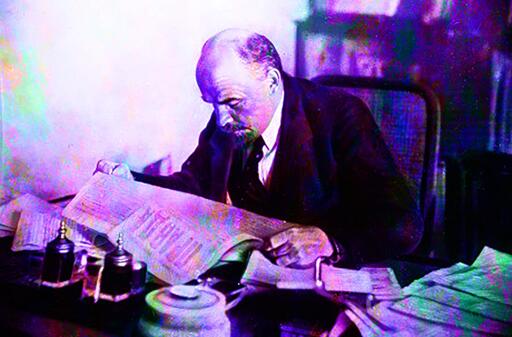
Lenin famously described imperialism as an epoch of crises, wars, and revolutions. That definition appears as apt as ever today as the U.S. and its Israeli satellite are carrying out barbaric wars in Gaza, Lebanon, and Iran, while the new rebellions are springing up worldwide against the existing order.
In Marina Garrisi’s 2024 book Découvrir Lénine (Discovering Lenin), she describes how Lenin built and led the Bolshevik Party in a moment similarly shaped by war and crisis, and how, in the midst of this catastrophe, the Bolsheviks carried out the first successful workers’ revolution in world history.
Here, we present Chapter 1 of the book, which details Lenin’s fight to launch Iskra, the revolutionary socialist newspaper published from abroad and spread clandestinely in Russia. Iskra would link together the previously dispersed cells of the Russian Social Democratic Labor Party and become a voice for the tens of thousands of Russian workers struggling against Tsarist repression and capitalist exploitation.
In the coming weeks, Left Voice will publish additional excerpts of the book, for the first time in English.
***
The Political Newspaper
A newspaper is what we most of all need; without it we cannot conduct that systematic, all-round propaganda and agitation, consistent in principle, which is the chief and permanent task of Social-Democracy in general and, in particular, the pressing task of the moment, when interest in politics and in questions of socialism has been aroused among the broadest strata of the population. 1Lenin, “Where to Begin?” (1901), Lenin Collected Works, Volume 5, Moscow, Foreign Languages Publishing House, 1961, p. 13-20.
In the spring of 1901, a wave of demonstrations and strikes broke out in several Russian cities, shaking up the various factions and currents within the Russian socialist movement. Faced with the growing activism of the working class, certain political factions called for a “full-scale assault” on tsarism. It was in this context that Lenin published “Where to Begin?,” which appeared in May 1901 in the third issue of Iskra (“Spark” in Russian), a social-democratic newspaper founded in December 1900 by Russian exiles and of which Lenin was then a co-editor. For Lenin, the essential task of the Russian revolutionary movement was to build a revolutionary party capable of methodically preparing the assault against autocracy, a patient undertaking in which the newspaper must play a leading role.
What did Lenin consider to be the top priorities for emerging Russian social democracy? How should a party be organized? What role can a political newspaper play in this process?
Marxism and Populism
Russian Marxism emerged in the 1880s under the dual influence of the Second International (particularly under the leadership of the German Social Democratic Party, the SPD) and the populist movements specific to 19th-century Russia.
Russian populism made its appearance as early as 1830, originating from small circles of the intelligentsia attracted to socialist ideas. The first major populist organization, Zemlia i volia [Land and Freedom], was founded in the early 1860s. The populists were convinced that Russia could escape capitalist development and that this was possible by drawing on the collectivist traditions that persisted among the peasantry: a hypothesis close to that suggested by Karl Marx at the end of his life in his correspondence with Vera Zasulich2Gulli, F. & Quétie, J. (2020) Découvrir Marx [Discovering Marx], Chapter 12. Les éditions sociales… Their movement, far from being unified, advocated the idea that the transition to socialism must be prepared through education and propaganda in the countryside, or brought about by revolutionary terrorism. As a response to the terror unleashed by the autocratic regime against opposition movements, revolutionary terrorism aimed to disrupt the state and raise public consciousness. Between the 1870s and 1880s, the populists carried out numerous attacks; one of them led to the assassination of Tsar Alexander II in 1881.
The split between Russian Marxism and populism was a gradual process. Throughout the 1890s, Georgi Plekhanov and later Lenin studied the socio-economic characteristics of Russia and demonstrated that capitalism was beginning to develop in the country. From that point on, any attempt to delay or prevent its emergence appeared to be a futile and reactionary endeavor. Russian Marxists, who adopted the name Social Democrats during those same years, now identified the country’s working class as the central agent of the revolution and made the cities — rather than the countryside — their primary arena of action. Similarly, they contrasted a “scientific” socialism, drawn from Karl Marx and Friedrich Engels, with a populist critique of the tsarist regime, which they deemed too altruistic and moralizing. Finally, they supplanted the heroic and romantic conception of revolutionary activism with the idea of the political party. From then on, therefore, Marxism and populism represented two divergent currents within the Russian revolutionary movement, which did not prevent Lenin from maintaining relationships with certain populist thinkers until the end of his life, starting with the writer Nikolai Chernyshevsky (see Chapter 2).
Once “the path” was laid out for the Social Democratic movement, new political questions arose — practical and concrete ones. It was these new questions that Lenin sought to answer in his article “Where to Begin?”
Fighting Against Localism, Building a Centralized Party
As student protests, workers’ strikes, and revolutionary sentiment spread throughout Russia in 1899 and 1900, a “system and plan of action” for revolutionaries became a pressing issue. For Lenin, the priority for social democracy was to “establish a revolutionary organization.” In 1898, the founding congress of the Russian Social Democratic Labor Party (RSDLP) brought together only a handful of delegates, the majority of whom were arrested by the tsarist police a few days later. In practice, the RSDLP was unable to organize existing local groups.
It was against this extreme fragmentation of forces that Lenin first polemicized. He waged war against the “artisanal methods” of Russian social-democratic organizations: “As for a standing army, we have only a few small detachments […] and even these are not mobilized, have no communication between them, and are not trained. ” Under these conditions, the priority was to combat localism — that is, the tendency for activists to become “completely absorbed in purely local tasks.” For Lenin, this was the main obstacle to the emergence of an organization capable of confronting a highly organized and centralized enemy: the tsarist autocracy. Only by breaking free from this localism and building a politically unified and organizationally centralized political party can social democracy prepare “to wage the decisive struggle.”
The Political Newspaper: Education and Organization
Lenin did not content himself with defending the abstract idea of a centralized organization; rather, he outlined the steps needed to achieve it. Among these, the creation of a political newspaper appeared to be the most promising means.
First, because the publication of “a political newspaper for all of Russia” made it possible to unify the views of activists from various local groups under a single, unified direction. To this end, the newspaper had to be political: more than a mere collection of local viewpoints, it needed to seek to raise the consciousness of the entire working class by advancing general political slogans, organizing campaigns to expose the autocracy, and popularizing the program and principles of Russian social democracy. It could not limit its activity to the investigation and exposure of specific situations (in a particular factory or neighborhood) but had to teach revolutionaries to closely follow and react to political events, always seeking “the best way for the revolutionary party to act on these events.” In other words, the newspaper made it possible to transcend localism by uniting various groups around a unified political vision.
Second, the tasks involved in launching a newspaper for all of Russia themselves became a source of political education for the activists. Organizing a network of agents capable of gathering information, distributing the newspaper, recruiting new correspondents, and maintaining contact among themselves and with the editorial board working in exile; all these tasks, which are particularly demanding and dangerous under the clandestine conditions inherent to activism in Russia, are at the same time a first step toward building the party apparatus itself. Lenin thus employed the metaphor of scaffolding to describe the newspaper’s role in relation to the party: “In this respect, it can be compared to the scaffolding erected around a building under construction; it outlines the contours of the edifice, facilitates communication among the various builders, enabling them to divide up the work and take in the full scope of the results achieved through organized labor.” In other words, the newspaper made it possible to bring the organization into material existence at the national level.
Ultimately, while there were already numerous press outlets within opposition movements in 1900, Lenin’s distinctive approach was to closely link the publication of a political newspaper with the work of building a centralized party.
Preparatory Tasks and Revolutionary Patience
Like other Marxists before him (notably Friedrich Engels and Karl Kautsky), Lenin drew on certain concepts in military theory to describe the work of revolutionary strategy. Against the “misguided zeal” of those who are already calling for decisive action against the tsarist autocracy, Lenin responded with a formulation that echoed a distinction Gramsci would later draw between war of maneuver and war of position3Gulli, F. & Quétie, J. (2020) Découvrir Gramsci [Discovering Gramsci], Chapter 4. Les éditions sociales.: “Our slogan at the present time cannot be: ‘To battle!,’ but rather: ‘Let us lay siege to the enemy’s fortress!’” For Lenin, revolution, as the most advanced form of class struggle, cannot be improvised but, on the contrary, requires patient and orderly preparation. Among these preparatory tasks, the building of a centralized party stands paramount.
This did not mean that victory (in this case, the fall of the tsarist autocracy) would be achieved only through “a proper siege or an organized assault.” Lenin was aware of the decisive role that the masses and their spontaneity would come to play (a role he would elaborate on starting in 1905; see Chapter 3), whose explosion no one could predict. A party cannot claim to organize the revolution from A to Z, nor even hope to trigger it, says Lenin, but revolutionary activists cannot, for that reason, base their conduct “on hypothetical outbursts and complications.” On the contrary, they must “carry out [their] systematic work without fail” if they do not want to be “caught off guard by the ‘historic turning points’” that are bound to occur.
Translation by Adrien Masson.
Notes[+]
Notes
| ↑1 | Lenin, “Where to Begin?” (1901), Lenin Collected Works, Volume 5, Moscow, Foreign Languages Publishing House, 1961, p. 13-20. |
| ↑2 | Gulli, F. & Quétie, J. (2020) Découvrir Marx [Discovering Marx], Chapter 12. Les éditions sociales. |
| ↑3 | Gulli, F. & Quétie, J. (2020) Découvrir Gramsci [Discovering Gramsci], Chapter 4. Les éditions sociales. |
The post Lenin’s Newspaper: The Scaffolding to Construct the Party appeared first on Left Voice.
From Left Voice via This RSS Feed.