

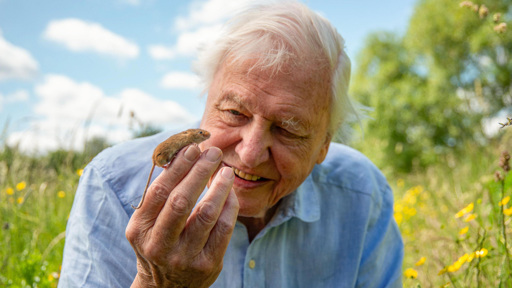
As his 100th birthday approaches, David Attenborough occupies an unusual place in public life: not a practicing scientist, not quite a conventional journalist, and no longer only a broadcaster. His voice, familiar from decades of natural history programming, has become one of the most recognizable ways the public hears about the state of the living world. That was not always the role he played. When Attenborough began his career at the BBC in the 1950s, the task was more modest. Television was still finding its footing, and natural history programming largely meant showing audiences what they could not otherwise see. Early series such as Zoo Quest were shaped by that spirit. They were exploratory, sometimes improvised, and often framed around the thrill of encountering unfamiliar species. The tone was one of discovery. The unspoken assumption was that the natural world, vast and varied, would endure. Attenborough in Borneo, 1982. Photo by Rex Features As his work evolved, so did the technology that made it possible. Color film, lightweight cameras and, later, digital imaging expanded what could be captured. Attenborough used those tools with unusual patience. His programs lingered on behavior as much as spectacle. Courtship rituals, feeding strategies, and migrations were given time to unfold. His programs did more than show animals; they asked viewers to notice how they lived. This attention to detail became one of his signatures. It reflected a view that understanding begins with careful seeing. Attenborough rarely made himself the story. His narration was measured and…This article was originally published on Mongabay
From Conservation news via This RSS Feed.
You know you read all that in his voice, too. 🥰🤗🥰🤌🏼
