

Last week, Republicans in Congress passed a framework for a proposed round of funding for ICE and Border Patrol. The measure was intended to end an impasse over Department of Homeland Security funding, which lapsed over 10 weeks ago.
But the budgetary framework, which includes $70 billion for both agencies, came with a twist: No Democratic input needed.
Republicans bypassed the normal budget process in a move The Hill said sets a “dangerous precedent” and could lead to one-sided steamrolling to secure unilateral funding for unpopular policies like continuing the US-Israeli War with Iran.
To secure funding without a single vote from any Congressional Democrat, Republicans have invoked an arcane procedure known as “reconciliation,” a legislative maneuver that allows a bill to bypass the Senate filibuster, provided it meets certain criteria. Their reason for deploying it? To sidestep opposition from Democrats, who had declined to fund ICE or CBP without reforms, and the democratic process altogether.
Democrats have been demanding ICE and CBP agents stop wearing masks, use body cameras, and discontinue raids on homes without warrants, among other stipulations, in exchange for funding the Department of Homeland Security. Republicans refused to concede on any of these issues, and a 76-day shutdown ensued.
But this week, Republicans decided to go it alone, and their effort may be successful. As a result, the passage of the budget framework through the reconciliation process is an alarming move for a party that has already demonstrated a clear willingness to discard democratic norms, processes, and guardrails.
The framework also left a lot of questions unanswered, including: Why the additional money for controversial agencies that already received nearly $140 billion from “The Big Beautiful Bill”?
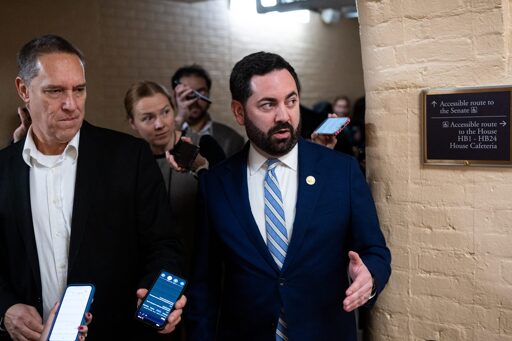
We posed that exact question to Republican Congressman Mike Lawler on the steps of Capitol Hill. He declined to provide specifics.
“That’s the cost of funding the department. Are you for abolishing ICE?” he replied. “You understand that is the appropriate amount?”
Since early last year, at the behest of President Trump, federal agents have flooded Democratically governed “blue cities” like Los Angeles, Minneapolis, and Chicago, deploying unconstitutional tactics, precipitating confrontations, and killing at least three American citizens.
DHS now has a record 73,000 detainees jailed across the country, the result of the Trump administration’s brutal “mass deportation” campaign and policy changes that, among other acts, no longer allow recent immigrants to remain free in the US while awaiting their asylum hearings.
Meanwhile, Lawler and his colleagues seem determined to use the reconciliation process to circumvent Democratic opponents and fund other MAGA priorities. Republican Congressman Mike Flood told us he anticipates another round of reconciliation to pay for the war with Iran.
“This, for me, makes the case for reconciliation 3.0,” Flood said when asked to explain the need for additional ICE funding. “We have to pay for the effort in Iran.”
Decades ago, Congress adhered to a budgeting method called “regular order.” It was a process established by a 1974 law called the Congressional Budget and Impoundment Control Act, which required public hearings on appropriations for individual agencies, along with testimony and debate.
But partisan politics, from Democrats and Republicans, forced that process into stopgap measures such as continuing resolutions and massive omnibus spending bills. The shift pushed negotiations over funding measures into the upper chambers of the House and Senate leadership, with public hearings and debate almost entirely abandoned.
Still, reconciliation has not been used for routine agency budgeting—until now.
Reconciliation requires the passage of a framework that instructs the appropriate committees to draft legislation to submit to the Senate parliamentarian. The parliamentarian then decides if the legislation qualifies for the exemption. A bill is considered eligible if it has a “non-incidental” fiscal impact and meets several other criteria.
Democrats fear this unprecedented use of reconciliation will allow Republicans to throw even more money at agencies like ICE for dubious or openly nefarious reasons.
“That’s why I go back to the lead-up to November,” Democrat congressman Rob Menendez said at a press conference last week. “I am worried they would use the $70 billion to have ICE and CBP in blue districts across the county to try to intimidate voters.”
Menendez explained that one of the Democrats’ demands to fund DHS focused entirely on keeping ICE and CBP out of the electoral fray in the upcoming midterm elections. Another demand Republicans rejected.
“One of the reforms we have asked for over and over again during the partial shutdown is to guarantee that they will not. And they have not agreed to those terms.”
Still, if Congressional Republicans are able to shower more cash on ICE and CBP without majority consent from the voters or even participation from the other governing party, it would suggest we’re entering uncharted terrain and a new phase in MAGA’s monopoly on fiscal and political power.
The question is: Can anything, or will anyone, stop them?
From The Real News Network via This RSS Feed.