


Bullets:
The US Treasury Department recently froze $344 million held by Iran’s central bank, in two digital wallets that contained Tether (USDT) Stablecoins.
Tether cooperated with Treasury in these actions, intended to shut off Iranian sales of oil.
Stablecoins were promoted as alternatives to traditional banks, and are in wide use outside the United States.
Tether is the largest stablecoin, with transaction volumes higher than Visa and MasterCard, and assets of hundreds of billions of dollars in US Treasury bonds, gold, and other investments.
Stablecoins were also perceived as decentralized, and outside the reach of regulators and governments, except in cases of egregious criminal violations.
Crypto market players reacted violently to the news of the freeze, and (truly decentralized) Bitcoin has traded sharply higher since.
Inside China / Business is a reader-supported publication. To receive new posts and support my work, consider becoming a free or paid subscriber.
Report:
Good morning.
Stablecoins are a kind of cryptocurrency that are usually pegged 1-to-1 to a fiat currency, like the US dollar. Tether, or USDT, is the most widely used stablecoin. There are good reasons why crypto is popular as a trading instrument, as well as a store of value. And there are good reasons why stablecoins were preferred to other types of cryptocurrency like Bitcoin, or BTC.
Since January of 2020, BTC is up over 10 times, to over $78,000. But we can see from the other charts why it would give companies headaches, to use it as a trading instrument, or a medium of exchange.
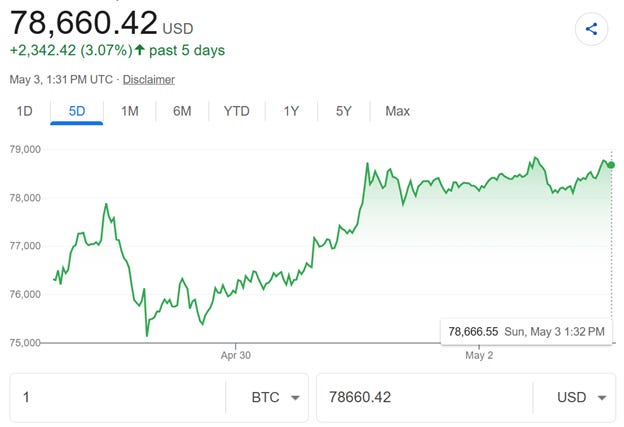
This is the past five-day chart of Bitcoin, going from 76,000 to 75,000 the next day, then up to over 78,000 two days after that. If you’re buying manufactured products, for example, and put up a 50% deposit today and remainder upon delivery to the outbound port 30 days later, we can see the problem. And we can see the opening there for stablecoins, which are believed to be completely secure, and outside the oversight of regulators, while being pegged to the US dollar, in the case of Tether.
Another major advantage to using Stablecoins is that they can be traded as dollars, during a time of global dollar shortages. That is driven by the monstrous US fiscal deficits now being run. The US government is borrowing a trillion dollars every hundred days, and total debt is now over $39 trillion. That equals $113,000 per American.
New buyers of Treasury debt are insisting on higher yields, to compensate for the higher inflation and repayment risk. In just five years, new borrowing costs for the US government have skyrocketed.
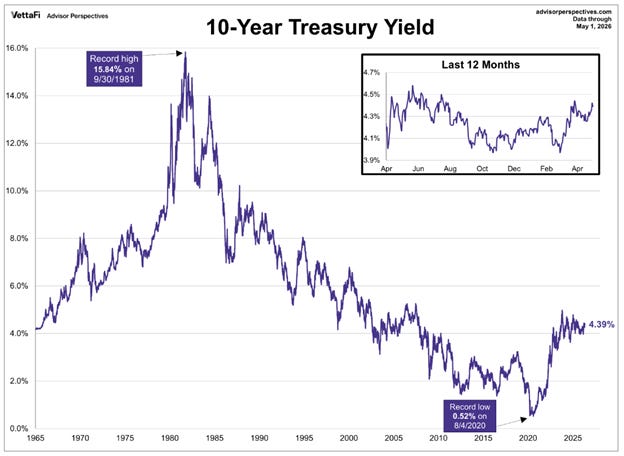
This is 10-year paper, which is also the reference rate for home mortgages. In 2020, the US government issued new debt at under 1% interest per year. Now it’s back to over 4%, and that dynamic is sucking hundreds of billions of dollars out of banks across the world, back to the United States to lend back to the US government at the highest rates in years.
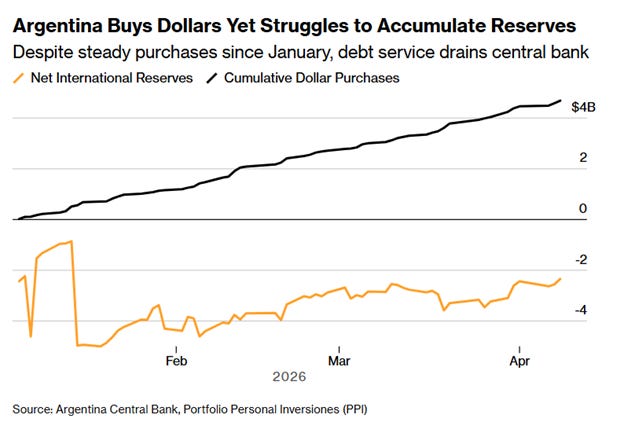
That results in shortages of US dollars, even in countries we wouldn’t expect. November 2025 was just six months ago, and Argentina got a $20 billion bailout after they ran short of dollars to pay back dollar-denominated debt. Argentina’s central bank is drawing down those lines, but the money is leaving faster than it’s coming in. Argentina’s dollar position is worse now than when they signed the deal:
Since World War 2, no country has gotten more US foreign aid than Israel — over $337 billion through 2024. Add another $4 billion for 2025 and again for 2026, then another $3.3 billion in military aid, hundreds of millions more for missile defense and other defense tech in just sixteen months. But as fast as the dollars are going in, they’re going out even faster. The moneychangers in Tel Aviv are running shortages of US dollars.
So Stablecoins are backed by US dollars, or other instruments that are denominated in US dollars. Trade done using Stablecoin went from just $3 billion in 2018, to over $18 trillion. The Visa network across the whole world was $15.7 trillion, by comparison.
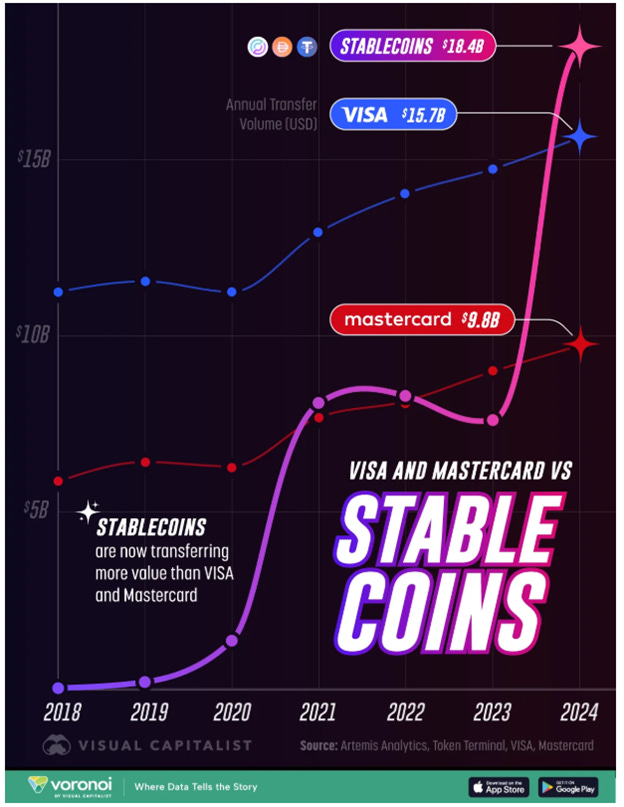
And that steep rise in stablecoin adoption, starting in 2020, coincided with the spike in US government bond yields. As US dollars were emptied from banks across the world to feed government borrowing, stablecoins were an alternative, a way to continue doing business in US dollars even though there weren’t as many of them around.
Briefly: Tether buys assets that they hope can maintain the US dollar peg, where $1 USD equals $1 USDT. That means they’re primarily buying a lot of Treasury bills and notes. As of 2025, Tether held more US Treasury bonds than most countries, ranking 17th, and ahead of South Korea and Germany.
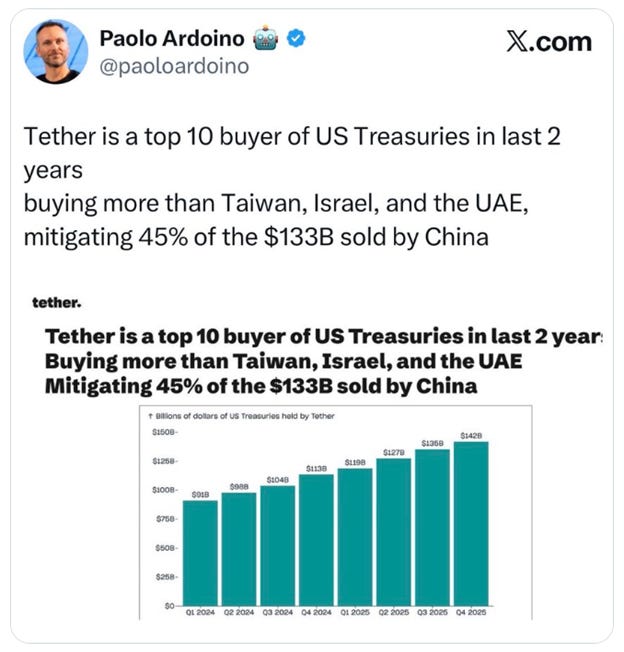
Tether is still buying, and is now Top 10. This is the CEO of Tether, who points out that Tether has stepped up to buy nearly half of the bonds that China’s central bank is selling off. Tether is also a major buyer of gold, and today holds 132 tons. Tether is the largest gold holder outside of financial institutions, central banks, and governments.
But Tether is not a bank, which lends long term and is repaid over years. Tether earns interest income from Treasury bond holdings, but lends very short term, often overnight, at very low rates. But they can flip their asset book over many times, even in a single month. USDT is how millions of people in Africa, South America, and Asia prefer to hold dollars.
American citizens are not allowed to use Tether. So this adoption of Tether, USDT, a US-dollar-denominated stablecoin, is taking place completely outside the United States. And that feature is also appealing for the users of Tether. They don’t need to worry about whether their central bank is doing a good job managing foreign exchange reserves, or whether moneychangers are recycling US dollars to buy villas in Cyprus instead of keeping dollars in circulation in Israel. Tether allows them to keep and use dollars, without concern of what is going on in-country, while also being outside the US banking system and out of the reach of regulators in Washington or in Europe.
And it’s that part that is especially attractive to users in Global Majority countries. Back to that graph of Stablecoin adoption, and we see that the biggest jump came after 2022. From 2021 through 2022, use of Stablecoins plateaued, at around $8 trillion in volume per year. Then it more than doubled; over $18 trillion. And that was because of the sanctions on Russia. Hundreds of billions of dollars held in European banks were frozen, seized. That action, alone, destroyed the credibility of the Western banking system in the BRICS countries, when policymakers everywhere learned that their US dollar holdings can vanish in an instant. The global majority countries now had no choice but to de-dollarize, and build up their foreign exchange reserves with gold, instead of fiat currencies issued by governments elsewhere, and held in banks elsewhere.
“Dollar assets held abroad can be frozen”. That explains so much of the appeal for Stablecoins, because they are held in digital wallets, instead of in banks.
But now those days are gone, too. I see the term “shadow banking sector” a lot and I’m not sure what it really is, but apparently Iran has one, and they use it to sell their oil abroad without going through banks in New York or London. Some of those buyers are Chinese refineries, and the Treasury Department is cracking down on those oil sales.
This is called “Operation Economic Fury”, and the Treasury Department says they seized $500 million in Iranian cryptocurrency assets, and they say they’re doing it as a favor, to the Iranian people. The campaign has been going on for over a year—which predates the shooting war, by the way. The Secretary of the Treasury is “freezing bank accounts everywhere”, like “the retirement funds that they thought they had outside of Iran”.
The agency is sending warnings to buyers of Iranian oil, threatening secondary sanctions on their industries, and on banks that are used to buy oil from Iran. “We will follow the money that Tehran is desperately attempting to move outside the country.” They’re going after the villas in the French Riviera. Everywhere Iranian oil money went out to buy things, Treasury is going after them.
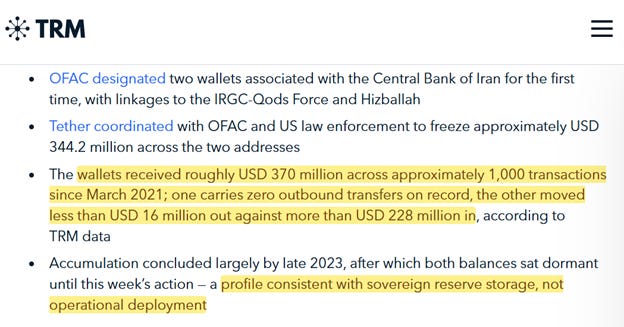
OFAC is the Office of Foreign Assets Control, and one of those sanctioned companies is a Chinese refinery in Dalian, and OFAC worked with Tether to seize $344 million in accounts. What is strange though, is that this was NOT money that was going to buy luxury houses in Europe. It was sitting on deposit at the Iranian Central Bank. It was held as “sovereign reserve”. Since 2021, the wallets took in $370 million USD over 1,000 transactions. Less than $16 million went out. Total outbound activity in both wallets was $25 million over their lifetimes, which is just 7% of what came in. What’s more, most of the activity in those wallets stopped about three years ago, and the reserves were just sitting there:
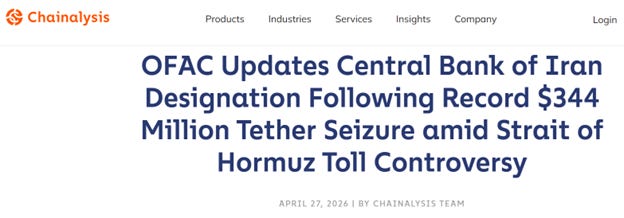
But now, with Tether, wallets can be frozen even if they’re sitting on reserve in central banks, anywhere. Not only can Washington or Europe seize assets held in custody, in trust, in their own banks—they crossed that line in 2022. Now they can get to USD stablecoins held anywhere in the world. This is Tether’s media release. US authorities gave Tether information about companies using USDT to buy Iranian oil, identified the wallets used, and Tether froze $344 million USDT on those two addresses. Tether points out there that their blockchains are a visible trail for investigators and regulators, and assets can be frozen before they can be moved if there are credible links to sanctioned entities.
It took about ten seconds for the whole world to realize the significance of what had just happened. Tether stablecoins are not a neutral currency. They’re compliance tools, and there is no point in holding them, because nobody can possibly know which way the political winds are going to blow.
Tether cooperated directly with the Treasury department to seize the funds, which were on the Tron network. The “level of coordination between Treasury and Tether is much more powerful” than anyone thought. Decentralization doesn’t protect you. Bitcoin had been selling off. But that stopped and is turning around, fast. Bitcoin cannot be censored or seized, but the world now knows that Tether can.
All the governments in the world just discovered that Tether is little more than buying Treasury bonds that can be frozen at any time. Here’s a nice, compact summary of the last five years: the SWIFT system was sold as a messenger service that helped banks move money. Now it’s a weapon. US dollar reserves in the European banks were safe, that’s over. Gold sitting in London vaults were the same as in your vault at home. Those days are gone. Then came Stablecoins, a way for people to trade with dollars, and now that’s over too. Tether could have been one of the most important companies in world history, but nobody can trust them anymore, either. All that’s left is gold, and central bank digital currencies.
Here’s what we mean. Going back to those Iranian wallets that were seized. Iran took in $370 million across a thousand transactions. That’s $370,000 each, on average. These are big purchases, but not supertanker-sized deals, which would be hundreds of millions of dollars. So just small percentage-sized proceeds of those oil trades went to those two wallets, and they were frozen.
Those transactions though are also much, much bigger than any household user in Brazil, or in Nigeria, can possibly ring up even over a lifetime of use. So what did Tether just do? They just told every government in the world that they cannot be trusted either. The Treasury Secretary and Tether’s CEO were taking victory laps on the freezing of $344 million or whatever it was, but that was a cheap lesson as far as the rest of the world is concerned. The growth of Tether and US stablecoins, the vertical line that blew through MasterCard and Visa—that just stopped, forever.
Be Good.
Resources and links:
Tether Acquires Over 6 Tons of Gold in Q1 2026, Expanding Holdings to 132 Tons
https://phemex.com/news/article/tether-acquires-over-6-tons-of-gold-in-q1-2026-expanding-holdings-to-132-tons-78288
https://www.binance.com/en/square/post/318603926546673
Tether Supports Freeze of More Than $344 Million in USD₮ in Coordination with OFAC and U.S. Law Enforcement
https://tether.io/news/tether-supports-freeze-of-more-than-344-million-in-usdt-in-coordination-with-ofac-and-u-s-law-enforcement/
OFAC Updates Central Bank of Iran Designation Following Record $344 Million Tether Seizure amid Strait of Hormuz Toll Controversy
https://www.chainalysis.com/blog/central-bank-of-iran-designation-ofac-update-april-2026/
Bessent says US seized nearly $500M in Iranian crypto as Operation Economic Fury sends regime into ‘crisis’
https://www.foxbusiness.com/media/bessent-says-us-seized-nearly-500m-iranian-crypto-operation-economic-fury-sends-regime-crisis
The US just seized $344 million in crypto from Iran — and it’s a preview of how sanctions warfare works in 2026
https://www.binance.com/en/square/post/318759455947378
JUST IN: Tether is a top 10 buyer of US Treasuries
https://www.kucoin.com/news/insight/USDT/69f4e1782f8d6c000731a218
The CBDC we already have
[ Gold and Geopolitics
The CBDC we already have
The product was sold as the alternative…
Read more
6 days ago · 146 likes · 66 comments · No1](https://no01.substack.com/p/the-cbdc-we-already-have)
Dollar Shortage Still Looms After Argentina Buys Time at IMF
https://www.bloomberg.com/news/articles/2026-04-17/dollar-shortage-still-looms-after-argentina-buys-time-at-imf
Scott Bessent’s $20 billion dollar gamble on Argentina
https://www.npr.org/2025/11/14/nx-s1-5609382/argentina-loan-bessent-treasury-bailout
Treasury Dept. Issues More Sanctions on Iranian Oil Exports
https://www.nytimes.com/2026/04/28/us/politics/treasury-iran-oil-sanctions.html
Treasury Yields Snapshot: May 1, 2026
https://www.advisorperspectives.com/dshort/updates/2026/05/01/treasury-yields-snapshot-may-1-2026
Stablecoins: Definition, How They Work, and Types
https://www.investopedia.com/terms/s/stablecoin.asp
How does US foreign aid work and where does it go?
https://usafacts.org/articles/which-countries-receive-the-most-aid-from-the-us/
Tether minted around $15 billion in profit last year—and its CEO makes a strong case for finance leaders to finally embrace stablecoins
https://fortune.com/2026/01/27/tether-15-billion-profit-lceo-strong-case-finance-leaders-embrace-stablecoins/
Why are BRICS countries buying so much gold?
https://www.idnfinancials.com/news/63107/why-are-brics-countries-buying-so-much-gold
Bitcoin on May 4: BTC Price Hits $80K for First Time Since January
https://bitcoinfoundation.org/news/bitcoin/btc-price-hits-80k-for-first-time-since-january/
Why Nigeria ranks number one globally in USDT, USDC ownership
https://tribuneonlineng.com/why-nigeria-ranks-number-one-globally-in-usdt-usdc-ownership-experts
Inside China / Business is a reader-supported publication. To receive new posts and support my work, consider becoming a free or paid subscriber.
From Inside China / Business via This RSS Feed.