

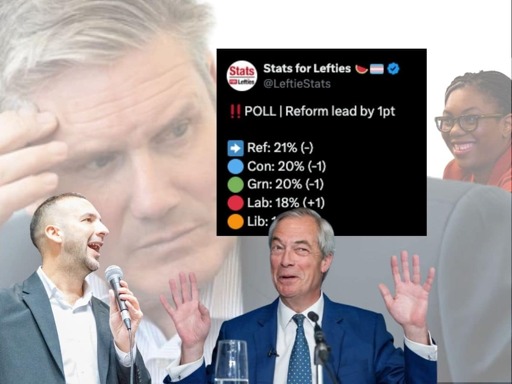

With the local elections set to take place on 7 May, all eyes are on the fight between the political parties. This is especially true given that we now no longer have two primary parties. Instead, we have five mid-sized parties (in terms of polling).
In the latest example of this, a new poll from Lord Ashcroft puts the Tories and Greens neck and neck, with both one point behind Reform.
POLL | Reform lead by 1pt
Ref: 21% (-)
Con: 20% (-1)
Grn: 20% (-1)
Lab: 18% (+1)
Lib: 11% (+2)
{ Seats }
SNP: 48
Poll: @LordAshcroft, 23-27 Apr (+/- vs 30 Mar) pic.twitter.com/QjevEqb8SJ
— Stats for Lefties
(@LeftieStats) May 3, 2026

Intranational
The data above relates to how people would vote in a general election if they voted today. Should the above play out, Reform and the Tories would have 331 seats between them, which would be enough for them to form a majority coalition government.
Meanwhile, the other five parties, would collectively have 292 seats, which is below the threshold needed to form a majority government (322).
Although Reform initially sold itself as an alternative to the Tories, both parties have increasingly shown willingness to work together. A key example of this is Reform UK admitting ex-Tories into the party (although they have put a stop to that following a polling dip).
Another is what the Telegraph reported on 29 April:
Nigel Farage has opened the door to a coalition with the Conservatives as Reform UK’s poll ratings plateau.
Speaking to broadcasters on Wednesday, Mr Farage was asked whether he would consider an arrangement with the Tories to enable the right to take power after the next general election. He responded: “Let’s see.”
His conciliatory reply was in marked contrast to his comments a year ago, when he declared he had “no intention in forming coalitions with the Tories at any level”.
The piece goes on to note that Reform has suffered a polling slump since accepting the Tories into its ranks. The reasoning for the potential coalition, then, seems to be that Reform now recognises it can’t win a majority without joining forces with the Tories.
In other words, these two parties are now functionally one. Anyone planning on voting Reform to spite the Tory-Labour duopoly should be aware of this.
Local election votes
Of course, a poll on how people will vote in a national election may not be the best indicator for how they will vote in the locals. On that front, Stats for Lefties has provided the following based on projections from eight experts.
Oth +99
Average of projections produced by eight experts.
—
(NOTE: predictions that utilised AI were excluded.) pic.twitter.com/33AzxweKkb— Stats for Lefties
This poll suggests big wins for the Greens, but even bigger wins for Reform. Labour is the biggest loser of course, while the Tories don’t really have to worry in the long run given its growing links with Reform.
The real question now is whether the above will prove accurate or whether pollsters have underestimated support for the Greens, as they did in the Gorton & Denton by-election.
Featured image via X/ Barold
By Willem Moore
From Canary via This RSS Feed.