

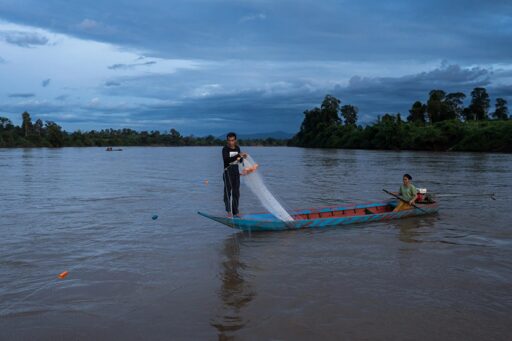
PHNOM PENH, Cambodia — Authorities from Cambodia’s Ministry of Environment were dispatched to Mondul Yorn, a small village in the remote northeastern province of Ratanakiri, on Feb. 13 to conduct water and sediment testing on the O’Ta Bouk River following community complaints of health problems linked to declining water quality. Then, from Feb. 17-20, the Inland Fisheries Research and Development Institute (IFReDI), a government agency that sits under the Fisheries Administration, sent two teams to catch 34 species of fish from the Sesan River and the O’Ta Bouk, a tributary that flows into the Sesan, itself a key tributary of the Mekong River. The O’Ta Bouk flows south through a gold mining operation in Ta Veng district before it reaches Mondul Yorn, where Indigenous Brao communities have reported experiencing skin rashes and itching sensations after coming into contact with the river’s water since gold mining began in mid-2023. To date, no results of water, sediment or fish sampling have been made public, despite experts urging more comprehensive testing and communities languishing in uncertainty over the safety of the river. IFReDI officials taking samples on the O’Ta Bouk River in February 2026. Photo sourced from IFReDI’s Facebook. A park in peril Villagers living along the O’Ta Bouk report the river had turned brown and murky starting roughly in mid-2023; the mud on its banks, sticky. Many of the Brao farmers and fishers have avoided entering the water, drinking it or bathing in it or fishing in the river. These problems persisted…This article was originally published on Mongabay
From Conservation news via This RSS Feed.