

By Weena Meily, AWIT
Acts 6:1-7
Psalm 33:1-2, 4-5, 18-19
1 Peter 2:4-9
John 14:1-12
When I think of the figure of Jesus as the Good Shepherd or Jesus as the Way, the Truth and the Life, I would always think of Fr. Joe Dizon. He went beyond his sacramental duties and brought to life what he preached. His prophetic witness, “a shining example of a man-of-the-cloth who transcended the traditional role of a priest in Philippine society” whose lifelong mantra was “Sandigan ang masa; paglingkuran ang sambayanan” (“Rely on the masses; serve the people.” At protest rallies against the Marcos dictatorship, he would say mass to prevent violent dispersal by the government. He actively campaigned for honest elections and helped form people’s organizations in rural areas to support those dealing with land-grabbing and military abuses. Till his last breath in 2013, Fr Joe defended human dignity and fought for workers’ rights to a just living wage.
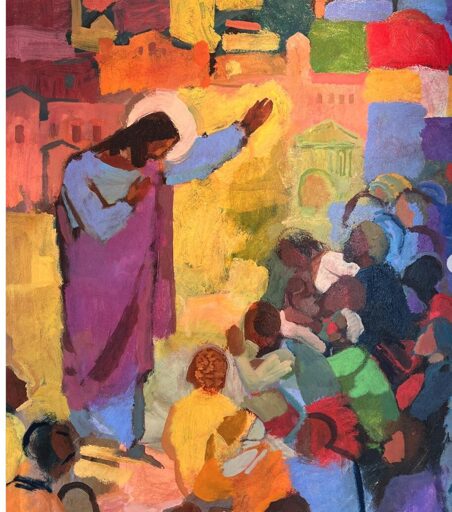
??Last Sunday we met Jesus as the Good Shepherd. In this Sunday’s readings we are invited to explore another facet of who Jesus is. Last week, we focused on listening to the Shepherd’s voice. This week, we are invited to trust where that voice is leading us, especially when the path feels uncertain or “troubled.”
?It is striking how a text written two millennia ago can feel so incredibly “on the pulse” of our current global crises. When we look at John 14:1–12 through the lens of today’s specific headlines—wars, geopolitical conflicts, climate change, systemic injustice, structural poverty—the passage ceases to be a gentle comfort and becomes a radical, grounding manifesto.
‘Do not let your hearts be troubled” – Resilience in the face of polycrisis
??We live in an era of “polycrisis”—where climate change, pandemics, and economic instability feed into one another. The command “do not let your hearts be troubled” isn’t an invitation to be indifferent or to “toxic positivity.” In a world of 24/7 news cycles and disinformation, “trouble” is a constant baseline. Jesus is offering a psychological and spiritual anchor. I believe He is suggesting that while the world is in chaos, our core identity does not have to be defined by that chaos. It is a call to maintain a “centeredness” so that we can act with clarity rather than reacting out of panic or despair.
‘The father’s house’ as global solidarity
?In our time, the “Father’s House” with its “many dwelling places” serves as a direct challenge to narrow nationalism, war, and xenophobia.
?While wars are fought over borders and “living space,” the Gospel presents a vision of a shared, universal home. It suggests that there is enough “room” for everyone. Within the context of refugee crises, mass displacement, and urban homelessness, this text acts as a social critique: if God’s house has many rooms, our world must also find ways to house the vulnerable. It reclaims the earth as a shared “oikos” (home) where every life should have a reserved space.
‘The way and the truth’ vs the disinformation age
?We are currently navigating a “post-truth” world where fake news and disinformation are used as weapons of conflict and political control. When Jesus says, “I am the Truth,” He is defining truth not as a set of manipulated statistics or “alternative facts,” but as integrity and sacrificial love. To follow the “Truth” today is to be a person of radical honesty in a world of spin. To follow the “Way” is to reject the “ways” of violence and greed.
?It challenges us to ask: Does this information lead to “Life” for the community, or does it sow division and death?
‘Greater works’ in the midst of crisis
?Jesus’ promise that his followers will do “greater works” takes on a profound urgency when we face hunger and poverty, pandemics, and climate change.
?In healing and science, the “greater works” are manifested when the human community collaborates to cure diseases, discover ways to food security, and innovate technologies to heal the planet. Jesus’ healing was local; modern “greater works” can be global.
?In the area of economic justice, in the face of an unjust living wage and economic crisis, the “greater works” involve restructuring our societies so that the “abundant life” mentioned in the Good Shepherd discourse is a material reality for the worker, not just a spiritual platitude. It means advocating for systems where no one is “homeless” in the economic sense. In our time, following “The Way” might mean choosing a path of sustainability instead of consumption, peace-making instead of polarization, and truth instead of convenience.
Life-giving vs death-dealing
?In our current world, we often encounter a “culture of death”— in the literal sense of violence or war, and in the systemic ways life is devalued: through the “disposable” nature of workers, the destruction of the environment for profit, the extra judicial killings, the consideration of civilians as collateral damage in wars, and the isolation that leads to despair. How then does Jesus, who is Life, stand in opposition to that culture?
Life as an offering, not a transaction
?The world’s culture of death often operates on the idea of taking. Power is maintained by taking resources, taking advantage of the weak, or taking a life to resolve a conflict.
?Jesus redefines power as laying down.
?”No one takes it from me, but I lay it down of my own accord.” (John 10:18)
?When Jesus lays down His life, it isn’t a defeat; it’s a radical act of sovereignty. He shows that the ultimate counter-measure to a culture that kills is a love that gives. By “laying down” His life, He breaks the cycle of “taking,” proving that self-gift is more powerful than self-preservation.
??Life as Quality (Abundance) vs. Quantity (Survival)
??The culture of death convinces us that we are in a “survival of the fittest” mode. It makes us live in a state of scarcity—fearful that there isn’t enough money, enough room, or enough time. This leads to the “death” of our joy and our spirit.
?Jesus says, “I am the Life.” This “Life” (Zoe in Greek) isn’t just biological survival; it is the unshakeable vitality of God. While the world offers “survival” at the cost of our soul, Jesus offers “Abundance” even in the face of physical threat. To choose His life is to choose to live with an open heart, even when the world tells us to close it for “safety.”
Life as the ultimate ‘inconvenience‘
?The culture of death often seeks the “easy way out”—silencing dissent, ignoring the poor, or choosing “efficient” solutions that ignore human dignity.
?Jesus being “The Life” is inherently inconvenient. Life is messy; it requires tending, patience, and sacrifice.
?The Good Shepherd doesn’t take the easy road; He goes into the thicket to find the one sheep. The Way is a narrow path of service, not a highway of convenience.
?The challenge of the Christian calling
?Every time we choose to protect the dignity of a worker, tell the truth in a world of lies, or care for a sick neighbor, we are participating in Jesus’ “laying down” of life. We are essentially saying that Life—in all its messy, fragile, and beautiful forms—is more real than the shadows of death. Fr. Joe Dizon, priest activist, champion of workers, and beloved of the masses, once said, “The church will never go astray as long as it continues to be with the poor in their work for struggle and resurrection from the many forms of ‘deaths’ imposed upon them by the evils of injustice.”
Balik-Tanawis a group blog of Promotion of Church People’s Response. The Lectionary Gospel reflection is an invitation for meditation, contemplation, and action. As we nurture our faith by committing ourselves to journey with the people, we also wish to nourish the perspective coming from the point of view of hope and struggle of the people. It is our constant longing that even as crisis intensifies, the faithful will continue to strengthen their commitment to love God and our neighbor by being one with the people in their dreams and aspirations. The Title of the Lectionary Reflection would be Balik –Tanaw , isang PAGNINILAY . It is about looking back (balik) or revisiting the narratives and stories from the Biblical text and seeing, reading, and reflecting on these with the current context (tanaw).
The post Balik-Tanaw | The inconvenient life: Radical solidarity in the era of polycrisis appeared first on Bulatlat.
From Bulatlat via This RSS Feed.