

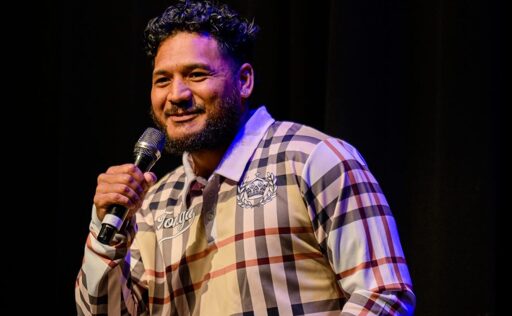

Opeti Vaka (Ngāti Porou, Tonga) is a nominee for this year’s Billy T Award. When he’s not doing stand-up comedy, he runs a kava bar in Levin and looks after his three children. (Photo supplied)
Among the many comedians performing at this year’s Comedy Festival — running in Wellington and Auckland until May 24 — are five nominees for the Billy T Award, which goes to up-and-coming comedians judged to have outstanding potential.
Here’s Dale, getting to know one of the nominees, Opeti Vaka (Tonga, Ngāti Porou), whose 2026 Comedy Festival Show is I LOVE MY MUM.
Tēnā koe, Opeti. I always start with names and villages, so I wonder if you’d be kind enough to shed some light on your whakapapa lines.
My father’s from Fua’amotu, a village in Tonga. His name’s Visone He-Lotu Vaka. And my mother, Maria Haenga-Collins, is Ngāti Porou. We whakapapa to the East Coast.
What about your name? Tell us how you got it.
I’m named after my granddad, my dad’s dad.
Where did you grow up?
I was born in Wellington and grew up in the eastern suburbs with both parents in the house till I was about 9 or 10, when they got divorced. And then my mum raised us. I’ve got two sisters, Kahurangi and Liletina, and one brother, Phillip.
I very much respect the work that comedians do. And, of course, our people, Māori and Pasifika, love performing. We love laughter. So it’s very important to us that we have people who celebrate with laughter. Tell us a bit about schooling and how you started performing. Were you in kapa haka and things like that?
I went to Rongotai College, and I wasn’t in any kapa haka or Poly groups at school. I was quite introverted. I was too shy to do anything. But around family, I was a performer. That’s my defence mechanism. If I’m embarrassed, I’ll make a joke. If I feel scared, I’ll make a joke. If I don’t know the answer, I’ll make a joke.
When was it that you first took an interest in comedy and comedians?
When I was about 14, I saw some comedy on TV. And I thought: “That’s really cool.” And I went and wrote me a little set, but I didn’t do anything with it. I just performed it to one of my best friends, and then forgot all about it.
The next time I saw comedy was the comedian Vela Manusaute on TV3, and I thought he was the funniest person I’d ever seen. I thought: “Man, I want to do that.”
Years later, when I turned 30, I was bored and trying to find something that I might be good at. And ever since I was a little kid, my mum always said: “Boy, you’re a comedian.”
So I thought I’d give that a try, and I went along to an open mic night at the Fringe Bar in Wellington. Just to see what it looked like and what was involved. And I thought: “I’m as good as these dudes.”
So I registered to compete in the next open mic night, and I went and did my six minutes. And I absolutely destroyed it. I crushed it. The organisers said I was the best first-timer they’d ever seen.

“I’ve always looked at things in a funny way. All the hurt times in my life, or the times that I’ve been vulnerable, I’ve always turned into comedy.” (Photo supplied)
When you perform, you’re just being yourself, right?
Yeah, pretty much. I’ve had a lot of feedback from other comics, and they say: “You’re just yourself.” That’s mostly because I didn’t have any previous experience with comedy, and I hadn’t watched a lot of comedy before I started doing it. So I wasn’t trying to be like Chris Rock or Chris Tucker, or any of these famous comedians. Some people mimic them, but I’ve got my own style.
What about comedy in the Tongan culture? It’s a beautiful trait of our Pasifika people, don’t you think?
I totally agree. I think one of the things Pacific people enjoy is each other’s company. We like being around family and friends, and when we’re together, we like to talk a lot. And while we’re talking, a lot of it is jokes and making light of situations that some people might not find funny, but we make them funny.
It’s a real skill. That first set that you did at the Fringe Club, tell us about that feeling of bringing the audience with you on that very first ride?
On the first laugh, I just got this rush. It felt unreal. I’ve never had that feeling before. It was like an out-of-body experience. That’s the only way I can put it. Like it was a super, super high, and my adrenaline was pumping.
It’s weird, because speaking publicly is my worst fear. I’m not scared of fighting or violence and stuff like that, but to speak in public was the scariest thing. When I performed, this big rush of energy just hit me.
Your mum recognised your skill way before anyone else, hey?
Yeah, she’d say, “That’s enough, Mister Comedian,” if she’d had enough of my jokes. But she’s been one of my biggest supporters to this day.

“Ever since I was a little kid, my mum always said: ‘Boy, you’re a comedian.'” Pictured: Opeti with his mum, Maria Haenga-Collins. (Photo supplied)
Have you performed your comedy to a Pasifika audience? How do they respond when you put your routine to them?
In most of the comedy clubs, the audience is predominantly white, but I’ve performed at a marae before. The feedback I’ve had is that my comedy goes both ways. It crosses the barrier between colours and different backgrounds. Most people get it. It’s comedy, and not everyone’s gonna love you, but most people seem to think I’m all right.
I was talking with Mike King one time, and he told me he fixated on the guy who wasn’t laughing. He just couldn’t shake him out of his head. Because if you’ve got an audience of 100 people and 95 of them are having a great time, you’re gonna get the odd stick in the mud with the glum face. How do you react when, despite your efforts, some people just aren’t in the mood for laughter?
I don’t focus on them. I focus on the people who are smiling. But they’re in the back of my mind. I don’t forget about them. I look at them first, I have a go, have a good crack at making them laugh, but if they’re not getting it, I just move on. I focus on the people who are enjoying it.
Often when you’re on stage and the lights are on, you can’t actually see the audience, āe?
Yeah, just the first couple of rows.
Tell us about putting your routines together. How do you identify material, and how much work is involved in making it work?
Most of it is behind the scenes — writing it, practising it — and the audience just catches the end part, which is when we perform on stage. I’m a night owl, and I’m more creative at night. So from about 12 to 3 in the morning, I will just sit there, think of topics that I’ve seen throughout the day, or write notes on my phone if I have a funny thought. And then I come back to it in the evening, and I work the jokes out.
I’m a bit of a storytelling comedian, so I make a story of it. And then I just add to it and add to it until it becomes a solid piece of work.
I’m a bit lazy when it comes to practising. That’s the bit I struggle with the most.
I marvel sometimes at the ability of comedians to maintain focus through an hour-long set. I know it starts off at six minutes, but then as you get better, it goes longer and longer. How do you remember what’s following what?
I don’t write my set lists on my hand because I don’t want to rely on it. So I memorise the whole thing pretty much word for word and break the hour into 15-minute sets. So when I finish one joke, I know what joke comes next. It’s called the outs and ins.

Opeti with his father, Visone He-Lotu Vaka. (Photo supplied)
What do your routines tend to focus on? Is it a Pacific and Māori view on New Zealand society?
I’ve always looked at things in a funny way. All the hurt times in my life, or the times that I’ve been vulnerable, I’ve always turned into comedy.
One time, the armed offenders squad came to the house where I was staying, and they put us all on the lawn and told us to lie face down. One of my cousins was taking too long to come out of the house, and a dog handler came from the back, and he said: “Who tried to climb out the window?” I couldn’t help it, I started laughing. And the cop said to me: “What are you laughing at? This isn’t funny.” And I said: “He can’t fit through the window.” I’ve always turned my pain into laughter.
What about inspiration, Opeti? Whose comedy have you looked at and thought: “Gee, that’s neat?”
George Carlin. I like him because he’s saying more than just jokes. There’s a depth and truth to what he’s saying. I also look up to Vela Manusaute, the comedian I first saw. He’s one of my friends now, and we talk comedy all the time.
I like Tofiga and what he’s done. We’ve got very different styles, but he was a big influence. Just seeing him reach the heights that he’s reached made me feel like I could do it too. David Chappelle is an influence as well.
The show that I did last year and a few years before that was more political, with Treaty-centric jokes and race relations jokes. But this new show doesn’t cover so many serious topics. It’s a lot warmer show.
Do you do sexual innuendo jokes, or do you try and avoid them?
I always add a couple in there, but I generally try to avoid that. It’s not my taste of comedy. I do some, but I do it in a way where you can’t get mad at me for doing it because the way I set it up was clever.
Have there been times where it hasn’t worked and you’ve had to question yourself?
I’ve had a couple where it was just the wrong joke for the wrong crowd. One time, I was doing Jesus jokes at a soccer club, and I didn’t know that most of the members of this club were Greek Orthodox Christians. It didn’t go down well with them. I remember the looks on their faces. They were shocked.

“I didn’t know there was a thing called an open mic. I had to Google ‘comedy’, and ‘open mic’ came up, and I thought: ‘Oh, that’s where you go.’ I had no idea where to start.” Pictured: Opeti performing at the 2024 New Zealand International Comedy Festival. (Photo supplied)
We’re living in tough times, but laughter is an antidote for tough times. How have you seen your efforts uplifting people?
I’ve had people come up to me after the show, and they say: “Mate, I needed a good laugh. I really appreciate it.” And I performed at a marae where they’d had a lot of funerals over the previous couple of months. They wanted to come together for a happy event, so they organised for me to perform at the marae for them.
If you’re not enjoying life and laughing, you’re doing something wrong. I think life is meant to be thoroughly enjoyed.
Billy T James was credited as being one of our great comics, but for a time, his material was almost cringe — you know, the old Māori who stole the TV joke. And for a time, it was almost shelved. Do you think we’ve changed our attitudes and can laugh at ourselves in ways that we weren’t able to 10, 20, 30 years ago?
Yes, some of Billy T’s stuff was a bit of a low blow, but you can’t say that it wasn’t good. I think you can say anything if you put it together in a way that makes it funny. It’s gotta be funny. Then it’ll be allowed, accepted, and people will be able to laugh at it. But if you do some questionable material, and you’ve structured it in a way that’s not funny, you won’t get away with it.
Do you think that comedy allows commentary about social issues that don’t normally get touched on?
Yeah. I think it’s hugely important, especially in the political climate at the moment, that we can voice our point of view. It’s much easier to digest if you do it in a funny format.
Congratulations on being nominated for the Billy T Award, again. What do your peers, your cousins, your workmates from yesteryear think of this area that you’ve delved into?
My family’s extremely proud, but a lot of my friend groups, I don’t think they get it. They don’t know what a Billy T nominee is. They don’t even know what a Billy T award is. So there’s a bit of explaining to say: “It’s a big deal for me, guys.”
When a group of comedians end up backstage together, do you try to one-up each other? How would you describe the community of people who do the work that you do?
I think with comedy, you get the extremes. You get people with big egos, and then you get people who are quiet, with no ego. Some people are way out on one side of the spectrum — their egos are through the roof, and I find them to be quite annoying. Then you get really selfless people. But for the most part, people are supportive and understanding, because we’re all going through the same thing.
When we look at our Māori and Pasifika kids, there are wonderful performance opportunities to sing, join bands, join choirs, do kapa haka. Do you think that we’re connecting with them about the potential of comedy in their lives? Are we encouraging them into this area of creativity and performance as much as we might?
No, I think we’re not doing enough. There aren’t enough of us in this space. Like, in the green rooms when I meet other comedians, I often feel weird, like I don’t belong there. It’s better now that I’ve been doing it for years, but when I first started it, I didn’t like it. I would just go sit in the corner, chill by myself.
The more Māori and Pasifika comedians there are, the more it will help the next generation come through. But we’re not really going out and finding the talent, or we’re not making it accessible for the rangatahi to come in and do comedy.
I only found out what an open mic was when I was trying to perform. I didn’t know there was a thing called an open mic. I had to Google “comedy,” and “open mic” came up, and I thought: “Oh, that’s where you go.” I had no idea where to start, so I think, to help the rangatahi, we should be making it more accessible to them and showing them that it’s an option.
Comedy requires attentive skills throughout your day, because this is where the humour of life is. It’s right in front of us, and sometimes we’re not attuned to it. But everything starts on a page. What do you think about the importance of writing skills and writing in a comedic way? Are there some books that you’ve read, or is there anything helpful here? Because quality performance comes off the back of quality writing, doesn’t it?
I totally agree that it starts with the writing. I used to write raps. That’s where I got my writing skills from. Doing the similes and metaphors in my rap music, it was easy for me to transfer those skills over to stand-up comedy.
Where’s it all heading for you, do you think? Are you going to be a stand-up comedian for life, or do you wanna delve into film, stage or some other creative endeavour?
I’ll just take every day as it comes. I don’t wanna get too far ahead of myself. I’ll just try the best with the opportunities presented to me, but I will always do comedy. I’ve come too far, and too many people have believed in me for me to stop it now.

“I think you can say anything if you put it together in a way that makes it funny. It’s gotta be funny. Then it’ll be allowed, accepted, and people will be able to laugh at it.” (Photo supplied)
(This interview has been edited for length and clarity.)
Opeti Vaka’s show I LOVE MY MUM is on May 5-9 at Wellington’s Cavern Club, and May 19-23 at the Basement Theatre in Auckland.
The five 2026 Billy T Award nominees will perform one-hour solo shows during the Comedy Festival, culminating in their final performance atLast Laughs on Sunday, May 24, at SkyCity Theatre, where one comedian will take home the yellow towel and be crowned the 2026 Billy T Award winner.
The post Opeti Vaka: ‘Boy, you’re a comedian’ appeared first on E-Tangata.
From E-Tangata via This RSS Feed.