

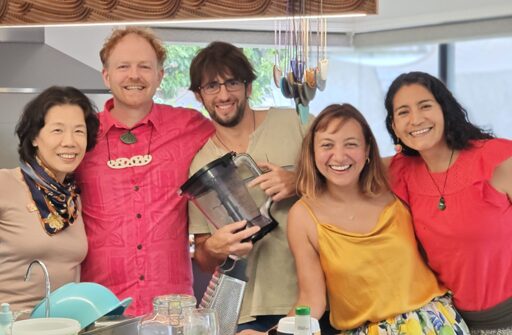

“I’d rather make the effort and court success than be too afraid of discomfort to try,” says Makaira Waugh (second from left) about his mission to acknowledge people in their own languages. (Image supplied)
A little bit of magic happens when you greet people in their own language, writes Makaira Waugh.
It started with an idea. A trip down south for the summer led to my wife and me staying at two different BnBs, both owned by Indian couples. Lovely people, whose hospitality I appreciated.
Driving back home to Taranaki slowly, just a few hours a day while Long Covid played havoc with my energy levels, I got to thinking. We’d met a number of Indian people, but what did I know of their languages?
Growing up in Cheviot, North Canterbury, I’d been pretty oblivious to culture and language. The only language option at school was French, and it wasn’t until I was 14 that I found out we had whakapapa Māori on my dad’s side. A curiosity developed that grew like a snowball until I made the bold move to leave our very Pākehā existence and venture north to Paraparaumu and then Taranaki, hungry for my heritage.
The transition between cultures was a huge journey. I’d grown up assuming that how we did things was how everyone did them, and learning te reo opened a door to another world. While there was plenty of crashing around with metaphorical shoes on inside the whare, learning the hard way to soften (or at least hide!) my expectations and observe rather than demand, gradually I came to understand how totally differently our people see the world.
The depth of thinking was like a drug to me, and I craved the insights of mātauranga that connected the whakapapa of life together in new and beautiful ways, rebuilding my own world.
The best part was the spiritual journey this learning enabled, and I found that the deeper meanings in my own wairua came to life within this language of connection, giving voice to my love of nature and spirit, and practices for uplifting it. Despite the arduousness of the journey and all its missteps, my relationship with my language, culture and especially my tūpuna is very much the first love of my life.
The joy of exploration and connection that came with opening the door to te ao Māori reverberates through my life, and the rich world I had discovered prompted a respect for and interest in other cultures and the languages that bring them alive.
After picking up a few phrases of Hebrew and Russian from various workmates, I settled into learning Spanish. There’s a whole other story here, a journey of love and romance that led me to México and marriage to the most amazing woman in the world, but the short version is that I speak it reasonably well for a beginner.
Once you begin studying your second language and overcome the main barrier of learning how to really listen and pronounce, new possibilities open up. There’s so much more than words and communication to gain from this journey.
When I explain to people why I decided to learn mihimihi (greetings and phrases) in as many languages as possible after my summer holiday, I put it like this:
When I walk into a shop in Aotearoa, my first words are: “Kia ora!” When the reply comes back, it’s often “Good morning”, “Hi”, or something similar — a response that leaves me a little flat, like something was taken from the interaction rather than exchanged. When I do get a “Kia ora” or “Tēnā koe” back, it’s a lift.
It’s like a little pōwhiri. My taki is submitted to the ground in generosity. Will it be taken up? Or kicked around, stood on? You wanted something less brown? Less mana-enhancing? Each time, it’s an offer to step into a relationship with me as mana whenua, to see and hear each other in this relationship in Aotearoa, this Tiriti partnership, this sharing of mana.
When I get a “Kia ora” back, it feels good. I am seen and recognised, valued. So why wouldn’t I want to give the same gift to others?
I decided to take up the challenge. To learn five mihimihi in as many languages as possible, so that I can give other people the basic respect of greeting them in their own language. To offer them the same koha as I enjoy, the warmth of heart that happens when we are seen, recognised, and valued.
My five mihimihi are:
Tēnā koe. Hello.
Nō hea koe? Where are you from?
Ko Makaira tōku ingoa. My name is Makaira.
Thank you.
Ka kite anō. See you again.
When I have to, I dive down the rabbit hole to learn these from online videos, but the best opportunities come when I meet someone who speaks another language and is willing to be recorded saying the mihimihi in that language. I record it once at normal speed, and once more slowly, so I can get all the sounds correct. There are so many nuances involved that I need to get right to honour the reo I’m attempting.
Of course, finding people to teach me their language presents its challenges. How do you guess whether someone might speak a language other than those you already know, and whether they might be open to either conversing in that reo or allowing you to record it?
Asking a random stranger if they speak another language mostly relies on the assumption that part of their ethnic heritage comes from another whenua. As a totally Pākehā-looking Te Ātiawa man, I have my own experience of being told I’m not really Māori, both subtly and in my face, mostly by non-Māori but also our own. The last thing I want to do is make someone else feel like they don’t belong here because of how they look. Yet I need to find people who speak a language from another country!
Relying on my own courage and honesty, I approach it directly and simply ask people (when I judge it appropriate) what languages they speak. I try to avoid anything that might indicate a judgment of who they are, but also trust in the genuine intention of respecting and connecting with people, and honouring their language and culture.
I figure I’d rather make the effort and court success than be too afraid of discomfort to try. It helps that I’m comfortable with appearing a fool, having survived many mortifying mistakes over the years. The results aren’t guaranteed, but I sure can back the integrity of my intention.
And the results have been magic. After weeks of learning mihimihi in 11 different languages, another trip south provides plentiful opportunities when my flight via Tāmaki Makaurau is delayed and then cancelled, leaving me stranded.
A nearby hotel puts me up, and I discover the rich ethnic diversity I’ve been longing for. While weighing up kai options, I practise Mandarin, Filipino, Japanese, Sāmoan and Tongan on unsuspecting airport staff. I imagine being a caped crusader, ready to whip out greetings like pistols in a gunfight. Up pops a fighter to my left, ready to shoot! Which language will I use? Pow-pow! One by one, they fall. The joy of connection is deeply fulfilling. Eyes light up.
On the evening bus to the hotel, my training is tested when I ask the Sikh driver which languages he speaks. I don’t think he really appreciates the question, but he lists them anyway: Punjabi, Kashmiri, English, Hindi. What a legend. In the split second I have to reply before walking on, my tired cogs fire and the correct reply leaps out of my mouth: “Dhanyavaad!” A smile. It helps that Hindi was the first language I worked on, but the satisfaction of having the right phrase in the right language come to me when I needed it is immense.
But there’s more to it than that. In this moment, in a creaky bus on a fading Tāmaki evening, I taste the reward of all this mahi. I am part of the world. As much as I already felt a love for people, for culture and for language, tonight something shifted. The simple act of sharing language with someone from far away has brought me a sense of kinship I’ve never experienced. A sense of being part of the world, less of an individual and more of a whole.
It’s only a small effort and a smattering of words against the sea of culture and history, but my small effort in many directions has taken some of the bitterness from my heart and brought me into relation with the entire world of people.
As much as it’s been about respecting and welcoming in other people, I realise it’s also about healing myself. The tears fall, and what was one very alone droplet of water is suddenly and smoothly absorbed by the great wholeness of an ocean, waiting so long for this very moment.
I thought I was doing good towards other people. It turns out, they were already there. Waiting to be let in.

Makaira with his wife, Tania Rodriguez Salinas (left), and friend Lata Gain. (Image supplied)
Makaira Waugh (Te Ātiawa) is a kaiako, artist and celebrant from Parihaka Pā in Taranaki. He is writing a book on his work facilitating Tā te Manawa healing and leadership retreats for Māori and Indigenous peoples in Aotearoa and México.
Makaira has learned the five mihimihi in Hindi, Sāmoan, Mandarin, Ayuujk, Filipino, ‘Ōlelo Hawai‘i, Cook Islands Māori, French, Gujarati, Japanese, Malayalam, Tongan, Tamil, Fijian, and Afrikaans so far, and aims to cover more than 100 languages.
The post A journey of one hundred languages appeared first on E-Tangata.
From E-Tangata via This RSS Feed.