

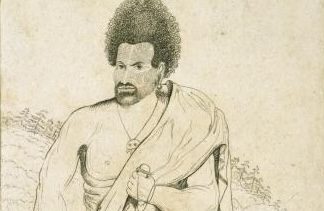

Te Tai Tokerau rangatira Te Pahi, who visited Sydney in 1805-06, “was a student of the colonists’ morals and standards, soaking up all he could about how they thought, acted and treated each other,” writes Eugene Bingham in this extract from his book The Chief and the Empire. (Alexander Turnbull Library)
In this extract from The Chief and the Empire*, Te Tai Tokerau rangatira Te Pahi has crossed the Tasman for the first time. One of the people he met during his three months in Sydney, after arriving in November 1805, was Samuel Marsden, who would later establish Anglican mission stations in Aotearoa.*
Te Pahi’s meeting with another figure in Parramatta was divine, and in centuries to come it would lead to a lasting impact on the whenua Te Pahi himself strode upon. Because if you go to Rangihoua today, in the bay alongside Wairoa, where Te Pahi had his pā, you’ll see a stone monument in the shape of a Christian cross, known as the Marsden Cross.
The land itself is a heritage park, developed by church and government bodies in partnership with Ngāti Torehina ki Matakā, commemorating the arrival in Aotearoa in 1814 of Samuel Marsden, and the establishment of the first Christian mission.
But Marsden’s influence went beyond religion, with academic Maarama Kāmira arguing, “Marsden’s relationship with Māori directly or indirectly paved the way for wheat, farming tools, the Anglican religion and guns being brought to New Zealand.”
And that all began with Te Pahi’s visit to Sydney in 1805–06. The timing is a bit unclear, but at some point during his stay, Te Pahi went to Parramatta and met Marsden.
Marsden was from working-class origins, born in Yorkshire, England; his father was a blacksmith turned farmer. Young Samuel helped his family on the land while also honing his skills as a lay preacher from a young age. Patrons who recognised his talent for spreading the word of God paid for his education, including a stint at Cambridge University. He was ordained as a priest in 1793 and almost immediately selected for service in the colonies, sailing with his wife, Elizabeth, to New South Wales in 1794.
They went to Parramatta, the second town of the colony, where Marsden quickly became influential. The thing about colonial settlements was that it was rare to have one job only. Hence, Marsden was not only a man of the church — officially the assistant chaplain of New South Wales — but he was also a large landholder, running sheep and cattle and growing crops, as well as a magistrate.
In these times, it might seem odd, a juxtaposition: preaching love and the mercy of God on a Sunday, dispensing justice and harsh punishments during the week. If so, the contradiction was apparently not an issue for Marsden; by 1805 he had been on the bench for almost a decade and had a reputation for severe sentences. He was known as the “flogging parson”.
To Marsden, his dual roles would have sat well together, preaching and upholding morality. Te Pahi was no doubt intrigued by this paradox, a society where so much stock was put on belief in one God only, a society which preached love for all mankind, and yet a society which meted out bloody, brutal and sometimes deadly consequences for those who breached its rules. And in Marsden — known by Māori as Te Matenga — that dichotomy existed within one man.
According to Marsden, he and Te Pahi sat for hours talking faith, religion and belief. He was impressed, later writing: “Tippahee was a man of high rank and influence in his own country. He possessed a clear, strong and comprehensive mind, and was anxious to gain what knowledge he could of our laws and customs. He was wont to converse much with me about our God.”
In terms of contemporary written records, we only have Marsden’s account of these conversations. Marsden gives the impression of Te Pahi and other Māori who visited him later as being taken by his descriptions of his Christian God, as if they had seen the light.
But his views were coloured by the attitudes of the day on race, and the European idea of the “Great Chain of Being”, the hierarchical ranking of all life and ethnicities. No prizes for guessing what ethnicity sat on top. Marsden wrote of Māori: “Their minds appeared like a rich soil that had never been cultivated, and only wanted the proper means of improvement to render them fit to rank with civilised nations.”
In time, of course, Christianity would come to have a considerable influence on some communities, one that many Māori treasured then and now. However, at the start of the 19th century, Māori remained fully grounded in their own beliefs, without European or any other influences. In fact, these concepts could be traced back to before Māori first arrived in Aotearoa, to Hawaiki.
Māori were grounded in their own whakapono (beliefs), guided by their own kōrero tuku iho (knowledge handed down through the generations) and tohunga, and with an intricate knowledge of the many atua of te ao Māori. So it’s not likely there would have been an immediate “Come to Jesus” moment for Te Pahi and others.
Kāmira, in fact, says those who met with Marsden vigorously debated his form of “spirituality, cosmology and god” and that there were arguments put that “Marsden’s god must have been lonely as there was only one”.
We do know that Te Pahi attended St John’s Church in Parramatta with Marsden, who observed: “When at public worship, [Te Pahi] behaved with great decorum.” The church still stands today, though it has been renovated and upgraded considerably. The layout and formality would have been an unusual sight to Te Pahi, with its pulpit and timber pews for the settler and convict congregation.
Marsden himself, then aged 40, stocky and vigorous with a firm jaw and an intense, earnest gaze, would have struck Te Pahi as a leader, but one who represented that strange confluence of punishment and prayer.
Parramatta was a source of many firsts for Te Pahi. For some of the time, he stayed at Government House in Parramatta, known as the country residence for governors since it was built in 1799. While there, it’s believed he tasted sugar for the first time — an explosion of taste that would have stimulated chemicals and reactions in his body and brain in a way he’d never known.
The settlement at Parramatta would have been a respite from the more bustling, fraught Sydney Cove. It was a rural setting with farmland, trees and the river. Huts, barracks and workshops were scattered around. Te Pahi would have smelt smoke rising from chimneys or open fires and heard the sound of axes thwacking into trees, the labour of land-clearing.
Back in Sydney, the vibe was different altogether. More grimy and urban. Ships were arriving from strange lands, barrels of rum were being rolled down gangways, and there was the noisy clanging of industry from the workshops and yards.
Meanwhile, far more refined but no less foreign to Te Pahi was the hoity-toity frivolity of what high society there was by then. Those who attended official dinners and events at Government House met with Te Pahi and were taken by his presence and wit.
Author and traveller John Liddiard Nicholas wrote about recollections of Te Pahi from “the gentlemen of the colony”, including the “shrewdness” of his remarks. “The colonists still hold in remembrance many of his remarks, which equally shew the solidity of his understanding and the justness of his conceptions.”
Nicholas recounted how one man, wearing poofed-up hair in keeping with the European fashion of the day, had found himself on the wrong side of Te Pahi after mocking his mataora and other moko. “On being laughed at one day by a gentleman for having disfigured his face in so unnatural a manner, the sagacious chief immediately retorted with pointed sarcasm, telling him he was quite as much an object of derision himself for having put powder and grease in his hair, a practice which he thought was much more absurd than the tattooing.”
Jousting with the bizarre-looking ladies and gentlemen of the colony was one thing, but Te Pahi was there to study, keenly observing all aspects of this society. He understood that there were many things to learn, things which could enrich and empower the trade possibilities and economic well-being of his people.
But he was also a student of the colonists’ morals and standards, soaking up all he could about how they thought, acted and treated each other. He was doing this to gain an understanding of the captains and crews of the ships that were coming with increasing frequency to Aotearoa, men whose behaviour was on a worsening trajectory — after all, there’s a reason that in a few decades Kororāreka in Pēwhairangi, the Bay of Islands, would become known as the “Hellhole of the Pacific”.
But Te Pahi was also someone who was very interested in people, in what made them tick. Dame Anne Salmond describes him as an anthropologist, as much as Sir Joseph Banks had been on Cook’s expeditions. Te Pahi wanted to get into the heads, to see into the souls, of these people. There were so many windows to see through — the social structure, the economy, the way they were governed. And so much more.
His meeting with Marsden had introduced him not only to the concept of religion, but that of crime and punishment, too. What underpinned the colonists’ penal system? How did they dispense justice?
A majority of the men and women had arrived as convicts, mostly impoverished people dispatched to the other side of the world, far away from their families, as sentences for crimes which, to his mind, seemed hardly fitting of the punishment.
Now he’d heard about the courts in the colony itself. What went on there? Who were the people who found themselves at its mercy? What happened to them?
His curiosity grew, so much so he decided it was time to see for himself.

The Chief and the Empire, written by Eugene Bingham and published by Allen and Unwin Aotearoa New Zealand.
Extracted from The Chief and the Empire by Eugene Bingham, published by Allen and Unwin Aotearoa New Zealand, RRP $39.99.
For more about Te Pahi and the book, see Eugene’s piece Te Pahi — a story of mana and mamae.
Eugene Bingham (Pākehā, Ngāpuhi) is a freelance producer and writer. He has been a journalist and storyteller for 35 years, reporting and producing news and current affairs across newspapers, television, digital and podcasts. Eugene has been learning te reo Māori since 2021, mostly at Te Wānanga o Aotearoa. He lives in Tāmaki Makaurau, Auckland, with his wife, journalist Suzanne McFadden, and their children and mokopuna.
The post Understanding the colonists appeared first on E-Tangata.
From E-Tangata via This RSS Feed.