

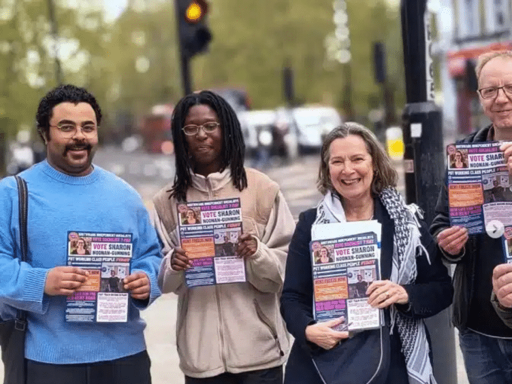

Southwark — With just five days until the local elections, polls expect Starmer’s Labour to take a significant hit at the ballot box. The 7 May looks likely to see thousands of incumbent Labour councillors losing their seats to opposition parties. Increasingly, the choice appears to be between the far-right Reform and progressive candidates in the Green Party or local independent community groups.
We spoke to Sharon Noonan-Gunning, a long-time public health campaigner and Right to Food activist. She is an Independent standing in Old Kent Road, Bermondsey, with the backing of Southwark Independent Socialists. Noonan-Gunning told us about her local campaign which draws on her extensive experience and long-standing commitment to progress and social justice.
She is also raising the alarm about the horrifying scale of infant deaths contributed to temporary housing — a scandal also amplified by Lullaby Trust, for which a terrifying lack of concern seems to be felt in the MSM and amongst the Westminster elite.
View this post on Instagram
A post shared by Southwark Independent Socialists (@southwarkindependentsocialists)
Noonan-Gunning: ‘It’s the scandal of our times’
Firstly, highlighting the urgency for socialism across London and the UK more generally, Noonan-Gunning told us about the horrific statistics surrounding temporary accommodation.
In particular, she drew attention to the devastating number of deaths attributed to living in inadequate and insecure temporary accommodation:
There are 3,500 children in temporary accommodation. The figures that came out last week show that between 2019 and 2025, 104 children died in temporary accommodation – 76 of those were infants – and it was living in temporary accommodation that contributed to their deaths.
On top of that, I think there’s another 176 where there were babies who died through either stillbirths or neonatal deaths.
The scandal of temporary accommodation – it’s the scandal of our times. That’s what I’m saying mostly to people on the doorsteps as well, because we can’t tolerate that – we can’t. And the fact that we only find it out because, I think, it was from the national news last week – this week – about healthy life expectancy. And in the North, the gap is getting even bigger, so working-class people are living shorter lives and with more illness.
I’d want to see myself as a public health campaigner, standing in some of the traditions of the trade unions who fought for public health over 150 years ago. I think that’s where we’re going back to now, but public health often gets rubbed out.

We asked Noonan-Gunning why she chose to stand and whether this was her first foray into local politics. Explaining her history with the local Labour Party, it becomes evident that this Independent is absolutely a safe bet for local voters to challenge our cruel establishment:
No, I was selected by Labour in Rotherhithe by the local Labour Party in March 2022 to be one of the three candidates. But very soon after, I was deselected, having had two interviews in which they accused me of not standing by the values of Labour.
The first issue was that I didn’t support the Canada Water Master Plan. So that’s one of the main developments taking place in SE16. They promised 35% affordable housing, but before Christmas they said they’d run out of money, and that dropped down to just 3%. I believe they then went to Sadiq Khan – it went to the GLA – and now I think it’s gone back up to 9%. But it just tells the story of what working with and trusting developers is like. You know, some of them could be very nice people, but their interests are totally different.
I left Labour after 2022 because there was no point in staying – they made it clear that they didn’t want people like me and my views within the Labour Party, which are very much community-based views. So then I recently got involved with Your Party, and then we became independent socialists, and are now standing in Old Kent Road. It neighbours Rotherhithe, and it was a ward that the Southwark Independent Socialists felt was important because it’s on the boundaries – it crosses Peckham and Bermondsey – so it borders onto Rotherhithe but covers both Bermondsey and Peckham.
I see it as the beating heart of Southwark. It’s at the centre of Southwark and brings all the communities together. But it’s also at the forefront of a lot of the developments that are taking place. So that’s the key thing. It’s the sort of struggles that we had with Canada Water, which are still ongoing, but they’re now amplified – much bigger around the Old Kent Road ward area because it’s a bigger development and impacts a lot more people.
In Southwark ‘the same issues affect us all’
Speaking of her local support in Old Kent Road and in the wider area generally, the independent socialist told us:
I’m well known in Rotherhithe, particularly around projects like Plush in SE16, run by Michael and Carmen. Michael set up a group of businesses — a West Indian and African barbers, food, a music studio, and a car wash. So it was a group of very local, very grounded, successful businesses in one spot, and people from all over south London would come – even Black celebrities would come and get their hair done at Plush.
But they lost their lease and there was a big battle to try and save that for the local community, because it’s a real community asset. Local kids in Rotherhithe were growing up getting their hair cut from the age of two by Michael, and it became like mentoring for local kids. So, it was a real social trauma when that closed. It’s all-around space for communities. I also do a lot of Right to Food work.
I’ve been living in Bermondsey for 16 to 20 years, but prior to that I lived in Deptford, on the border. There’s a big estate called the Pepys Estate – I lived there for 20 years – and that’s where I was heavily involved in community politics, setting up a TRA, a Tenants’ Association, and doing a lot of community work and campaigning. I’ve always moved back between the two because they border each other – it’s just one ward boundary, and it’s superficial to people who live here.
People mainly know me as a Right to Food activist and from campaigning around Plush, so that’s probably the main way people know me in Rotherhithe. And then, yes, in Old Kent Road I’m not that well known, because it’s very hyperlocal.
But that said, the same issues affect us all – wherever we live, we border each other – and those ward boundaries just don’t make sense, because we all have the same local issues, particularly around gentrification, development, the displacement of local people, and the breaking up of families.
We then asked how local people are feeling about issues in their community and how she intends to address the anger and apathy we have seen generally across the country, with Noonan-Gunning telling us:
What we find in Rotherhithe is what we find in Old Kent Road – the council working with developers to build new homes, but most of those homes are for profit and not for local people. And even when they are for local people, you might have the right to return, but sometimes when you come back to refurbished properties, you face higher rent. You really need grassroots democracy to ensure that all of these details – how policy stays grounded in the needs of local people and what their rights should be – are properly addressed, and that just isn’t happening at the moment.
Because of the bidding process in Old Kent Road, people can stay in temporary accommodation for many years, which means their children have to change schools. We met one woman at a primary school whose children have had to move four times. For a mother in temporary accommodation, that’s highly stressful, and for her children it’s really unsettling.
She tries to take part in the bidding process, but it all depends on your housing officer, so it comes down to the whole structure of the council. For me, that shows there needs to be a relook at councils – asking whether we’re really there because we care about people, or whether we’re just there to manage the system.
We’re managing a system that’s short on money, deprived of funding through central government, so we end up managing something that just doesn’t work. People working within it know it doesn’t work, so morale often isn’t great, and that impacts the community, because people aren’t getting the service they need, whether from housing officers or in repairs.
It all adds up to a general sense of discontent. There needs to be a complete relook at that, alongside getting money back into the council – Southwark Council.
We also need to think about what our systems of care really are. And that doesn’t just mean adult social care – it means community care. How do we actually care for each other? People are already doing it through charity work and food support, but they’re not paid for that, and I think they should be.
View this post on Instagram
A post shared by Southwark Independent Socialists (@southwarkindependentsocialists)
‘a massive anti-Labour feeling’ in Southwark
Showing that she understands how councils and public health systems work, and reinforcing her credibility as a local councillor, the independent told us:
If I was on the council, then I would fight tooth and nail for the charity food sector to be brought under public health, and for the workers to be paid a living wage and recognised – not just with a certificate for being a good citizen in Southwark, but with the pay, the status, and the value that should go alongside hard work.
Neil Coyle might say you’re doing a good job, but Neil Coyle’s taking over £100,000. So, there’s a lot there in terms of what it means for us to care within a council. And councillors – many of them are good people – are just managing a broken system, which they can’t really fix, and now they’re tainted by it. So, what we’re finding is a massive anti-Labour feeling. It’s big, and the main thing people say is that they’re tired of Labour.
One of the things I organise around across the two areas is emergency food provisioning. Particularly towards the end of COVID, myself and Barry Duckett were involved in the Right to Food SE16 Alliance. I began working very closely with Ian Byrne MP around the Right to Food, helping to set up Right to Food London and organising projects in SE16. Southwark became a Right to Food borough because of what myself and Barry put to the council.
Although saying it is different to doing it, and now we’re involved in work around what it actually means on the ground for local people to have the right to food – what does it mean in practice? Because it doesn’t solve everything when it’s delivered as charity rather than as a public right.
So, I’ve worked across the two areas – SE8 and SE16 – particularly at a hyper-local level around Pepys and Rotherhithe over recent years. That’s how people mainly know me.
Asked about the local appetite for billionaire-interested Reform UK, and touching on Musk-backed Restore Britain, she shared her worries about how vulnerable the area might be to far-right manipulation:
I think there’s an undercurrent for Reform. I don’t know how big that’s going to be, but it’s definitely there. Often people are voting Reform, but they don’t see themselves as being racist. There’s a lot of chatter in the community about standing with Nigel, without really seeing that Reform put through cuts, and without really seeing that Reform is made up of millionaires at the top.
They say that everyone’s got the right to be rich – that we can all be – but no, we can’t all be like that. So, a lot of the class politics has gone, and I think it is quite a mess. It’s going to take time – you have to really be in communities in order to undercut and expose the failings of Reform and show that they’re not the answer.
The bigger one is people talking about ‘Restore Britain’ with Elon Musk’s crowd. I was actively involved in the 1980s, seeing all the different names of racist and fascist groups, and for me that’s the biggest fear – how the far right might come together.
The only way to counter that is to organise in our communities. That means standing with all the diversity within our communities – from Peckham, which is mostly a Black community, to Bermondsey, which is now very mixed.
Too often it gets stereotyped, and I think that’s unhelpful. I’m a supporter of Millwall Football Club, and it often gets stereotyped. But Millwall has a strong working-class tradition — it came from the dockers, like a lot of clubs around London and the River Thames. They were the first club to support the Right to Food, and they’ve made many stands against racism, which isn’t always recognised.
When those stereotypes are repeated, it can actually legitimise small far-right groups. What we need instead is to build unity – to show that that isn’t Millwall. The true face of Millwall is all our communities.
So, I’m a proud Millwall supporter. Steve Turner, Assistant General Secretary of Unite, is involved with the Millwall supporters’ board, and Eddie Dempsey goes to Millwall. There are a lot of good, proper working-class people involved.
View this post on Instagram
A post shared by Southwark Independent Socialists (@southwarkindependentsocialists)
‘It’s privatisation, and it’s dangerous’
Noonan-Gunning then explained her track record with the Right to Food Commission. A huge amount of experience will clearly come to the table, enabling this potential councillor to hit the ground running if elected:
I’m a commissioner on the UK Right to Food Commission with Ian Byrne MP – Ian leads the Right to Food UK Commission.
I’m also a dietitian. I did 20 years unpaid working in the community, because when you’re young you’re just fighting for your community. I’ve got a degree, but I haven’t got any A-levels. I became a dietitian at 40. I haven’t got a master’s, but I went on to do a PhD, partly because of my community work.
What I’m aware of, throughout that whole journey, is what we had in the past – things like Sure Start and the community food provision we used to have. I was on a Sure Start board, and we had 44 parents on that board. Then, over time, you saw how a lot of those projects were gutted by austerity, and a lot of the community food provision that existed has now shifted towards charity. So, it’s a gutting of the public sector – our jobs being replaced by volunteer work, a free labour force.
We’ve just put a motion into the British Dietetic Association that we hope will go to conference this year, about what is happening with food bank workers – which trade union takes responsibility for organising them – and to set up a working party to look at that. We’ve been pushing that for years, so hopefully it might get somewhere.
The reason I’m saying this is because now you’re increasingly seeing the health system trying to buy into these community food projects – paying someone £30 to deliver a nutrition workshop. But these are often casual, young workers just out of university. Then social prescribers are trying to refer people in, so rather than going through the health system, they’re tapping into the charity sector to meet a health need. It’s privatisation, and it’s dangerous.
It’s a really slippery slope – using food and nutrition as a way towards further privatisation and ‘charitisation’ of our services. Food banks are also now doing wraparound services, which is part of why I’m standing – because the trajectory isn’t good. It’s towards more developers, more privatisation, more charitisation – more of our rights being turned into charity, and us becoming charity cases rather than having our rights respected.
We also asked whether Labour have any hopes of votes from local people at the ballot:
We’ve probably spoken to 100 people, and I’ve only had two of those say they’re voting Labour. And one of those was last night. She said she’s only voting Labour because she’s scared of letting Reform in, but she knows that Reform are only getting a vote because of Labour.
There are a few Green voters, but in the Old Kent Road – if there are any Green voters reading the Canary – there are two Green candidates and one Independent. So, they can vote Green, and we’re just saying, give us one of your votes. Then they will have two Greens, and one of us.

‘Bermondsey has a really long socialist tradition’
She then spoke to the rich history of socialism in practice seen in Bermondsey. The borough saw its first female mayor Ada Salter elected in 1922, which subsequently inspired further socialist progress.
Underscoring how essential socialism truly is to uplift communities and improve lives, Noonan-Gunning told us:
Ada Salter was the first female mayor in London, and she was an independent socialist, but they built convalescent spaces for the dockers, they built parks. Ada Salter got 10,000 trees planted all around Bermondsey. Bermondsey had its own health system before the NHS. And so, Bermondsey has a really long socialist tradition.
And so, for public health, I think that’s the key thing, because people think, ‘oh, it’s public health’ but it is about our homes, it is about the food we eat, it is about, you know, the places we come together, it’s where we get our food from, it’s the conditions in which we work – that is all public health. It’s forgotten.
This is seen to be something, you know, that’s in a council department, in a council building now, but it’s actually on the street. Public health is out there. The health of the public is what it is.
We at the Canary wish Noonan-Gunning all the best for 7 May. We also urge those in Old Kent Road not to miss this opportunity to elect a councillor who has truly proven she cares, understands the issues, and will fight for the change you want to see.
Featured image provided via author
From Canary via This RSS Feed.