



Illustration: Shawn Parkinson / The Narwhal

The average home in British Columbia uses around 10,000 kilowatt hours of electricity per year.
There are approximately 2.2 million homes in B.C. This means the province needs to make sure the grid has enough energy to supply about 22 billion kilowatt hours every year to keep those homes warm and the lights on.
And that’s just for homes. It doesn’t include all the electricity needed for industry, businesses and a rapidly expanding electric-vehicle market.
In B.C., the average resident pays around $100 a month for electricity, roughly $1,200 per year for those 10,000 kilowatt hours.
Residential rates just went up on April 1, when BC Hydro increased its rates by 3.75 per cent. That’s partly to start paying off some of the sunk costs the government has already invested in building new power infrastructure.
Electricity demand is only going to rise over the coming decades, as B.C. tries to reduce its use of fossil fuels while also bringing a whole lot of industrial projects onto the grid.
So where will all this energy come from, where is it going — and who will pay for it? There’s much we don’t know (yet) but here’s what we do.

First, let’s clear up a couple of things about the units of measurement — because utility companies use a variety of terms to describe electricity generation, output and consumption.
Kilowatts, megawatts and gigawatts represent an amount of power, at a single point in time.
1,000 kilowatts is one megawatt. And 1,000 megawatts is one gigawatt.
Add the word “hours” to the end of any of those units and it describes how much of that power gets used up (or is generated) over time. Kilowatt hours is the unit most British Columbians will encounter, on their monthly bills, so while the others are useful to know we’ll stick to that measurement as much as possible.
Take a fridge, for example. If yours sucks up about 200 watts per hour (a large, older fridge might use twice as much) that means you’ll use around 1,750 kilowatt hours per year to keep the milk fresh. To meet the demand of millions of fridges, power producers need to make sure they have enough capacity to send all that electricity across the province every day.
Ensuring there’s enough electricity to go around is getting expensive for the B.C. government — and the taxpayers that fund it.

B.C.’s newest source of hydroelectricity, the Site C dam, produces about 5,100 gigawatt hours (GWh) per year, or 5.7 billion kilowatt hours. It added about eight per cent more power to the province’s existing grid.
Site C cost around $16 billion.
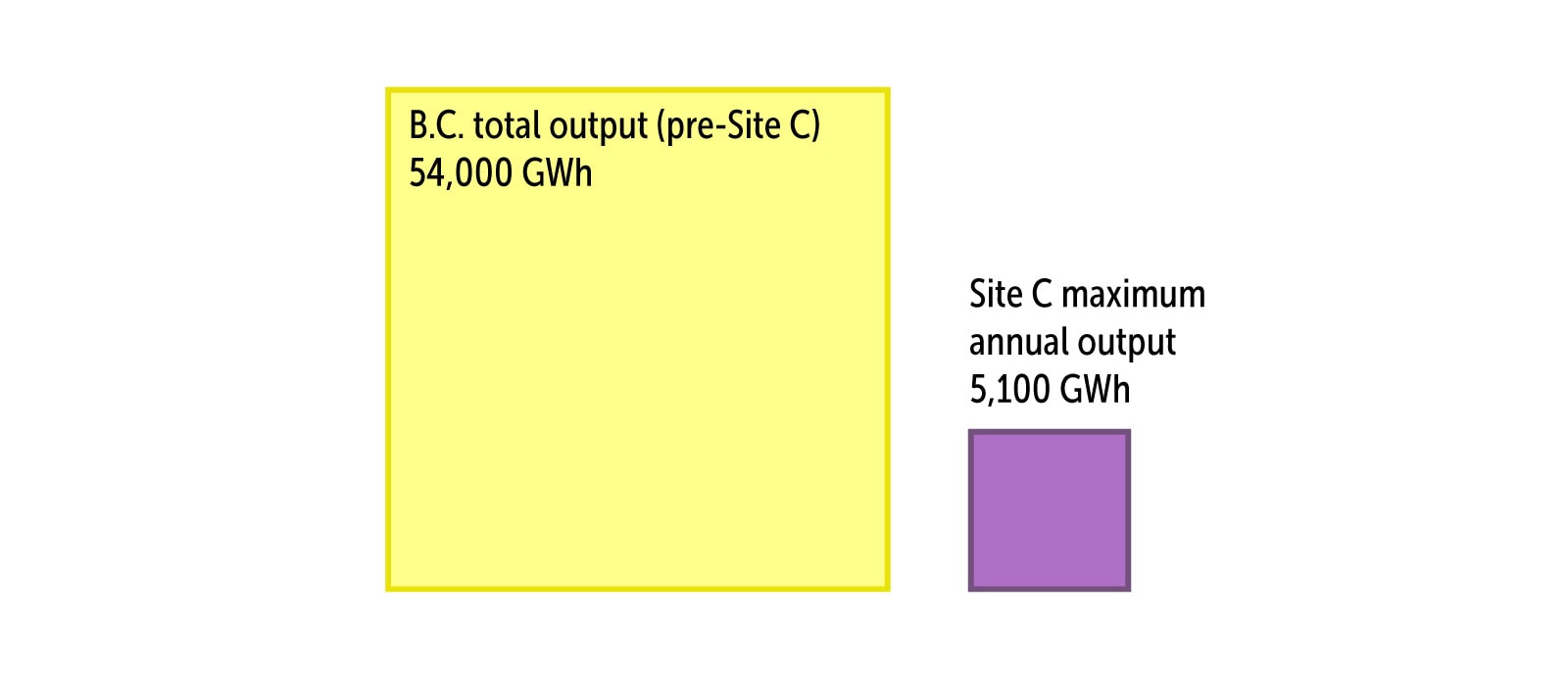
Site C added about eight per cent more power generation, or 5,100 gigawatt hours (GWh), to the provincial grid. Graph: Shawn Parkinson / The Narwhal
BC Hydro doesn’t expect to pay off the costs of building Site C until 2094, 70 years after the project began producing electricity.
Now, the province is planning to invest at least $6 billion to build the first two phases of the North Coast Transmission Line, a network of around 450 kilometres of high-voltage power lines spanning the northwest. The B.C. government says it is building the line to “enable development” of mining and LNG projects. A third phase is proposed, for power lines heading north to service mines and Ksi Lisims LNG. If that happens, the final cost for the transmission network could rival Site C.

LNG Canada, under construction in Kitimat, B.C., in 2023. Photo: Marty Clemens / The Narwhal
To state the obvious: this is a lot of public money. It’s hard to grasp just how big these numbers are. Understanding the difference between one million and one billion, expressed in time, might help.
One million seconds is about 11.5 days. One billion seconds is more than 30 years.
So when the estimated cost of the first two phases of the North Coast Transmission Line doubled from $3 billion to $6 billion in 2025, that’s like jumping from 90 years to 180 years.
On top of infrastructure investments like Site C and the transmission lines, B.C. spends public money enticing private companies to build big industrial projects. Those subsidies are eventually reflected in residential utility bills — and in other ways across the economy.
Take the push to grow the province’s LNG industry. Last year, the B.C. government coughed up $200 million to connect Cedar LNG, a liquefaction and export facility being built in Kitimat, to the grid.
Or take LNG Canada, the country’s first major liquefaction and export facility, also in Kitimat. It received a suite of subsidies, including reduced rates for the small amount of hydroelectricity it uses, as well as tax credits and an exemption from B.C.’s industrial carbon tax for the first two years of operations. Between the provincial and federal governments, public investments in LNG Canada are estimated to be almost $4 billion.

In the years ahead, homes and businesses in B.C. are going to need more power. BC Hydro predicts annual demand for electricity is likely to climb from 58,400 gigawatt hours in 2025 to more than 87,600 gigawatt hours by 2050. These amounts are way too big to wrap your head around if we convert them to kilowatt hours, but let’s just say it’s a lot.
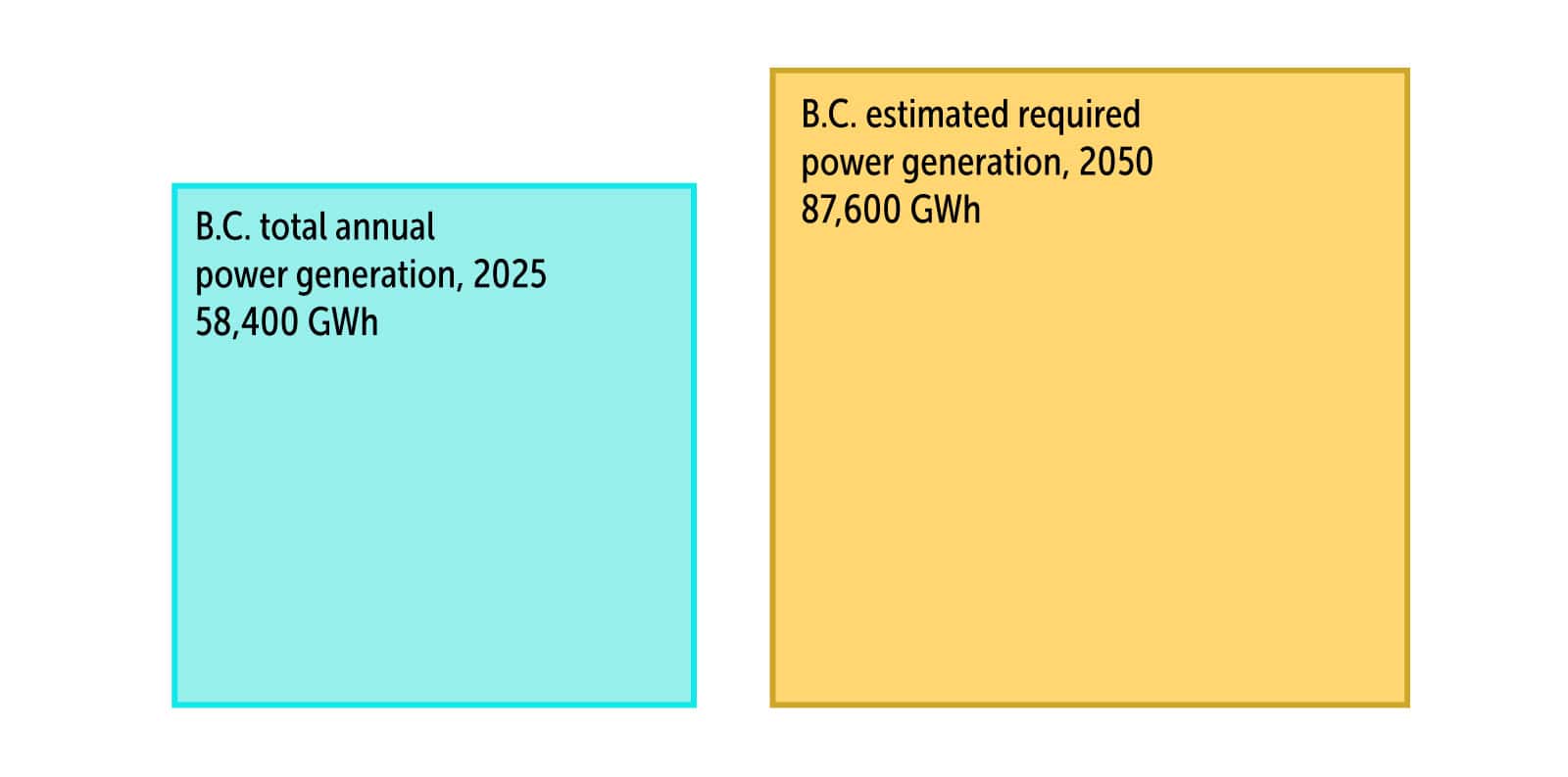
BC Hydro predicts annual demand will rise by around 50 per cent over the next two decades. Graph: Shawn Parkinson / The Narwhal
The more things we need to plug into the grid, the more power the grid needs to be able to deliver. The sooner we plug things in, the faster BC Hydro has to find ways to meet that demand.
Electricity demand in B.C. could rise even faster if the province prioritizes providing power to industries, which are eager to portray their products as “clean” or “green” in an increasingly climate-conscious market. LNG facilities that plan to power their operations with B.C.’s electricity are already advertising their products as “low carbon” and “net zero.”
B.C.’s history of abundant, cheap and low-emission electricity has been hailed as one reason the province is well-positioned to supply LNG to countries like South Korea and Japan.
But liquefying natural gas requires an enormous amount of energy. As a liquid, methane takes up a fraction of the space that it does as a gas, making it viable for transport overseas. That process requires not just chilling the gas, but supercooling it, which LNG Canada does by burning gas to power massive turbines. But other approved facilities, like Ksi Lisims LNG and the aforementioned Cedar LNG, want to use electricity instead. Hence, the new power line with a multi-billion dollar price tag.
So how much power does all this industrial infrastructure need?
Well, Ksi Lisims, a floating LNG facility proposed for B.C.’s North Coast requested the equivalent of around 5,200 gigawatt hours, or 5.2 billion kilowatt hours, from BC Hydro.
That’s more than the electricity output of the Site C dam potentially going to power just one project.
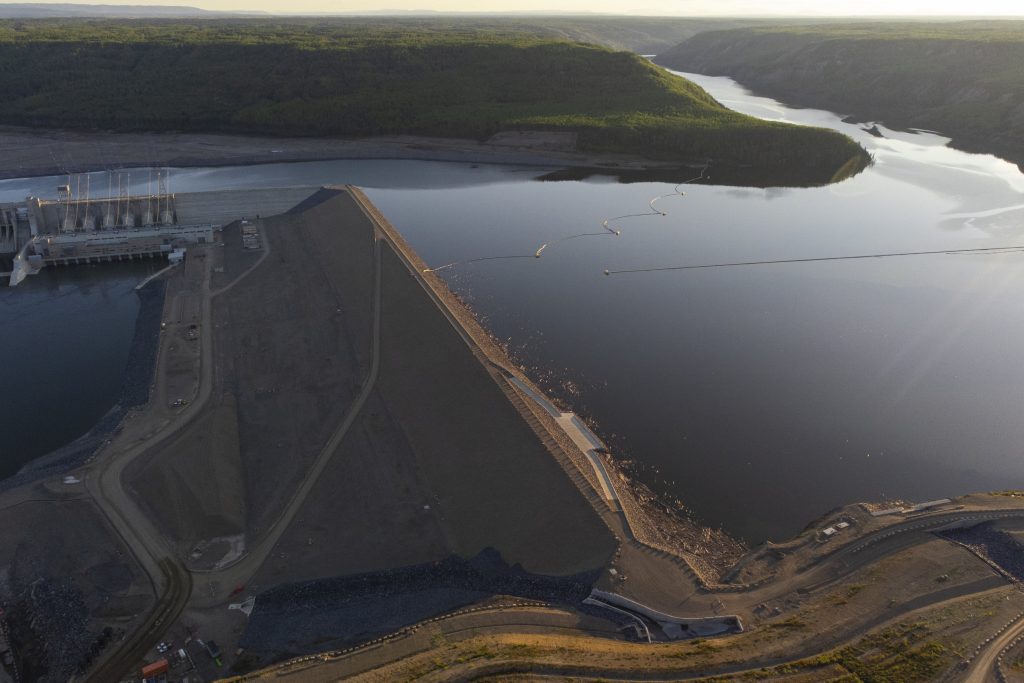
The Site C dam near Fort St. John, B.C. Photo: Amber Bracken / The Narwhal
Cedar LNG expects to use up to 1,800 gigawatt hours, or 1.8 billion kilowatt hours.
Powering just those two LNG projects could use up to the equivalent electricity that would keep power flowing to 700,000 homes.
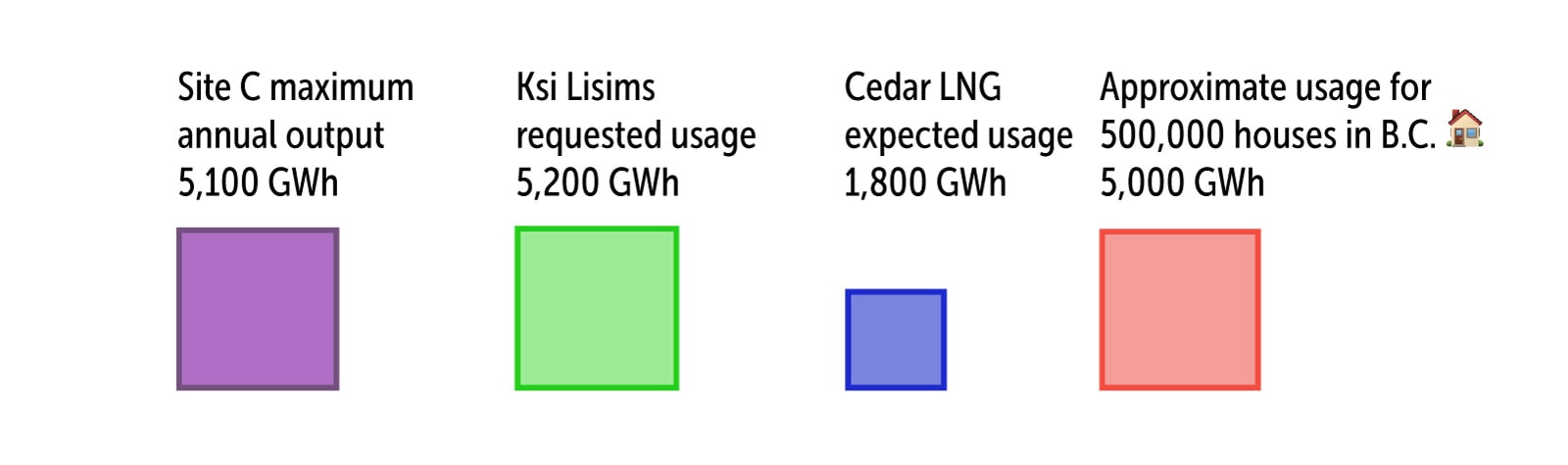
Providing electricity to just two LNG projects would use up all of Site C’s power, or more than the equivalent energy used by more than 500,000 average homes. Graph: Shawn Parkinson / The Narwhal
All that electricity isn’t free, of course. But it is cheaper for industrial users. Residential customers currently pay $118.70 for the first 670 kilowatt hours they use in a month.
That climbs to around $140 for each additional 1,000 kilowatt hours. Small businesses pay about the same as heavy-use households.
But for larger businesses it’s the opposite: the more they use, the less they pay.
Large industrial customers — consumers that use more than 550,000 kilowatt hours of electricity per year — pay $67.90 per 1,000 kilowatt hours, slightly over half the residential rate.

So what does all this mean for the average British Columbian?
Well, to keep the lights on in homes across the province over the coming decades, B.C. will continue to build out more power capacity. It will also keep trying to find ways to use industrial revenues to balance the government’s budget, so homeowners don’t have to pay (much) more per kilowatt hour consumed. But the province is up against the clock — and a moving target.
Less than six months after releasing a new forecast for electricity demand, BC Hydro now anticipates needing to supply an additional 2.7 billion kilowatt hours to its customers. The LNG industry is identified as a driving force behind that increase.
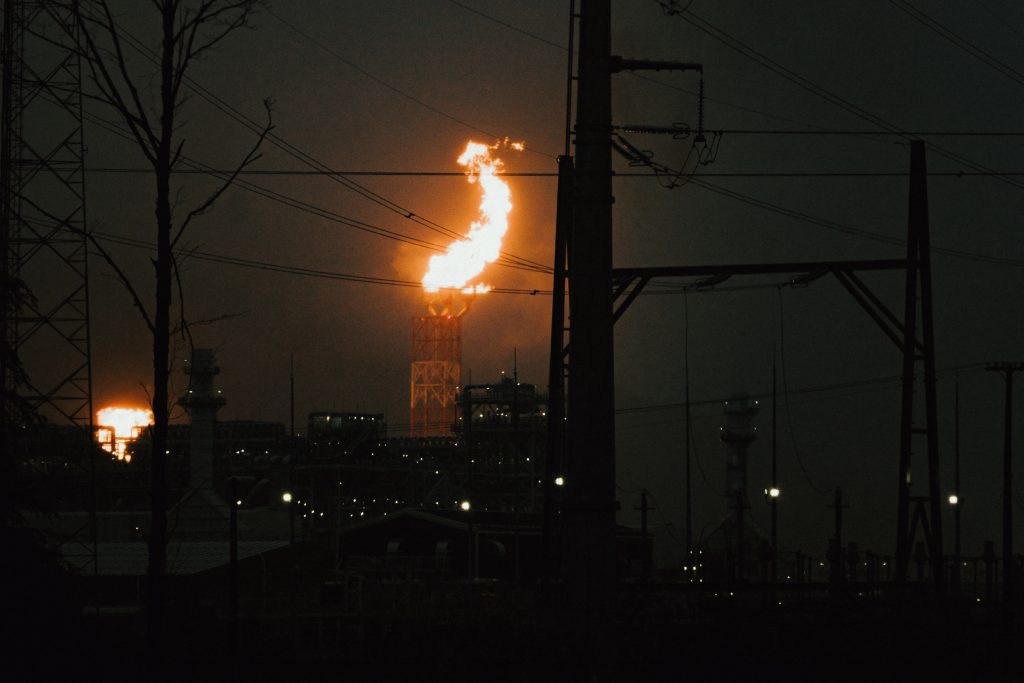
A flare stack at the LNG Canada facility in Kitimat, B.C. Photo: Marty Clemens / The Narwhal
Because B.C. relies heavily on hydroelectric dams, the province’s ability to meet demand with power produced domestically is subject to droughts. When this happens, the province imports electricity from its neighbours, including Alberta.
Whether on monthly bills or in other ways spread out across the economy, taxpayers are paying for provincial support of massive industrial projects, including the push to get those projects on the grid. Those hidden costs could eventually surface on utility bills or through cuts to other government services.
Either way, future British Columbians will pay for decisions made today about how to make sure all that electricity keeps flowing through the wires.

The Narwhal’s reporters are telling environment stories you won’t read about anywhere else. Stay in the loop by signing up for our free weekly dose of independent journalism.
From The Narwhal | News on Climate Change, Environmental Issues in Canada via This RSS Feed.