

In just the last year, the United States has witnessed not one, not two, but three separate days of record-breaking demonstrations. In June, October, and March, millions of people participated in No Kings Rallies across the country to show their opposition to Trump’s reactionary authoritarian agenda, ICE, and the war on Iran. Those marches, each bigger than the previous, were the largest single-day demonstrations in U.S. history.
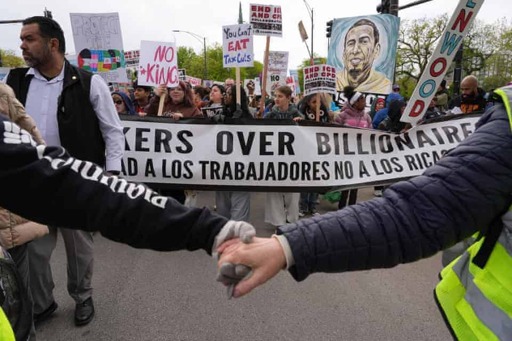
Today’s May Day demonstrations, though not as large, were a continuation of this trend of mass mobilization. The marches, walkouts, direct actions, and economic blackouts, which took place in more than 40 cities across the country, were all part of one of the largest May Days since at least 2006, when more than one million workers participated in a “Day without Immigrants.” In Los Angeles, Detroit, Minneapolis, Chicago, New York, and many other cities, hundreds of thousands of working people, many alongside their unions, marched to celebrate International Workers Day. Like the No Kings rallies, they were also joined by tens of thousands of students who walked out of their schools to participate.
Education workers, in particular, who have been building up years of experience in class struggle, played a prominent role this May Day. Teachers in Georgia, Illinois, North Carolina, Oregon, Wisconsin, and Minnesota forced classes to be canceled or called out sick to join the marches. And in Chicago, where students and teachers joined the rally after class, the Chicago Teachers Union was able to impose recognition of May 1 as an official day of civic action.
The common thread running through all of the demonstrations was the high level of union participation and the resounding condemnation of Donald Trump’s anti-immigrant policies. Union contingents, including the PSC CUNY union at the City University of New York, made their condemnation and outrage against ICE and the brutal persecution of migrants loud and clear, showing just how deeply the resistance to the agency’s tactics has taken root in the labor movement. This was perhaps the best possible tribute to Rene Good and Alex Pretti, who gave their lives fighting to defend their immigrant neighbors.
In addition to celebrating International Workers Day, marchers also put forward a list of demands and slogans developed by the May Day Strong coalition, including: “tax the rich so our families — not their fortunes — come first. No ICE. No war. No private army serving authoritarian power. Expand democracy [and] Hands off our vote.” These demands, much more directly political than those of the No Kings marches, highlight a developing awareness among working people in the U.S. of the connections between exploitation, oppression, and imperialism. Indeed, the war in Iran and the genocide in Gaza have awakened an entire generation to the horrors of imperialism, while Trump’s attacks on unions and immigrants have laid bare the fact that working people are all in this together; a sentiment that was on display in slogans, signs, and conversations across the marches.
Unlike the No Kings rallies, however, which were enthusiastically co-opted by the Democratic Party to sell itself as an alternative to Trump, today’s demonstrations were largely led by unions and working people of all stripes fed up not only with Trump, but with the entire capitalist class that is trying to solve its crises on their backs. This was evident in the many criticisms of billionaires and calls to tax the rich, particularly in New York City, where widespread discontent with the capitalist status quo led to the election of Zohran Mamdani as mayor last year. But it was also on full display in some of the more direct actions planned by groups like Rise and Resist, which staged a blockade of the New York Stock Exchange.
International Workers Day, of course, began in the United States after the execution of striking workers in Chicago in 1886. But for many years, particularly after the neoliberal offensive, the anniversary passed almost unnoticed in the country of its birth. The size of today’s May Day marches and the many actions organized by teachers, and walk-outs led by students, are signs that people are not just angry with Trump, but that they’re waking up to the knowledge of their own collective power as a class both in itself and for itself. Today’s marches also show the power that the working class and the labor movement still have — despite the declining density of union membership — to lead the masses of people discontented with a capitalist system that has grown more authoritarian and ruthless in its decline.
In this sense, today was a good day for working people and a sign that they are looking for ways to fight back. But a single day’s protest, without greater self-organization and a more militant confrontation with the ruling elite, is obviously insufficient. Today’s marches are merely a taste of the power available to us as a class when we act together with purpose and determination. Though such marches can be exhilarating, there remains the very difficult work of organizing ourselves in workplaces, schools, and universities to directly confront not only Trump, but the entire bipartisan regime and the billionaire bosses they represent.
Despite this show of strength, the union bureaucracy and social movements continue to pin their hopes on the midterm elections and a strategy of putting pressure on the Democratic Party to grant some modest reforms. And even though there is a desire to fight among the rank and file, labor leaders are not organizing their members in their workplaces to broaden the struggle and launch more militant actions such as strikes and pickets to defeat Trump and the ruling class. As the struggle in Minneapolis demonstrated, we are stronger when the rank-and-file organizes from the bottom up, and we must build on this example by organizing grassroots assemblies in our workplaces, schools, and communities.
It is important that this May Day not be just another protest but a springboard to build a broad united front of unions, community organizations, the Left, and the student movement to fight for full rights for immigrants, the abolition of ICE, an end to the war against Iran and Lebanon, and for a free Palestine.
Furthermore, it is essential that the many socialist groups that took part in today’s demonstrations, including the PSL and the DSA, put forward a clear message of class independence. We must not allow the young people and workers who no longer trust the Democratic Party to be brought back into its fold or fooled into believing the party can be reformed from the inside by politicians like AOC and Mamdani. Instead we must be clear about the absolute necessity of building a working-class, anti-imperialist, and socialist party now that is committed to fighting against the two parties of big capital at home and abroad.
The post Biggest May Day in Decades Rocks Trump’s America appeared first on Left Voice.
From Left Voice via This RSS Feed.