

“How much longer will we tolerate the suffocation of journalism, the systematic obstruction of reporters and the continued erosion of press freedom?”
CAGAYAN DE ORO — The Philippines slightly improved its ranking in the 2026 Press Freedom Index. However, the country is still considered dangerous for journalists and media workers.
Out of 180 countries and territories in the world, the Philippines’ ranking climbed from 116th placement in 2025 to 114th spot this year with a global score of 46.79. It is still under the dark orange category, which implies a “difficult” state of press freedom.
More than half of the countries and territories, for the first time in 25 years, were categorized as having “difficult” or “very serious” press freedom situations. Eritrea, North Korea, and China remain the countries with the lowest scores.
Reporters Without Borders (RSF), which has been publishing the index, defined press freedom as the ability of journalists to produce and disseminate news that is independent of political, economic, legal, and social interference without threats to their physical and mental safety.
The state of press freedom of a country is evaluated based on five indicators, namely the economic, legal, security, political, and social environments for journalism.
Out of these indicators, RSF saw the sharpest decline in the legal aspect which determines the degree that journalists can work without censorship or judicial sanctions, the ability to access information without discrimination, and the presence of impunity.
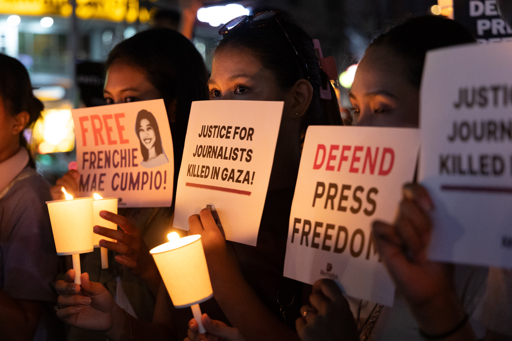
This is evident in the Philippines given the detention of Tacloban-based journalist Frenchie Mae Cumpio following her conviction for alleged terrorism financing, a court decision assailed by local and international press freedom watchdogs.
The National Union of Journalists of the Philippines (NUJP) also documented what it described as the weaponization of laws, including the filing of cases against media workers in Manila, Capiz City, and Cagayan de Oro, and the killing of a radio broadcaster in Negros Occidental.
Community journalist RJ Nichole Ledesma was also killed in an alleged armed encounter in Negros Occidental on April 19. The military claimed that he was a member of the New People’s Army, the armed wing of the Communist Party of the Philippines. This was refuted, however, by his colleagues.
Overall, NUJP documented a total of 242 alleged press freedom violations in the country under the Marcos Jr. administration as of April 2025. Harassment topped the list while there were 10 journalists and media workers killed.
Anne Bocandé, RSF editorial director, said that authoritarian states, complicit or incompetent political powers, predatory economic actors, and under-regulated online platforms are responsible for the worsening state of press freedom.
“How much longer will we tolerate the suffocation of journalism, the systematic obstruction of reporters and the continued erosion of press freedom?” she asked.
Bocandé stressed the need for effective measures to protect journalists, and it should start by stopping the criminalization of journalism. (DAA)
Disclaimer: Bulatlat editor-in-chief Ronalyn Olea is the secretary general of the National Union of Journalists of the Philippines
The post Philippines remains dangerous for journalists appeared first on Bulatlat.
From Bulatlat via This RSS Feed.