

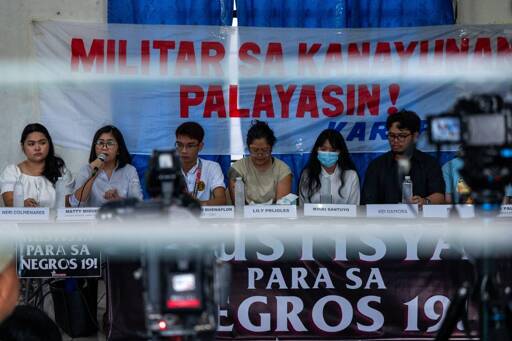
“What happened in Toboso is a massacre.”
MANILA – The Armed Forces of the Philippines (AFP) must be held accountable for violations of international humanitarian law, said human rights lawyer Julianne Agpalo at a press conference on April 29.
“We call for the upholding of international humanitarian law. And when we uphold international humanitarian law, we call for accountability, not only on the actual perpetrators, but also those officers who concealed and even made this operation possible,” said Agpalo of the National Union of Peoples’ Lawyers (NUPL).
Agpalo said that the truth must come out on what really transpired on April 19, when 19 people were killed in what the AFP claims was an armed encounter.
The Communist Party of the Philippines (CPP) released a statement saying that only 10 out of the 19 were members of the New People’s Army (NPA) and the rest — including two minors — were civilians.
Read: Investigations into Toboso killings sought
“What happened in Toboso is a massacre. There are blatant violations of the principles that should apply in an armed encounter,” Agpalo stressed.
Right to life
Agpalo said that there are rules regarding armed conflict and that the International Covenant on Civil and Political Rights stresses that the right to life is paramount.
“And even under the international humanitarian law, there are certain principles that apply, including the principle of proportionality, the principle of distinction between a combatant and a civilian. A principle of distinction between military targets and civilian objects. And what we saw from the facts that are available, these principles were blatantly violated in Toboso,” Agpalo said.
Read: Right(s) Up: Negros massacre warrants probe on int’l humanitarian law violations
Agpalo explained that from the military’s own accounts and the facts based on the retrieval of the victims’ remains, it appears that the military operation failed to distinguish between combatants and civilians and that excessive force was used, resulting in the deaths of journalists, students, peasant rights activists, and even two minors.
Agpalo said that there are conflicting accounts by the military on what happened in Toboso.
“The AFP said that there were eight encounter sites and yet all the remains were recovered from one location. Or, if you listen to another account from the AFP, that there were only two encounter sites and the other group was killed in hot pursuit,”
Agpalo stressed that “hot pursuit” suggests the group was already fleeing. “Hence, there was no longer any imminent threat that would justify the excessive force used in Toboso, Negros.”
She said that families, after retrieving their loved ones’ remains, were able to observe the extent and severity of the wounds sustained, further indicating violations of the principle of proportionality and the use of excessive force.
Karapatan Secretary-General Cristina Palabay said that a video of NPA leader Roger Fabillar that circulated online would indicate that he was not in a position to fight back. The video was reportedly uploaded on the AFP’s page but has since been taken down.
Palabay said that footage showed Fabillar still alive.
“He even looked up at the drone. I believe the footage has since been taken down from one publication, but many people were able to download it.”
Visiting communities not a crime
The AFP has insisted the 19 were all combatants and has questioned their presence in the area.
But groups said their being in Toboso does not automatically make them a target military operations.
Matti Miguel, co-convenor of Defend Negros and National Network of Agrarian Reform Advocates Youths (NNARA-Youth), said that advocates like them go to remote communities as part of studying society.
“The conditions in Negros are severe and these are realities that are not reflected in government statistics,” Miguel said.
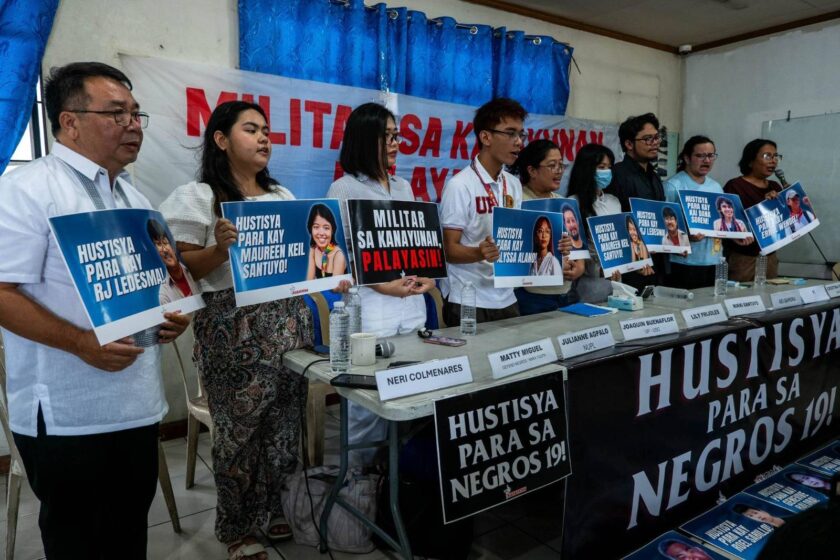
Photo courtesy of Altermidya
On Negros Island, the “sugar bowl” of the Philippines, 63% of the land is privately owned and many who live there are farm workers.
Miguel said that farm workers suffer from low wages and residents experience poverty even more when it is off-milling season or tiempo muerto.
This means no income for up to six months those who work in sugar plantations.
“There is also what we call structural violence. Hunger is violence. Poverty is violence. Driving farmers away from their land is violence,” Miguel said in Filipino.
She said the pay that farm workers get does not even meet the supposed minimum wage because of the pakyawan system or piece-rate system.
As of 2025, daily minimum wage in Western Visayas for agriculture is at P520 ($9) while non-agriculture/industrial/commercial is at P525 to P550.
“That is why we cannot deny why advocates, students, and human rights defenders go to Negros Island to conduct investigations and to study society,” Miguel said.
She said the realities of the ordinary people in Negros are not reflected in government data and only come to light when activists, advocates, and students go to communities there to understand the conditions the people of the island live in.
Read: Contextualizing militarization and killings in Negros
Read: The continuing anguish of Negros
Joaquin Buenaflor, chairperson of UP Diliman Student Council, said that they are not just a council for the students but also “a council that defends the rights of various sectors in the country.”
“That is why, as head of the Education and Research Committee, [Alyssa Alano] carried out her responsibility to understand the social realities of our country,” Buenaflor said.
“We are therefore not surprised that Alyssa went to different communities. She went to Hacienda Luisita, Lupang Ramos, and now to Negros Occidental to understand the struggles of farmers.”
Alano was a third year Political Science major at UP Diliman and was on the student council when she was killed in Toboso.
Buenaflor said that Alano went to communities so that they could formulate action plans to help the communities she visited, “whether by amplifying their campaigns, supporting them, or lobbying for bills in the Senate, Congress, and elsewhere.”
He said that the military’s smearing of Alano and others is a deliberate attempt to conceal the true nature of the AFP and to hide its human rights violations.
“Because they do not care what Alyssa cares about. What they only care about is killing people, submitting reports to their superiors, and receiving payment from those they protect,” he said.
Agpalo said that visiting communities, documentation, and solidarity, are not crimes.
“I think shifting the burden onto the victims who are already incapable of telling their side of the story, by questioning why they were there or why they were in a conflict area in the first place, already shifts the burden of accountability, because there are rules that apply.”
Fourth massacre under Marcos Jr.
Palabay said that this is the fourth massacre under the Marcos, Jr. administration. She said that the latest incident is similar to earlier ones Karapatan has documented.
“First, there were minors. Second, there was no distinction between civilians, combatants or those considered as hors de combat. Third, the crime was cleaned up and made to appear like it was a legitimate military operation. But in truth, the crime scenes were staged,” she said.
Palabay added that the number of people killed already raises questions.
“Wasn’t there two or three individuals who had been neutralized? Even if you claim some of them were combatants, wouldn’t there still be questions about whether they were still capable of fighting?” Palabay said.
Former Bayan Muna Rep. Neri Colmenares, a human rights lawyer, assailed the AFP’s inconsistencies.
“They claimed that all those who were killed last April 19 were NPAs, but the AFP, in an interview, they cannot confirm anything,” Colmenares said.
Colmenares referred to the interview of AFP Spokesperson Col. Francel Margareth Padilla where she admitted that they cannot confirm whether Alano, UP student Maureen Santuyo and community journalist RJ Ledesma were armed when they were killed.
Padilla also did not respond to the question whether they have established the relationship between the civilians and NPA leader Roger Fabillar.
This is why, Colmenares said, that it is only right to conduct an investigation that is objective and independent. (RTS, DAA)
The post Lawyer: Hold AFP accountable for Toboso 19 massacre appeared first on Bulatlat.
From Bulatlat via This RSS Feed.