


Rhode Island Hospital
Erin In The Morning is a reader-supported publication. To receive new posts and support my work, consider becoming a subscriber.
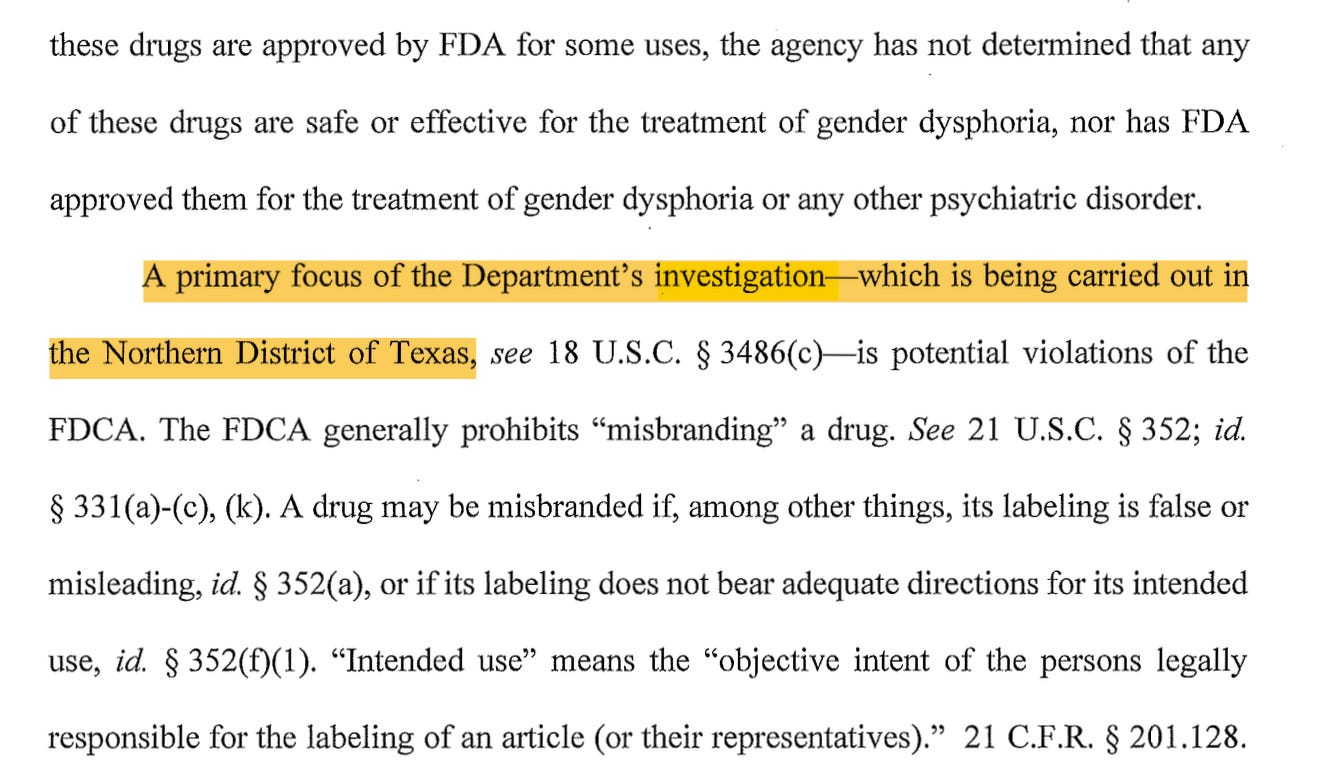
In a brazen act of forum shopping, the Trump administration has filed a petition in the Northern District of Texas—the most notoriously conservative federal court in the country—to compel Rhode Island Hospital, 1,800 miles away, to hand over patient records from its transgender youth care program. The petition seeks to enforce an administrative subpoena served on the hospital last July under HIPAA authority, as part of an investigation into alleged violations of the Federal Food, Drug, and Cosmetic Act. The subpoena includes level clinical records and private patient and doctor information. The hospital has refused to comply for ten months. It is easy to see why the DOJ chose Texas: it has lost every single subpoena fight it has brought against hospitals providing gender-affirming care—in Massachusetts, Pennsylvania, and Colorado. Now, rather than accept those rulings, the administration is exploiting a HIPAA provision that allows subpoena enforcement wherever “the investigation is being carried out”—a location the DOJ selected itself.
The filing reveals the scope of what the administration is after. The DOJ served the subpoena on August 7, 2025, claiming authority to “investigate violations of the Federal Food, Drug, and Cosmetic Act.” The legal theory is that because the FDA has not specifically approved puberty blockers or cross-sex hormones for the treatment of gender dysphoria, any hospital prescribing them for that purpose is engaged in “misbranding”—distributing drugs without adequate labeling for their intended use. The filing states that the FDA “has determined neither their safety nor effectiveness” for gender dysphoria treatment. This framing ignores the fact that off-label prescribing is legal, routine, and up to 25% of all prescriptions written in the United States—from aspirin for heart disease to gabapentin for anxiety. No court has ever held that a doctor commits a federal drug crime by prescribing medication off-label.
But the most alarming part of the filing is what the DOJ intends to do with the information. The subpoena seeks to identify the doctors involved in patient care, obtain billing and coding records, and acquire the private medical records of the transgender patients themselves. The filing makes explicit that the DOJ wants to go directly after patients: “Providing patient records including patient identities can also provide essential investigative leads,” it states. “Parents may be witnesses about what disclosures were made. Patients (depending on age and circumstances) may provide information about the informed consent process, side effects, or other false or misleading information about the drugs conveyed during treatment.” The filing goes further, arguing that “without this information, the Government cannot fully determine the scope of the violations, identify patterns of misbranding or fraudulent billing, or assess whether the conduct was undertaken with intent to defraud or mislead, as required for felony liability.”
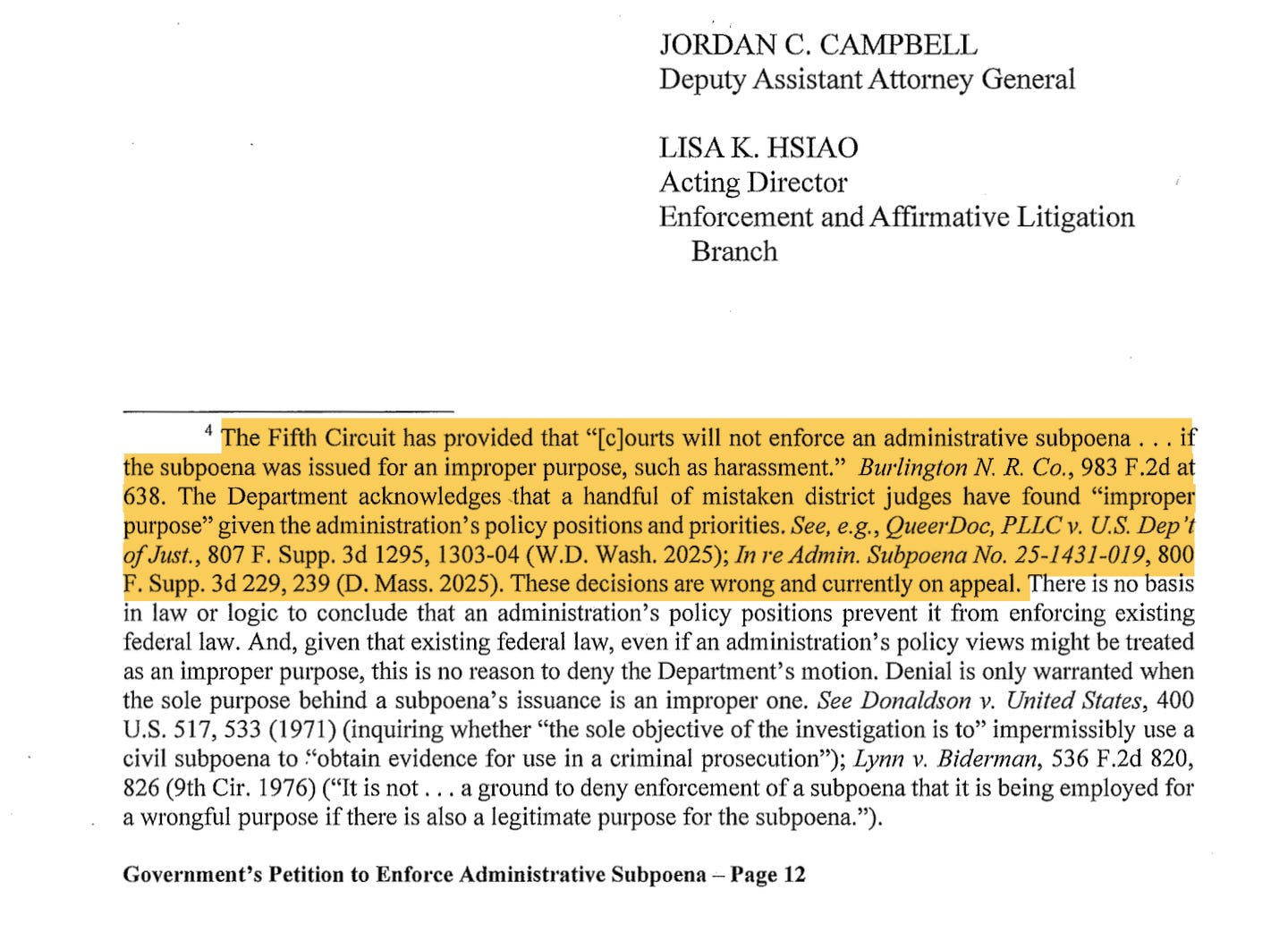
Similar subpoenas have been quashed by federal courts across the country—and the language those judges used was scathing. In Massachusetts, a federal judge found that the DOJ’s subpoena to Boston Children’s Hospital was “motivated only by bad faith,” concluding that “the true purpose of issuing the subpoena is to interfere with the Commonwealth of Massachusetts’ right to protect GAC within its borders, to harass and intimidate [the hospital] to stop providing such care, and to dissuade patients from seeking such care.” In Washington state, a judge quashed a subpoena to QueerDoc, a small telehealth provider, finding it was “issued for a purpose other than to investigate potential violations of law.” In Pennsylvania, a judge limited a subpoena to Children’s Hospital of Philadelphia, ruling that patient-specific records were not relevant to the DOJ’s stated investigation—because the records “do not speak to how products were labeled, marketed, introduced into interstate commerce, or billed to health care benefit plans.” The DOJ’s own filing in Texas acknowledges these losses—but dismisses them in a footnote as the work of “mistaken district judges” whose rulings “are wrong.”
From filing
Instead of accepting these rulings, the DOJ moved its fight to Texas. The HIPAA statute allows enforcement of administrative subpoenas in the district where the hospital is located or where “the investigation is being carried out.” Ordinarily, these investigations are based in Washington, D.C. or at nearby DOJ field offices—the Enforcement and Affirmative Litigation Branch that signed this petition is headquartered in D.C., and the subpoena was signed by its Acting Director, Lisa K. Hsiao, the same official whose subpoenas were quashed in Massachusetts, Washington, Pennsylvania, and Colorado. Instead, the administration chose to base this investigation in the Northern District of Texas—a court that has become the go-to destination for conservative litigants seeking friendly judges, that refused to adopt the Judicial Conference’s anti-judge-shopping reforms, and where every case filed in certain divisions is guaranteed to land before a single Trump-appointed judge. The DOJ is laundering a Rhode Island subpoena through the most conservative court in America because every fair court told it no.
From the filing
If the Northern District of Texas sounds familiar, that is because it is home to Judge Matthew Kacsmaryk—a former attorney for a Christian legal organization who was appointed by Trump in 2019 and has since become the most sought-after judge in the conservative legal movement. Kacsmaryk is the sole judge handling civil cases in the court’s Amarillo Division, meaning any case filed there is guaranteed to land on his desk. He has used that position to try to revoke FDA approval of mifepristone, a ruling so extreme the Supreme Court unanimously reversed it, and recently ruled in favor of a drag ban in the state. Though this filing is not in Amarillo, the district is known for its extreme Republican slant, and its parent circuit, the 5th Circuit, has acted as a rubber stamp for the Trump administration. Now, through a major loophole, the administration has chosen its own judges who are likely to accept its demands.
You can view the full filing here:
Us Petition For Enforcement
854KB ∙ PDF file
From Erin In The Morning via This RSS Feed.