

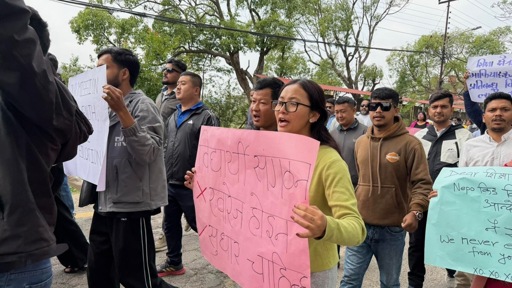
Student groups in Nepal have come together to oppose the government’s decision to ban political party-affiliated groups from the country’s educational campuses and demanded the immediate withdrawal of the decision.
A joint statement issued earlier this month by 14 national student organizations, including the left groups, has noted the positive contributions of the student movement in the country’s democratic development, underlining its role in the anti-monarchy protests.
The statement described the move to ban political outfits in universities and campuses as unconstitutional and undemocratic, calling it a part of the larger authoritarian tendencies shown by the newly-elected government.
It underlined that student organizations have undertaken corrective measures whenever required to improve their functioning and called the newly-elected Balendra Shah-led centrist government’s claims that student politics has been responsible for most of the problems in the country “immature and superficial”.
It has demanded the immediate withdrawal of the decision and launched a nationwide movement to press for the same.
Alternative arrangement
The new Rashtriya Swatantra Party (RSP)-government, led by Shah, decided to ban political party-affiliated student organizations from educational institutions, blaming them for declining academic standards in the country, apart from holding them responsible for rising political interference in educational institutions and the inadequate representation of student issues.
The decision to dismantle the politically-affiliated student groups within 60 days was taken by the newly-elected cabinet on March 28, two days after Shah took the oath of office.
On April 19, the government also decided to deploy security personnel inside universities and other educational institutions to dismantle the existing political party-affiliated student organizations by force if necessary.
The government wants to dismantle the present “Free Student Unions” in universities and introduce an alternative system, calling it “Student Council” or “Voice of Students” which will have no overt or covert presence of groups affiliated to political parties/ideologies.
Student leaders and political commentators have opposed the move, calling it an apparent attempt to curb the dissenting voices and deprive students from acquiring crucial experience for their future role as political representatives.
Student organizations have already organized protests in various universities demanding the withdrawal of the decision.
The critics have also claimed that the move is in complete violation of article 17 of the Nepali constitution, which guarantees Nepali citizens the right to form organizations and engage in political activities.
Nepal’s authoritarian move
Reacting to the move, the Communist Party of Nepal (Unified Marxist-Leninist) have called it “authoritarian”.
Talking to the Kathmandu Post, Bijay Sapkota, leader of the student organization affiliated to another major left party, the Nepali Communist Party (NCP), also described the move as “inappropriate”.
Left parties in the country have warned that if the government goes ahead with the planned move they will launch a popular agitation against it.
Speaking to Peoples Dispatch, lawyer and left activist Karuna Parajuli questioned the government’s move, noting the positive contributions student unions have made in the country’s politics.
“They have played a crucial role in almost all democratic movements in Nepal. They have consistently raised their voices on issues related to people’s livelihoods, price hikes, privatization of education, and have notably contributed to policy changes such as student discounts in public transportation,” Parajuli argues.
Parajuli does agree that, in recent times, most of the student organizations have faced increased pressures to take on political tasks on behalf of the mainstream political parties. However, she rejects the idea that this is sufficient ground for an outright ban on them, as these groups also provide crucial political training to a large section of the country’s citizens.
“At present, the government tends to portray politically affiliated student unions as the main problem in higher education. In reality, the deeper issues lie in unregulated private educational institutions, insufficient government investment in education, and weak infrastructure,” Parajuli argues.
She sees the move to ban political activities on campuses as part of larger efforts undertaken by the Shah government coming to power, claiming that moves such as “limiting trade unions for public employees” are restricting democratic space in the country.
“These actions are raising fears that the country could be moving toward a more authoritarian or fascistic direction,” Parajuli concluded.
The post Nepali students demand government reverse ban of political groups on campus appeared first on Peoples Dispatch.
From Peoples Dispatch via This RSS Feed.