

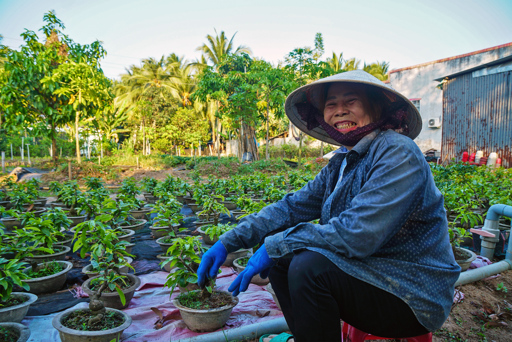
Vinh Long, VIETNAM — Khanh Chi tends a small apricot blossom orchard in Nhuan Phu Tan, a commune in southern Vietnam’s Vinh Long province by the Co Chien River, one of the Mekong River’s final distributaries before reaching the ocean. Her orchard is 55 kilometers (34 miles) inland. According to the provincial hydrometeorological observatory, Chi’s commune is the furthest point along the Co Chien River where, this year, salinity levels hit 4 parts per thousand (ppt) — the threshold at which rice farming is damaged. As saltwater pushes deeper and less predictably into the delta in recent decades, Vietnam has responded with canals, dikes and sluice gates to keep it out. For farmers, such projects offer the most explicit and immediate relief. Scientists say that might be a problem. Instead of engineering its way out of the salinity crisis, scientists argue, the region must adapt to it. “I buy freshwater, bring it back by truck, and just spray it like a mist,” Chi says, describing how she waters the apricot during dry season, when the river is saline. She used to grow fruit seedlings, durian and jackfruit but made the switch to ornamental plants as they are more resilient to saltwater. A few years ago, Chi dug a small pond in her orchard to store water when it rains or the river runs fresh. She uses it sparingly, enough to stretch through a few worst days of an intrusion. “The bigger the orchard, the larger the lake,” she says. “My…This article was originally published on Mongabay
From Conservation news via This RSS Feed.