

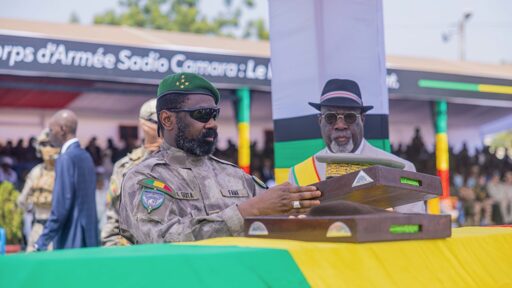
Barely four days after repelling the coordinated terror attacks by an Al-Qaeda affiliate and a northern separatist group on six different cities, the government of Mali, whose collapse the Western media has long been prophesying, is pressing on with developmental projects.
Electricity supply, healthcare, education, and the state of livestock and fisheries were among the matters discussed at the cabinet meeting in the Presidential Palace on April 29, while the military continued “mopping-up” with search-and-secure operations.
Following a report by Foreign Minister Abdoulaye Diop, the council ministers adopted the draft texts ratifying the agreements signed with the African Development Bank (AfDB) in February, for a loan amount of over USD 70.5 million.
Development remains a priority
It will be used to finance part of the cost of the 225-kilovolt Northern Loop project to secure a continuous and reliable supply of electricity to Bamako and its surrounding areas.
Along with ensuring access to domestically-produced energy for consumption, the power plant is also critical for the success of the sovereignist government’s push for industrial advancement from merely extracting raw materials for export to domestic processing and value addition.
Underdeveloped by colonialism and the subsequent neo-colonial regimes propped up by France after formal independence, much of the population still engages in agro-pastoral work, with livestock being an important source of livelihood for 85% of farmers.
The Livestock Minister announced at the cabinet meeting that a nearly two-month-long “General Assembly on Livestock, Fisheries and Aquaculture” will be held from May 4 to July 29, to explore the “modernization of the animal, fisheries and aquaculture sectors”.
Under the title, “Media and national languages: challenges for contemporary African societies?”, the “4th Information and Communication Sciences Days” will be held on May 14 and 15, added the Minister of Higher Education and Scientific Research. The health minister reported a drop in Dengue cases in the meeting at the Presidential Palace, chaired by Mali’s president, Col. Assimi Goïta.
Defense minister’s fall in battle is “an immense loss for the Malian nation”
The meeting started with a minute of silent tribute for Defense Minister Lieutenant General Sadio Camara, who fell in battle during the attack on April 25, just about 15 km away, in the garrison town of Kati.
After killing several attackers in an intense gunfight, Camara was fatally wounded when a suicide bomber drove in a car so heavily laden with explosives that the blast collapsed Camara’s residence and destroyed a neighboring mosque, killing and wounding several others.
Describing him as a “valiant officer” in his televised address on the evening of April 28, Goïta said Camara’s “passing constitutes an immense loss for the Malian nation.”
He was among the core group of officers with Goïta who, in 2020, overthrew the regime of Ibrahim Boubacar Keïta, propped up by France, against whose military presence and economic domination, mass protests were rocking the country.
As a defense minister in Goïta’s military government, Camara subsequently oversaw the expulsion of French troops in 2022, consolidating its popular support.
France, Ukraine, and Sahelian terror groups
Insisting Mali had evidence that France had been flying missions in its airspace to collect intelligence and airdrop arms to terror groups after its troops were ordered out, Foreign Minister Diop wrote to the UN Security Council that year, seeking “an emergency meeting.” It was not granted.
Later, similar allegations were also made by neighboring Burkina Faso and Niger, after the France-backed regimes there too were ousted in coups amid mass protests, replacing them with popularly supported military governments that expelled French troops.
While France itself continues to deny these allegations, its ally, Ukraine, has not been shy. Ukraine’s military intelligence spokesperson, Andriy Yusov, boasted in a 2024 interview that it provided “necessary information, and not just information” to Tuareg armed groups to carry out attacks in Mali.
Nevertheless, with reported support from Russia’s Africa Corps (formerly Wagner), Camara oversaw the Malian army’s retaking of Kidal in November 2023. The city had been overrun by a Tuareg Islamist coalition affiliated with Al Qaeda – one of the many jihadist groups that became prominent in the aftermath of NATO’s destruction of Libya, in which France had played a key part.
Intervening to ostensibly protect its former colonies from these groups it had helped spawn, French troops captured this city in 2013. However, forbidding the Malian army from entering the city, French troops practically handed it over to a Tuareg separatist group, the National Movement for the Liberation of Azawad (MNLA), allowing its fighters in.
While Bamako, Kati, Konna, Mopti, and Gao, were secured by the government forces after the attack, the MNLA-linked Azawad Liberation Front (FLA) managed to retake Kidal last Saturday, on April 25, after attacking it with the support of another Al-Qaeda-affiliated organization, abbreviated as the JNIM.
Earlier, in late 2024, when the JNIM was attacking tankers to choke fuel supply to Mali, especially to Bamako, Western media widely reported that the capital was “under siege” and encircled by jihadists closing in on power. Some version of “Is Mali about to fall?” was a rhetorical question across its headlines, while the Atlantic Council declared the country was “unraveling”.
“A proxy war”
However, the Malian security forces prevailed, repelling these terror attacks and securing the fuel supply lines. “We must not think we are simply facing terrorist groups. No, this is a proxy war, where certain powers, cowardly and unable to confront us directly, are using terrorist groups and asymmetric forces to fight us,” Diop had said in his media statements at the time.
“These terrorist groups have drones. Where do they come from? Who manufactures them? Who provides them in areas where people cannot even eat?”
The Ukrainian authorities are supplying drones to a Tuareg armed group, and providing it with the necessary training to use them, France’s “newspaper of record”, Le Monde, had reported in 2024.
It is in the backdrop of such multiple reports and allegations of Western backing of the Sahelian terror groups that the attack on April 25 unfolded. At least 23 civilians and soldiers were killed, according to official figures. The terror groups, on the other hand, lost 2,500 fighters and 102 vehicles, according to the Russian Defense Ministry.
“These attacks are not isolated events. They are part of a vast destabilization plan conceived and executed by terrorist armed groups and the foreign sponsors of Azawad who provide them with intelligence and logistical means,” Goita said in his televised address on Tuesday, April 28.
Adding that “I have instructed the government to take all necessary measures to strengthen assistance to victims, support bereaved families, and accompany the wounded,” he stressed that Mali is going through a trial that “must consolidate its cohesion and unity.”
“No violence, no intimidation, much less desperate attempts at destabilization,” will reverse the progress the country has made, Goïta said, reassuring the Malian people that “Sovereignty will be consolidated.”
The post “Sovereignty will be consolidated”, reiterates Malian president after “foreign-sponsored” terror attacks in six cities appeared first on Peoples Dispatch.
From Peoples Dispatch via This RSS Feed.