

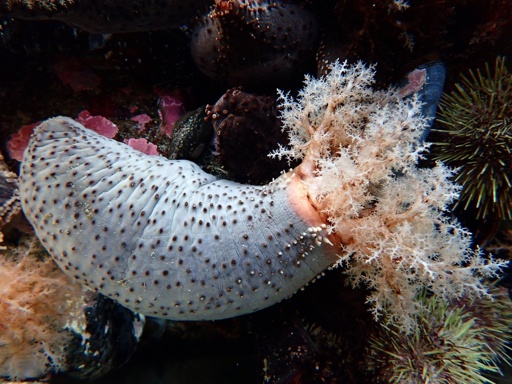
The global trade in sea cucumbers has grown since 2013 and continues to decimate the populations of many species, according to a recent study that cites “escalating impacts” and calls for stronger conservation measures. “Nowadays it’s overexploited nearly all over in the world,” Chantal Conand, an emeritus associate at France’s National Museum of Natural History and lead author of the study, told Mongabay, speaking of sea cucumbers generally. Conand and her co-authors write that the harvest of sea cucumbers is now “contagious” — spreading from place to place — and that the “continued growth and expansion of the global sea cucumber trade is alarming as the sustainability of many species-specific fisheries remains of great concern.” The paper, which was published Feb. 19 in the Journal of the Marine Biological Association of the United Kingdom, follows other recent sea cucumber studies that also raise conservation concerns. Chantal Conand, lead author of a recent study on sea cucumbers, holds a pineapple sea cucumber (Thelenota ananas), amid the research collections of France’s National Museum of Natural History, where she is an emeritus associate. Image courtesy of Chantal Conand. Diving for good data Globally, there are roughly 1,800 species of sea cucumbers, which make up all of the taxonomic class Holothuroidea. Like starfish (class Asteroidea) and sea urchins (class Echinoidea), they sit in the phylum Echinodermata. Sea cucumbers act as recyclers and processors on the seafloor, eating detritus — decaying organic matter — and discharging it in a more aerated, nitrogen-rich form that helps…This article was originally published on Mongabay
From Conservation news via This RSS Feed.