


Janine Jackson interviewed Drug Policy Alliance’s director of federal affairs Maritza Perez Medina about rescheduling marijuana for the April 24, 2026, episode of CounterSpin*. This is a lightly edited transcript.*
https://media.blubrry.com/counterspin/content.blubrry.com/counterspin/CounterSpin260424Medina.mp3
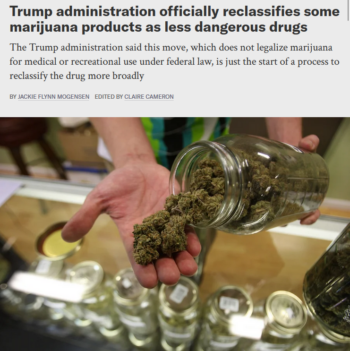
Scientific American (4/23/26)
Janine Jackson: Here in Manhattan, you can hardly throw a rock without hitting a cannabis store or dispensary, and see all stripe of people walking in. Marijuana, we understand, has now been officially “rescheduled“—that is, legally reclassified from a schedule I to a schedule III controlled substance, liking it less to heroin and more to Tylenol with codeine.
That’s an acknowledgement that marijuana has accepted medical uses and a lower abuse potential than previously acknowledged. We even heard conversation about how the new legal status of marijuana would come with some measure of repair for those who’ve been impacted by its criminalization. In other words, some people weren’t going to start making money off selling weed while other people still languished in prison for having it. But how is that part playing out?
Maritza Perez Medina is director of federal affairs at the Drug Policy Alliance. She joins us now by phone. Welcome back to CounterSpin, Maritza Perez Medina.
Maritza Perez Medina: Yes. Thank you so much for having me today.
JJ: Let’s get right into it. I think many people are celebrating rescheduling, but what doesn’t it do, by itself, that maybe folks thought that it would?
MPM: Yeah. So one thing I want to clarify is the order that we saw today from the Department of Justice acknowledges that rescheduling marijuana, by moving it to schedule III of the CSA, means that there is medical value in marijuana, but I want to be clear that they only rescheduled medical marijuana. So medical marijuana that is state-licensed, or that is FDA-approved. It does not actually schedule recreational marijuana; that is still on schedule I.
They also announced that there would be a hearing to determine marijuana’s ultimate schedule on the CSA. They would like to see marijuana placed on schedule III permanently, and that would include recreational and medical marijuana, but that hasn’t happened, and it won’t happen until there’s a hearing. And that hearing is expected later this summer.
JJ: I feel as though, for as long as we’ve had conversations about any measure of legalizing marijuana, there have been people saying, “Well, you can’t just do that without talking about clearing folks’ records, without talking about investing in communities that have been harmed.” And I was pleasantly surprised by that conversation. So did that get dropped along the way? What’s happened?

ACLU (4/16/20)
MPM: It seems like it did, unfortunately. One thing that I try to communicate to folks is that they need to understand that moving marijuana on the CSA, which is what the Trump administration is doing, does not do anything for criminal cases, or have an impact on the criminal implications of marijuana use.
At the end of the day, marijuana remains prohibited as long as it remains on the CSA. So even if it is ultimately moved to schedule III, criminal penalties will remain in place unless marijuana is completely descheduled and removed from the Controlled Substances Act.
So that means that folks could still face prosecution, could still hold arrest and conviction records at the federal level, for marijuana use or activity. And it also means that people could still face damaging collateral consequences for marijuana activity, such as being detained or deported for marijuana use, even state-legal marijuana use. It could also mean that people will lose their ability to find employment, or keep their housing, or even receive benefits like SNAP to feed their families.
So, unfortunately, I do think that the human aspect has been lost in this discussion around rescheduling. Of course, it’s important to recognize that marijuana holds medical value, but I’m afraid that this order leaves behind people. People will remain susceptible to marijuana criminal penalties under rescheduling. And to fix that, what we actually need is a legislative solution through Congress.
JJ: I’m going to move you onto that, because then—let me just say, first, with my other guest, we were talking about homelessness, and how the punitive and carceral and, frankly, profiteering measures being pushed didn’t seem to really be about helping human beings experiencing homelessness. They’re about something else.
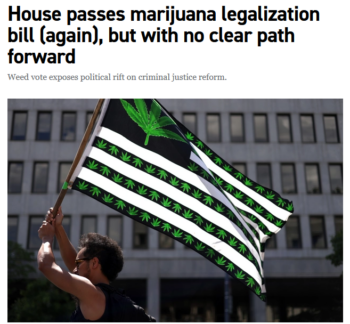
Politico (4/1/22)
And it’s hard not to feel that way about drug policy, that if the goal were really to fairly assess social harms, to help people who needed it, we’d be doing something different. Not a little tweak, but something different. And I’m guessing that’s where the MORE Act comes in.
MPM: Yes, absolutely. The MORE Act is a bill that lives in the House. It has actually passed the House twice at this point. We are hoping that we see movement of that bill, either in this Congress, but if Democrats are able to take back the majority, I do think we’ll see that bill move pretty quickly.
The MORE Act is a bill that would deschedule marijuana. It would remove marijuana completely from the Controlled Substances Act, which is essentially federal decriminalization of marijuana.
In addition to that, it would resentence marijuana convictions. It would provide expungements. It would reinvest marijuana tax revenue into communities that have been most harmed by the war on drugs, ensuring that folks can have access to legal services, quality education, health services, and other things that really build a healthy, happy life. It would also address the collateral consequences of marijuana convictions, ensuring that people can no longer be detained or deported or lose their federal benefits because of marijuana use.
Drug Policy Alliance (8/28/25)
So it really is a far-ranging, comprehensive bill that tries to address criminal justice issues, human rights issues, but, really, the bill is grounded in equity and social justice and human rights, which is why it’s the bill that we support, and are always excited to try to push through Congress.
JJ: Yeah. I think there’s an odd view that you can structurally, systematically, culturally harm people for decades—as you note, people couldn’t get jobs, they couldn’t get housing, due to marijuana convictions—and then just say, “OK, we removed the barrier. Now any problems you have are your own fault,” without actually redressing and looking at those harms that have been done, and that don’t suddenly disappear when you reschedule marijuana.
MPM: Yeah, absolutely. There are lasting consequences in people’s lives when laws change, and those laws should be inclusive of that. They definitely need to look back at the harm that’s been done.
JJ: You stated it, but what is the status of the MORE Act? Where are you seeing support for it, and where do the barriers remain to its passage?
MPM: Yeah. So the bill has very broad support from the Democratic Party, which is why it was able to pass when Democrats were heading the House. And, again, it’s passed twice at this point.
Where we lack support is really with Republicans. And right now Republicans are the majority in Congress. So it’s very unlikely that this bill will move in a Republican Congress, but of course if that changes, then we’ll see support for the bill again. That is one frustrating aspect of working on marijuana reform at the federal level, is that there really are huge differences in what the parties support when it comes to comprehensive federal marijuana reform.
JJ: Right. And I think a lot of folks don’t understand that what might be happening in their city, or even their state, is different than what the federal law is saying and doing.
MPM: Absolutely. Yeah. There are so many people who think because marijuana is legal at the state level, because they have a medical marijuana license and are able to partake in the medical market, or even the recreational market, they might think they have a level of protection. And they do at the state and local level, if they’re following the law.
But unfortunately, because marijuana remains a Schedule I drug on the Controlled Substances Act at the federal level, folks can still be implicated for federal crimes. People can still face federal consequences.
One way this shows up is for noncitizens. There are many noncitizens who partake in the market, either as consumers or laborers, not realizing that because of federal prohibition, it could really jeopardize their immigration status. This is another reason we support full descheduling, because we want to make sure that people have full protections.
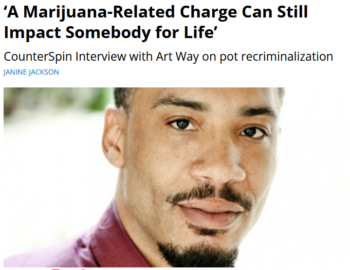
CounterSpin (1/12/18)
JJ: Finally, when I was talking about this back in 2018 with Art Way from Drug Policy Alliance, we were talking about then–Attorney General Jeff Sessions at that point saying, “Good people don’t smoke marijuana.” That was the level of the conversation at that point. And I think folks will understand that, yes, it’s very different now. The conversation, the public understanding, might be different now, and yet, and yet, and yet.
I wonder, finally, what role you think journalism could be playing now. What should they stop doing? What could they do more of?
MPM: Yeah. I think one thing that certainly helps make change is when culture changes, and certainly the media play a big role in cultural change. For far too long, people who use any sort of drugs, marijuana or not, have been highly stigmatized in all media, and popular culture generally. We need to change that in order to actually place laws that are based in reality, based on public health, equity and human rights. So the media could help by reporting the facts, and not stigmatizing individuals who use drugs.
JJ: I would add, just personally, weed is like, it’s everywhere in media. It’s cool, it’s OK, it’s great, it’s a cool thing to do. And it just, to me, that erases the harms that are still happening underneath the surface. If you watch media, it seems like everyone smokes weed, and it’s all fine, and yet that’s not the reality.

Maritza Perez Medina: “There are people who are serving decades-long sentences for marijuana….They’ve been really punished for what others are making so much money off of.”
MPM: Absolutely. I think that’s a really good point, when it comes to marijuana specifically. In the same vein, I find it frustrating when people make light of marijuana and joke about marijuana. We see lawmakers do this all the time.
But to me, it’s a very serious issue, because of what you just said. There are people who are serving decades-long sentences for marijuana. That means they haven’t seen their families for decades. They’ve been really punished for what others are making so much money off of. That, to me, feels very unjust, and it doesn’t feel like a laughing matter.
So that’s one personal frustration with lawmakers. You think this is a joke, which means that you’re not taking it seriously, and not passing laws to change it. And that needs to change.
JJ: All right, then. We’ve been speaking with Maritza Perez Medina from Drug Policy Alliance. You can find their work on this and other issues online at DrugPolicy.org. Maritza Perez Medina, thank you so much for joining us this week on CounterSpin.
MPM: Yeah, thank you.
From FAIR via This RSS Feed.