

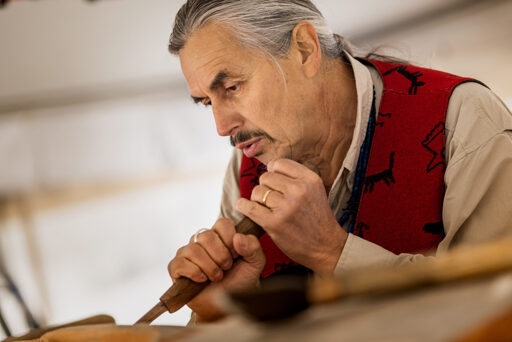
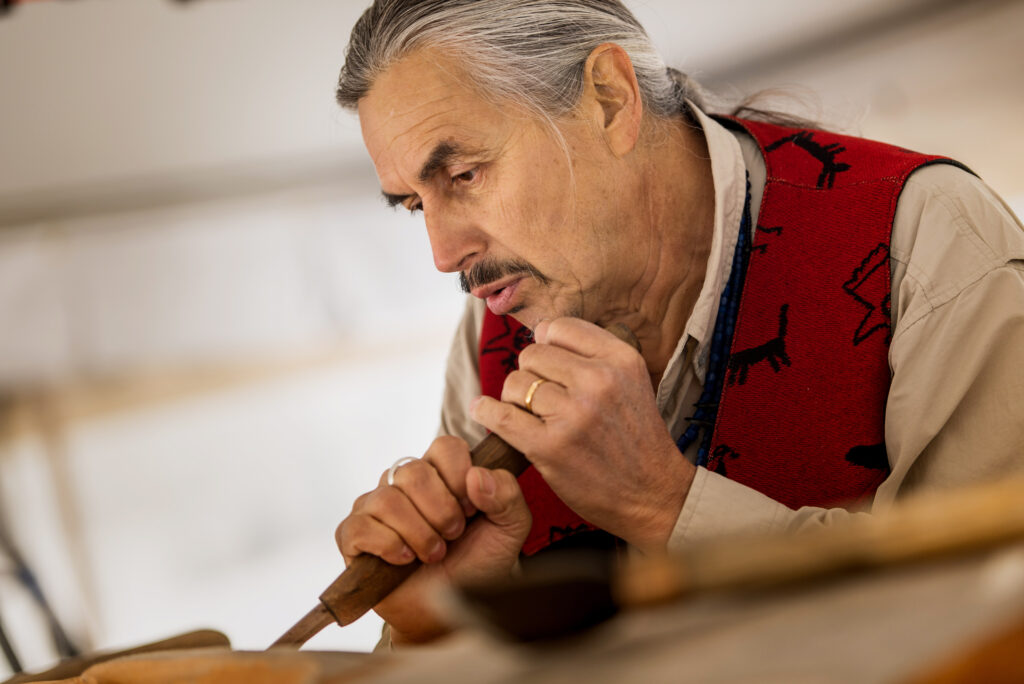
James Hart works on carving a totem pole. Photo by Paul Joseph / UBC
Although his career has spanned four decades, prolific Haida artist 7IDANsuu James Hart says that it took him “around ten thousand years” to master the craft of carving.
The hereditary chief feels his hands are guided by his ancestors, especially his great-great-grandfather Charles Edenshaw.
“I had it in my bones and my system that I could do this stuff,” said Hart.
“I started learning once I discovered Haida art in this world and what our ancestors had left for us. I started studying artwork right from that point forward.”
Late last year, Hart released the book A Monumental Practice, which is co-authored by art curator Curtis Collins and gives readers a glimpse of the artist’s life and work. It includes hundreds of photos of his monumental works — from totem poles to massive bronze pieces and cedar sculptures — placed amid personal stories from Hart and reflections on his life and practice.
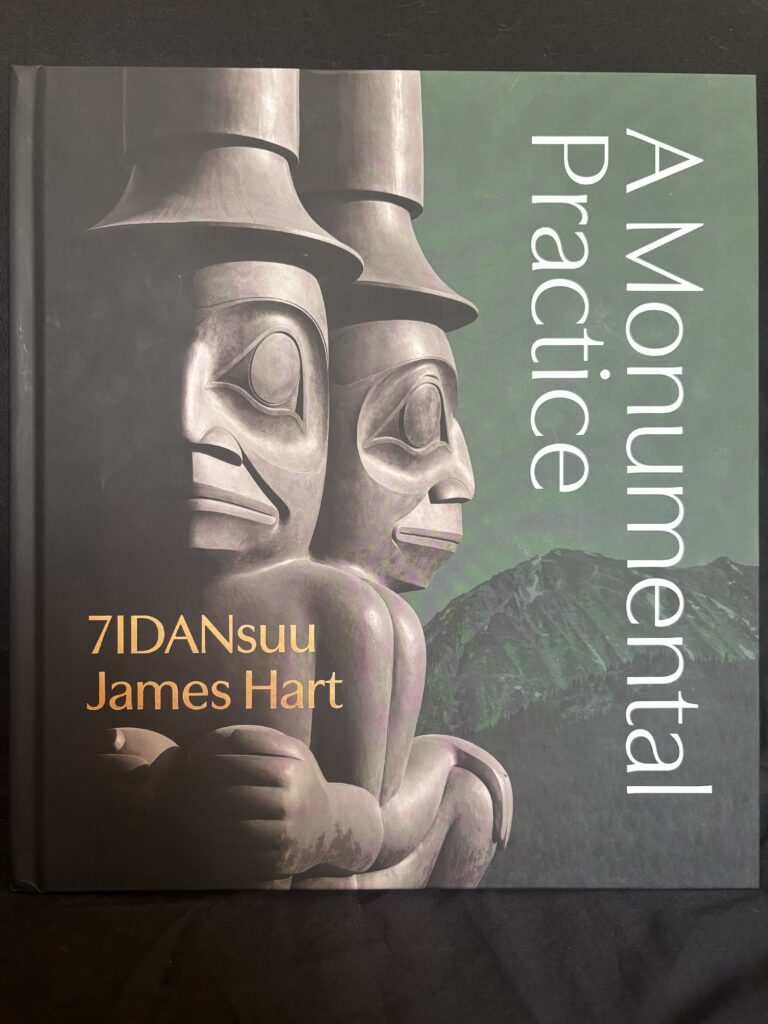
On April 25, Hart brought A Monumental Practice home to Haida Gwaii, with a book launch and celebration was held at the Haida Heritage Centre at Ḵay ‘Llnagaay.
Citizens from both ends of the island gathered in the Gina Guu Aahljuu Naayperformance house, a traditional longhouse-style event space with pit seating. Once seated, Haida singers and drummers opened the event with a few songs before Hart, his son Gwaliga, and Collins spoke about the book in the centre of the pit.
“It’s a historic thing for me and my family,” Hart told guests at the event, “and it’s been wonderful to spend the time pulling it together.”

Curtis Collins, 7IDANsuu James Hart, and Gwaliga Hart sitting in the performance house for the Haida Heritage Centre book launch event. Photo by Ileah Mattice
At the launch, Lynn Hughan, a Haida artist, writer and former manager of the Haida Gwaii Museum Trading House Gift Shop, spoke about the book and the impact Hart had on revitalizing Haida art.
A Monumental Practice represents Hart’s work “over a lifetime” and showcases his love of Haida Gwaii, his culture and storytelling, she said.
“It gives us great pride to speak from the heart about Jim and what he has contributed to the beauty and revitalization of the Haida art on a worldwide scale,” she said.
“It’s hard to put into words how proud we are of Jim, not only as our chief, but as a leader. Jim is an example of what it means to carry and teach culture with responsibility, strength, and grace.”
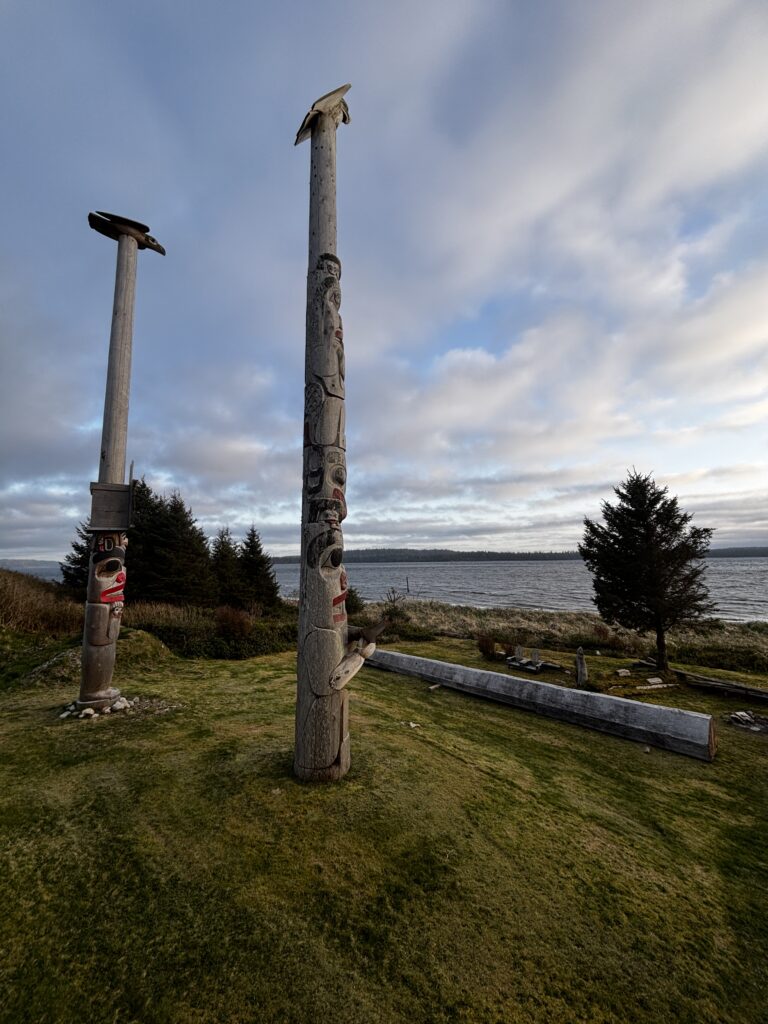
Hart’s Carl Hart Memorial Pole (2023) and Morris White Pole (1999) in front of Three Rainbow House, looking over Masset Inlet. Photo by Ileah Mattice
Hart was born in 1952 in Masset. In 1977, he was working as a commercial fisher when he heard about an opportunity to make carving tools with Haida artist Robert Davidson.
Soon, Hart was working as a fulltime artist. A few years after making his tools, Hart was asked to work with Haida artist Bill Reid on a project for the Museum of Anthropology at the University of British Columbia.
Hart worked with Reid for four years on projects including The Raven and the First Man, and a Masset pole that’s on display at MOA. He relocated to “Vancouver” to assist Reid, who was struggling with Parkinson’s disease and sought help to complete his carvings.
Moving to the city was a culture shock for Hart, coming from a village of just 344 people. But the move meant he was able to visit Haida artworks in museums and personal collections — looking to the ancestors for carving techniques and history, and absorbing what he could while also putting it into practice.
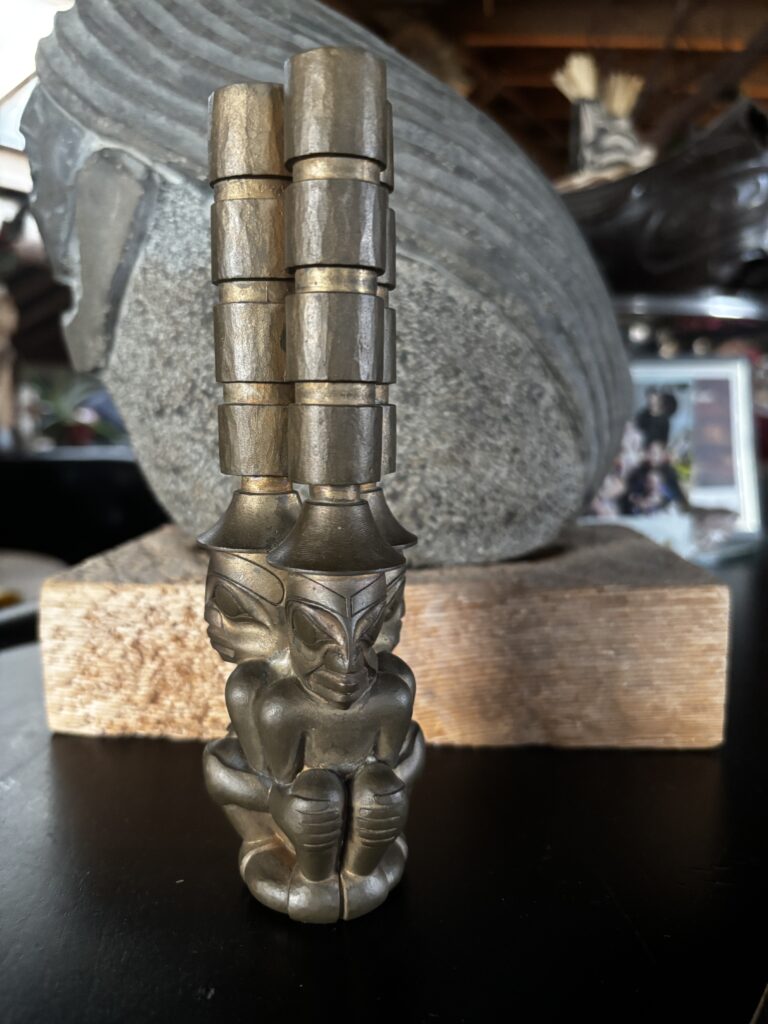
Hart’s miniature bronze sculpture, the Three Watchmen. Photo by Ileah Mattice
In 1999, he inherited his title as chief of the Saangga.ahl Stastas Eagle Clan.
Before receiving his title about two decades into his carving career, he carved the Morris White Memorial Pole with Christian White, and raised the pole in front of his home.
They then held a Potlatch where he received the name 7IDANsuu. 7IDANsuu is one of 18 hereditary titles recognized by the Haida Nation.
A Monumental Practice includes an opening by philanthropist and collector Michael Audain and an introduction to Haida Gwaii and its history by anthropologist Wade Davis. It then focuses on 19 of Hart’s works crafted between 1979 to 2023 in a chronological order — including The Frog Constellation, the Dance Screen (The Scream Too), The Celebration of Bill Reid Pole, and The Three Watchmen.
Hart said A Monumental Practice took about four years in total to put together, with help from co-author Collins, the director and chief curator of the Audain Art Museum in “Whistler.”
“I was always included in books and stuff in my work, and then I started thinking about it and said let’s do it,” Hart said about the decision to create a book.
Collins interviewed Hart, and they worked on writing sections while compiling images.
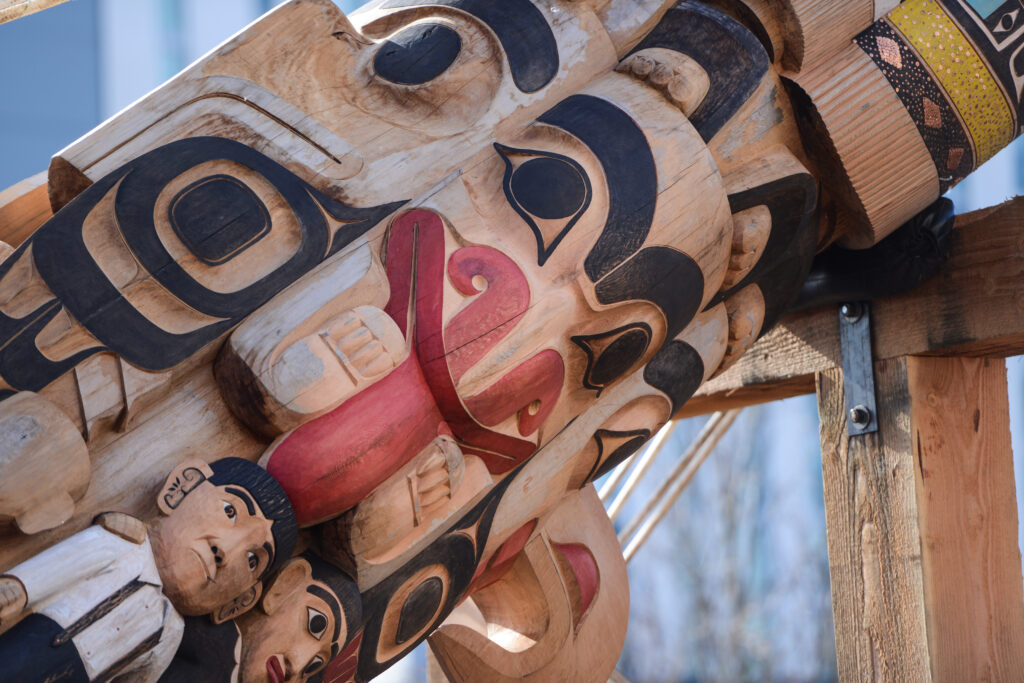
Details of James Hart’s reconciliation totem pole, located at UBC. Photo by Paul Joseph / UBC
“When I first came on my first visit here (on Haida Gwaii) and talked with Jim, the line that kept coming up quite frequently was that monumental work,” said Collins. He added that in particular, the totem poles and his elaborately-carved cedar dance screen came to mind as the backbone of Hart’s practice.
The event concluded with a book signing beside one of his bronze sculptures, The Spirit of Bill Reid, and food was provided for the guests. During the signing, guests purchased copies of A Monumental Practice from the Trading House Gift Shop and formed a long line through the centre.

7IDANsuu signing copies of ‘A Monumental Practice’ on April 25. Photo by Ileah Mattice
Bringing the book home to Haida Gwaii to launch was a full-circle moment for the authors — to bring the book back to the place where it all began. It will sit on shelves around the world as a reminder that the Haida people and their stories have always been here and will continue to be here.
Hart’s son Gwaliga Hart closes the book with some words about his father. He said in an interview that being part of the book was an honour for him.
Gwaliga is also a carver and started his career after university, working alongside his father and other carvers. He assisted with a reconciliation totem pole his father carved at UBC, along with other projects.
He spoke about his father’s influence and how he is grateful to have spent so much time around his culture growing up.
“When those kinds of opportunities present themselves, you have to rise to those occasions,” he shared.
“And I was excited. I was finally being asked to write about the work and be a part of my old man’s story and all this kind of stuff and help hold that up high.”
The post Prolific artist 7IDANsuu James Hart brings new book home to Haida Gwaii appeared first on Indiginews.
From Indiginews via This RSS Feed.