

Idaho Capital Sun
Erin In The Morning is a reader-supported publication. To receive new posts and support my work, consider becoming a subscriber.
Six Idahoans have filed a class action lawsuit against the state over what amounts to the most extreme anti-trans bathroom ban in the country.
HB 752, signed into law last month, extends to restrooms both in public and private buildings, as well as single and multi-occupancy bathrooms. Trans people could face criminal penalties, including years in prison, for entering a restroom that differs from their sex assigned at birth.
The rule applies to government-owned buildings as well as private businesses that are open to the public, such as libraries, rest stops, airports, malls, gas stations, restaurants, entertainment venues, hospitals, and more.
Left unchallenged, HB 752 would go into effect on July 1st. But the ACLU, Lambda Legal, and several law firms are requesting an injunction for what’s been characterized as a brazenly unconstitutional and animus-driven bill.
Nearly half of all states have anti-trans bathroom restrictions, but Idaho’s are particularly pernicious. “What makes Idaho’s law really unique is its criminal punishments, which are incredibly severe, as well as the fact that it reaches so far into public life in Idaho by covering government-owned buildings and places of public accommodation,” said Barbara Schwabauer, senior staff attorney for the ACLU’s LGBTQ & HIV Rights Project.
Kell Olson, counsel for Lambda Legal, also issued a scathing condemnation of the policy. “This law leaves transgender people in the impossible and exhausting position of trying to determine what is allowed on a daily basis almost anywhere in their public lives,” Olson said. “HB 752 applies even to single-user restrooms that are designated by sex, revealing that its purpose is not safety or privacy, but to subject transgender people to the humiliation that comes with a state-mandated disavowal of their identity.”
The complaint argues HB 752 violates the Fourteenth Amendment, and should be struck down for its vagueness; that it constitutes sex discrimination; that it violates the Equal Protection and Due Process clauses; and that the law is unconstitutional because the state has “no legitimate interest, let alone a compelling or important one” in functionally forcibly outing a trans person any time they use a public restroom.
Statehouse testimonies from lawmakers characterized transgender people as criminal and violent. Meanwhile, in those same hearings, those same legislators openly fantasized about physically brutalizing transgender women, as seen in the complaint excerpt below—evidence that the bill is motivated by animus.
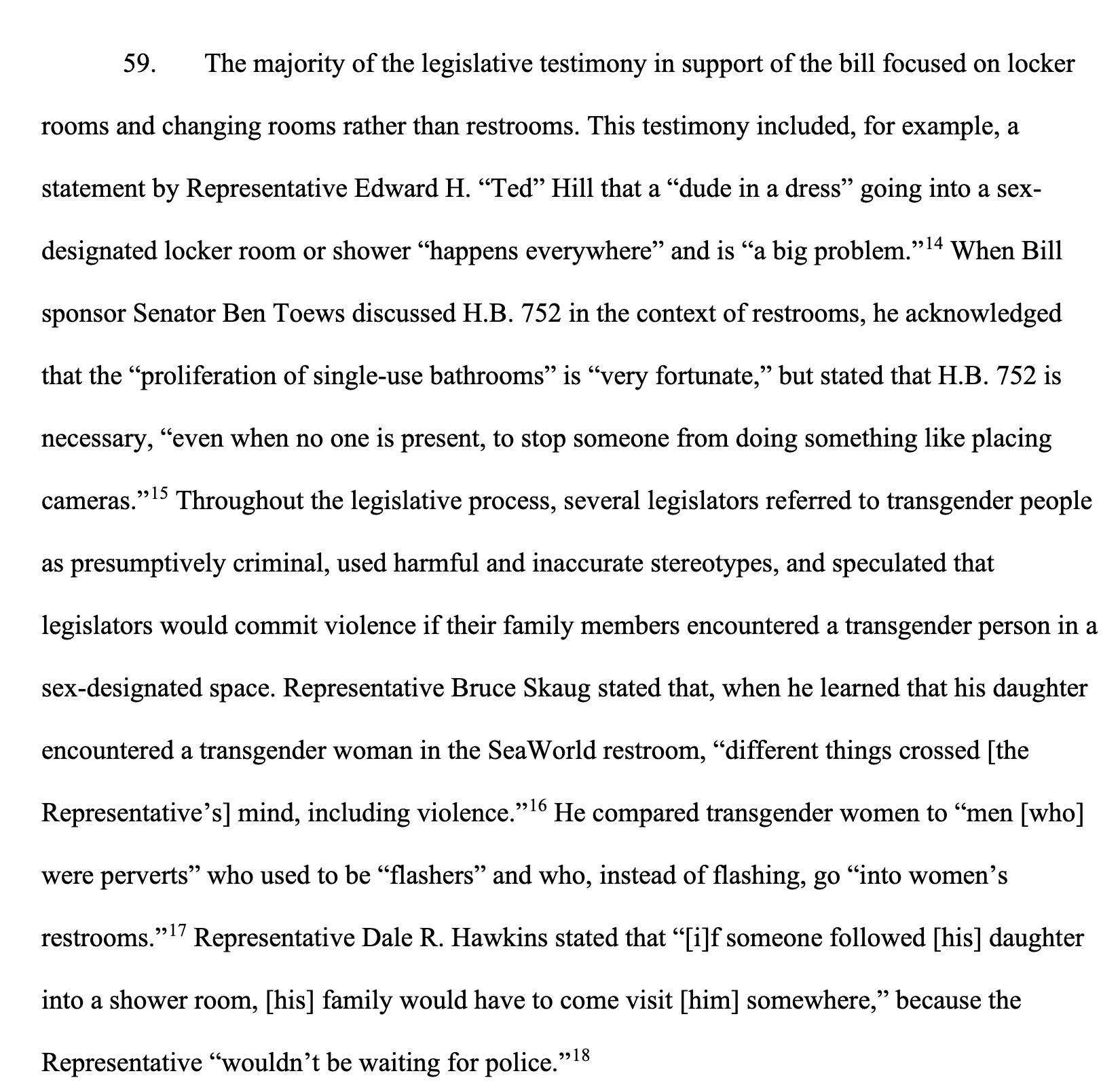
CAPTION: Excerpt from the complaint.
Moreover, the law is rife with “exceptions” carved out to make it as unobtrusive as possible for cisgender people. It undermines the rhetorical red herring that contends lawmakers simply wanted to reinforce barriers between men and women in bathrooms, and that it didn’t exceptionalize trans people.
Some of the law’s exceptions “have nothing to do with restrooms at all,” Schwabauer pointed out. “If you are an athletic trainer or a coach, you can go into the restroom of the opposite sex, and talk to your team during a team event.”
Of course, we know from experience that these discriminatory policies harm cisgender people, too. Those who are presumed to be trans often face violence due to the anti-trans bathroom panic.
Meanwhile, multiple law enforcement groups begged lawmakers not to pass the bill due to the burdensome and litigious risks thrust upon those called in to be the literal bathroom police. “Officers responding to a complaint would be placed in the difficult position of determining an individual’s biological sex in order to enforce the statute,” a letter from Idaho Fraternal Order of Police addressed to lawmakers reads. However, “there is no clear or reasonable way for officers to make that determination without engaging in questioning or investigative actions that could be viewed as invasive and inappropriate.” The law’s vagueness creates an “unenforceable standard.”
Plaintiffs emphasized the impacts are dire. One plaintiff, Diego Fable—a transgender man who has called Idaho home for a decade—said this would likely cause him to have to flee the state.
“Do I risk my personal safety and privacy by complying with the law and using the women’s restroom? Since I look like a man, using the women’s restroom would only invite suspicion, questions, harassment, and potentially violence,” Fable said. “Or, do I avoid going out altogether?”
Erin In The Morning is a reader-supported publication. To receive new posts and support my work, consider becoming a subscriber.
From Erin In The Morning via This RSS Feed.