


Fire Tisch. Fire Tisch. Fire Tisch.
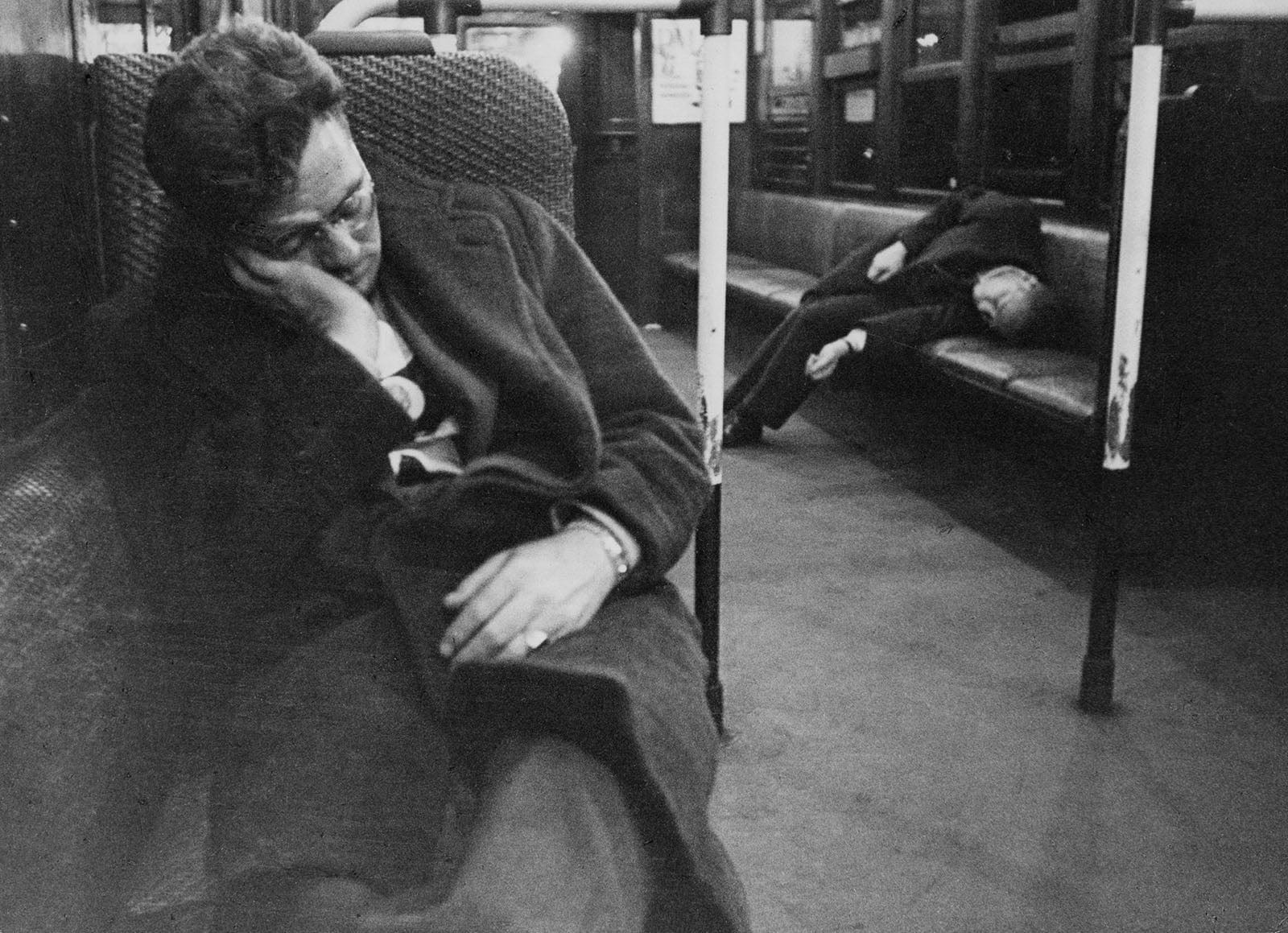
Two men asleep on the New York City Subway, 1945; by a 17-year-old Stanley Kubrick.
Zionist billionaire heiress Jessica Tisch’s first year in charge of the NYPD saw a 3,000% increase, compared to the previous year, in arrests where the most serious charge was lying down or taking up more than one seat on public transit. A new investigation by Gothamist outlines Tisch’s “public safety” crusade–noting that this practice of arresting poor people for being poor in public has continued apace, if not increased, under the new mayoralty of NYC-DSA cadre Zohran Mamdani. “Between January 1 and March 31 of this year,” writes Gothamist’s Samantha Max, “police arrested 643 people whose only initial charge was stretching out on the subway.”
This news comes a week after DSA member and Socialist-in-Office, friend of Zohran, Chi Ossé, was thrown to the ground and concussed in a violent assault by police as they attempted to execute an eviction of a deed theft victim in Bed-Stuy. Referring to this event, a ‘concerned’ Mayor Mamdani said that he was “in touch with Commissioner Tisch.”
Though nowhere yet analyzed in tandem, these are two mirrored expressions of the same singular class war function of the NYPD. On one hand is the ethnic cleansing of Black Bed-Stuy by means, here, of deed theft–only made possible, and often made irreversible, by NYPD-enforced eviction–and on the other, the genocidal cleansing of the poor from public sight. Both are expressions of the capital system’s cyclic annihilation and purging of surplus populations; both show how the police serve to protect the vortex of real estate speculation that swirls at this city’s financial heart.
That the NYPD is performing class violence on the city’s marginalized and minoritized communities, and assaulting political figures standing in the way of such violence, is nothing new. This is what they do. What is novel, of course, is that their boss’ boss is a socialist, and a fellow member of NYC-DSA.
Back in September of 2024, MUG member Sid CW, discussing Zohran’s then-hypothetical mayoral campaign, noted that
Governing the city under its present political system would require the Mayor to engage, negotiate, and compromise with a police department that has used its deep embeddedness within our city’s so-called democracy to demand more funding and resources as schools and libraries go without… [W]e should treat the police as a political force capable of using its institutional authority (especially around issues of crime and “quality of life”) and its various advocacy organizations (the police “union,” the Republican Party, local news media stoking crime panic) to exert control over city politics.
“Victory,” Sid wrote, “would thrust DSA into a governing coalition without a mandate to govern.”
And yet, this is the world we now live in. Zohran has stood steadfast alongside his rabidly Zionist, billionaire-heir, Adams-appointee cop commissioner; he has backtracked on plans to dismantle the infamous Gang Database; while he has maintained his commitment to do away with the even more infamous Strategic Response Group (SRG), the actualizing of this intention remains firmly speculative; his Department of Community Safety is too-often framed as an olive branch to the NYPD–dear rank-and-file cops, it goes, let us do the jobs you don’t want to–rather than any form of attack on its power. The assault and arrest of Chi was a show of impunity and perhaps a response to the only bit of confrontation Zohran has mounted against the police, in disbanding a narcotics team that was filmed beating the living hell out of an unarmed man in a liquor store.
The news that the subways are being patrolled more fiercely than ever before shows that Tisch and her foot soldiers are not bending to Zohran’s campaign rhetoric of compassion. Then a few days later: Tisch mocks Zohran at the NY 100 event, telling him in front of an audience: “Since taking office, you’ve governed by a core principle to ensure the strength of our city: Support, Reinforce and Grow, or, for short, SRG.”1 They are testing and taunting us.
I’m reminded of something Marx said in a letter to Wilhelm Liebknecht as the fall of the Paris Commune became imminent:
It appears that the defeat of the Parisians was their own fault, but a fault which really arose from their too great honnêteté [decency]. The Central Committee and later the Commune gave the mischievous abortion Thiers2 time to centralise hostile forces, in the first place by their folly in trying not to start civil war.
We are not in a revolutionary setting; the Commie Corridor is no Commune. But just as for the Communards, for socialists today, there is no choice; this choice has been made for us. The civil war has long raged–the NYPD is a class war partisan, and their daily function requires us, as socialists, to choose a side. They are just as much, as Marx put it, a mischievous abortion of hostile forces as Theirs, his aristocratic backers, and their Prussian mercenaries were; Tisch, in taunting Zohran on stage, is centralizing her forces.3 Decency will not appease them.
Nor will appeals to higher forms of unity above and beyond the class struggle.
Perhaps even more consequential than their failure to immediately apprehend Theirs was the Communards’ decision to leave the Bank of France untouched, despite its headquarters falling within the Commune’s territory. If the bank were under the Commune’s control, Marx would write in another letter, “they could have reached a compromise with Versailles useful to the whole mass of the people.”4 The Commune’s representative to the Bank of France, Proudhonist Charles Beslay, explained the decision this way: “I went to the Bank with the intention of preserving it from any violence on the part of the radical elements of the Commune, and it is my conviction that I have saved for my country the establishment that was our last financial resource.”
Zohran’s treatment of the NYPD–which, as he insists, falls fully under his jurisdiction–imitates Beslay’s reasoning; rather than confront this avowed class enemy, whose monopoly of coercive control structures a class-differentiated life experience, there is a liberal appeal to a higher abstraction of unity, the city, the country. When asked, back in January, about his and Commissioner Tisch’s differing views on ‘quality-of-life’ policing (e.g. the arresting of very-poor people because they make not-so-poor people uncomfortable), Zohran replied: “What we are fully aligned on is the fact that we need to see genuine public safety across the city.” The recent Gothamist report sheds new and unfortunate light on this alignment.
Yet the folly of Zohran–in trying not to start this long-ongoing civil war–is more so the folly of NYC-DSA, as our chapter has politely tailed behind our ‘hand-tied’ mayor: offering not a modicum of pressure on him, pretending–as he pretends–that this unresolvable contradiction, this decision that has already been made for the working class, that sits at the heart of contemporary municipal governance, can be effectively avoided or otherwise somehow managed through shadow work and the opening of this or that new office. Subordinating one plank of our politics–and as socialists, abolition is a foundational plank–to another (something like working-class quality of life) produces incoherence and betrayal.
What is to be done?
Two things.
The first is for NYC-DSA to demand the firing of the billionaire heiress, Zionist-extraordinare Cop Boss Jessica Tisch.
This is an obvious political orientation for our socialist organization to take: she is a class enemy thrice embodied. But importantly, this demand constitutes a declaration of political independence by the chapter: Zohran is mayor, and that is what it is; he wouldn’t be there without us but he is no longer ours; for the socialist movement, his mayoralty is somewhat good and also somewhat risky (60/40 or 40/60 maybe Deng would say). But given this new world we live in, the chapter needs to clarify, loudly, its political program with regard to the NYPD and be comfortable that this program will conflict with Zohran’s–in fact, Zohran needs us to do this just as much as we need to do it for our own integrity. That program should begin with firing Tisch. Firing Tisch is a non-negotiable. It then should include following through on his commitment to disbanding the SRG, opening up the books and auditing the whole department, deleting the gang database, truly empowering the Civilian Complaint Review Board to actually discipline the NYPD, dismantling police “unions,” making a Jumaane Williams-style ‘worst cops in the city’ list, and closing Rikers, among much, much else.
What Lenin said in 1917, in an article presciently entitled, “They Have Forgotten the Main Thing,” remains true, if not truer in the here and now:
In all bourgeois republics, even the most democratic, the police (like the standing army) is the chief instrument of oppression of the masses, an instrument making for a possible restoration of the monarchy. The police beats up the ‘common people’ in the police stations of New York, Geneva, and Paris; it favours the capitalists either because it is bribed to do so (America and other countries), or because it enjoys wealthy “patronage” and “protection” (Switzerland), or because of a combination of both (France)… A people’s militia instead of the police force and the standing army is a prerequisite of effective municipal reforms in the interests of the working people.
Secondly, the chapter needs to abolish the cone of silence that separates our elected officials–our Socialists in Office (SIOs)–and our general membership.
Our Chapter Co-Chairs meet weekly with the Mayor, yet all we know of these discussions is the rare reference to them we hear in the news! What our leadership is telling the Mayor and what he is telling them–the content of the most consequential relationship for our organization–is a black box. At our last convention, the very convention where Zohran’s mayoral campaign was endorsed, a resolution was passed that committed the chapter’s State and City SIO Committees to distribute, at a minimum, monthly written reports to chapter membership. I am very pleased that just this week, 18 months later, the very first of these reports was released. And while this is a nice step toward something like transparency, it is not nearly enough; the reports have no account of dialogue between the chapter and leadership; they are mostly neutral-sounding updates on SIO activity–and Zohran, notably, is not included in these reports whatsoever.
We, the rank-and-file of this chapter, have very little idea what is being discussed between our leadership and our elected officials. How can we begin to expect to trust the relationship between our chapter and our chapter’s elected officials if we have no information on the actual content of those relationships, are left guessing from afar? How can we expect transformative transparency from our elected officials when it’s not even practiced within our socialist organization? How can we hope to move beyond the decision-making process of our current bourgeois government, driven by backroom dealings and sleights of hand, if we imitate the same system in NYC-DSA? The rank-and-file of the chapter are, too often, relegated to volunteer laborers who play distant audience to real political machinations. Regular reports, like the one we received this week, as well as actual outlines of discussions and deliberations–and disagreements–along with the releasing of meeting minutes and, why not?, regular open meetings with the general membership.
These two prescriptions are, just like the instances of police violence above, not separate but one. They are both aspects of the singular project of democratization, within the chapter and in our city, that is to say: socialism.
The SRG has become this convenient, even jocular point of disagreement for Zohran and Tisch that allows them each their posturing of opposition whil subsuming the more fundamental antagonism.
Adolphe Thiers (1797-1877) president of France who suppressed the French Commune.
Rumors abound about Tisch’s own mayoral ambitions.
The Bank of France did not prove neutral during the civil war; as Georges Beisson writes: “During its 72 days of existence, the Commune received 16.7 million francs [from the Bank of France]: the 9.4 million that the City of Paris had in its account and 7.3 million that were actually lent by the bank. Meanwhile the Versaillais received 315 million francs […] from the Bank of France.”
From The Socialist Tribune via This RSS Feed.