

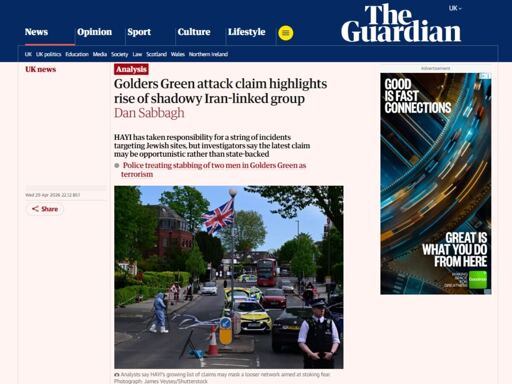

A series of attacks targeting Jewish communities across Europe has been widely attributed to a group calling itself Harakat Ashab al-Yamin al-Islamia (HAYI). The Guardian’s Dan Sabbagh seems to have been overcome by a rush to the head of certainty that HAYI is backed by Iran.
Given how long it took for the Guardian to start describing the genocide in Gaza as a genocide, we are intrigued by how quickly he and his editor have come to this conclusion. We’d like to check with Dan if he has verified these claims and that they are from an unbiased source that is not part of an agenda to gain advantage from the fallout.
The so-called ‘mainstream’ media is now consistently describing HAYI as having “Iranian state links” or being an “Iran-backed network.” However, we’ve been looking at the evidence, the language used in the group’s statements, and the reliability of sources, and we have to say that not only is there no reliable evidence we can find to support this narrative, but the circumstantial evidence all points the other way.
The Guardian’s reporting on HAYI and its gaps
In its recent article following the Golders Green knife attack, the Guardian reported that HAYI claimed responsibility within an hour of the incident. While the article correctly notes that investigators found “no initial evidence of Iranian state direction” and described the group’s claims as “most likely opportunistic,” it still maintains the narrative of potential Iranian involvement. Where did this come from?
Sabbagh’s reporting suggests that HAYI “is considered not to exist in its own right” and the “working assumption” is that it is “a cutout, a front for an Iranian state agency.” Whose working assumption, Dan? Yours? The police haven’t said that. The conclusion appears to rest on speculation rather than concrete evidence.
Linguistic analysis casts doubt on authenticity
One of the biggest puzzles here comes from reading the group’s statements. As detailed in an investigation by Younes Saramifar, a political anthropologist at VU University Amsterdam, the Arabic language used in HAYI communications shows clear signs of artificial generation.
“The language of announcements shows a clear lack of fluency in Arabic,” Saramifar noted, explaining that “the language is generated by an AI tool” and that technical details like punctuation placement indicate “the group is neither native Arabic nor English speakers.”
Perhaps most telling is the group’s inconsistent terminology. HAYI refers to Palestine as “the Land of Israel”, with a capital “L” – a phrase overwhelmingly associated with Israeli state ideology rather than Palestinian resistance.
Call us suspicious, but when the IRA released statements during the Northern Irish troubles, they had to have a code word in them to be taken seriously by the RUC Special Branch, or anyone else. If they’d been spelling Irish words wrong and talking about ‘our wee Ulster’, there would have been some adults in the room to pour cold water on the whole thing.
Questionable sources and unverified incidents
A MintPress News investigation revealed that mainstream reporting on HAYI has relied heavily on sources which we would not regard as unbiased.
The International Centre for Counter-Terrorism (ICCT) report, frequently cited by journalists, receives core subsidies from the Netherlands Ministry of Foreign Affairs and maintains partnerships with NATO, USAID, and other Western governmental institutions. The report itself states that “there is no unequivocal proof of Iranian involvement”, while at the same time not addressing any of the reasons to doubt the Iran-linked narrative, such as the lack of motive, or rather that Iran has a very strong motive to avoid association with such attacks.
It makes no reference to the fact that there are other states and state actors with a strong motive to frame Iran as being behind attacks on Jews in the West, and that any other group or intelligence agency could easily set up a Telegram channel at short notice that appears to be within the Iranian information ecosystem, leading to the same conclusions that the report comes to.
The fact that this report gives no cursory consideration to these obvious alternative possibilities does not give us much confidence in it.
When examining the actual incidents attributed to HAYI, the evidence becomes even more problematic. Of the ten incidents claimed by HAYI between March 9-23, at least five appear to have never occurred:
- Greece (March 11-12, 2026)
- France (March 23, 2026)
- Haarlem, Netherlands (March 23, 2026)
- Antwerp, Belgium (March 23, 2026)
- Chabad Hebrew School in Heemstede, Netherlands (March 23, 2026)
The Antwerp incident, initially reported as an arson attack targeting a Jewish neighbourhood, was later revealed to involve a car owned by a Moroccan woman, not a Jewish resident.
Who benefits? The political context
The timing of HAYI’s emergence – coinciding with the US-Israeli war against Iran and growing European calls to designate Iran’s Islamic Revolutionary Guard Corps (IRGC) as a terrorist organisation – cannot be ignored. The same media outlets and commentators amplifying the HAYI narrative have also been prominent voices in the push for IRGC proscription.
History also strongly suggests caution. As documented by Skwawkbox and many others, there have been multiple instances where violent attacks against Jewish people have been used to serve pro-Israeli political agendas, from the Lavon Affair to recent attacks in Australia, which were so obviously cooked up that even the Guardian reported them as fake. The use of violence in attacks on Jewish people or organisations is often traced back not to Israel’s enemies but to Israel itself, but we generally find this out only many years later. Prof Avi Shlaim is one impeccable source of information on the bombings in Baghdad in the 1950s, which he exposed in his book, Memoirs of an Arab Jew as being mostly carried out by Israeli Zionists.
The need for responsible reporting on HAYI – and everything
The consequences of reporting something in haste that may later be disproven are serious, and we really think that Dan and his employer should consider them. If the Iran theory turns out to be wrong, and we think it may well do, these are the real-world effects:
- Tensions escalate during a period of international conflict
- The real instigators of violent attacks to avoid investigation
- Trust in the media is undermined
- Islamophobic sentiment and discrimination are heightened
- Government policy is hastily changed to benefit certain interest groups, such as those demonstrating at Golders Green during the Prime Minister’s visit; quoted in the Guardian on 30th April 2026 as wanting “the Government to proscribe the Islamic Revolutionary Guard Corps (IRGC) as a terrorist organisation and shut down the Iranian Embassy”.
It’s clear enough that there are plenty of people in Britain’s ruling class who are determined to push forward on those last two points and really couldn’t give a rat’s ass about the first three. In their reporting of this incident, The Guardian appears to be playing to that gallery in a most obedient way. Media organisations have a responsibility to distinguish between verified facts and speculation, especially when reporting on matters of national security and international relations. We’re not seeing any of that here.
Featured image via the Canary
By The Canary
From Canary via This RSS Feed.