

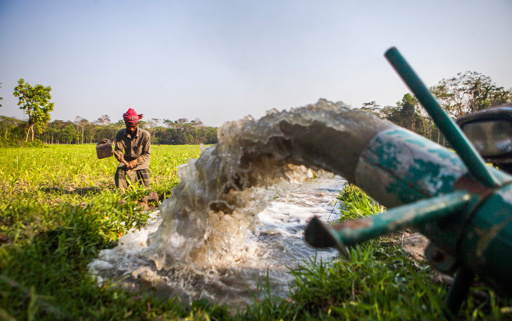
Considering the rapidly depleting groundwater table in Bangladesh’s northwestern zone, known as the Barind Tract, the country declared 25 subdistricts of the region as water crisis-prone areas in December 2025. In a circular, the government suggested that farmers immediately cut their cultivation of the high irrigation-intensive rice variety boro. At the same time, it directed the state-owned Barind Multipurpose Development Authority (BMDA) to stop providing irrigation to the farmers. BMDA is an authority under the Ministry of Water Resources that oversees irrigation of extracted groundwater through roughly 16,000 deep tube wells to more than half a million hectares (1.2 million acres) of arable land in northern Bangladesh. “The water crisis is nothing new in the region. However, the sudden declaration of stopping irrigation and boro cultivation brought BMDA and the farmers into a confrontational situation,” said Md Abul Kasem, additional chief engineer of BMDA. “Later, we discussed the situation with the Water Resources Ministry and got a verbal direction to continue the irrigation till the next formal decision is made,” he added. The declaration came per the suggestion of the Bangladesh Water Resources Planning Organization (WARPO), as it suggested the government take measures to curb groundwater depletion in the country. According to WARPO, five subdistricts of Chapai Nawabganj, 10 subdistricts of Rajshahi and 10 subdistricts of Naogaon are marked at different levels of groundwater scarcity, including high, medium and low. A 2024 study said the Barind Tract was the most drought-affected zone in the country due to its lesser rainfall,…This article was originally published on Mongabay
From Conservation news via This RSS Feed.