


Editor’s note: ICT will refer to individuals defending the Black Hills as treaty defenders. The Black Hills is unceded territory in the Fort Laramie Treaty of 1868 and acknowledged by the 1980 Supreme Court ruling of the United States v. Sioux Nation of Indians.
Amelia Schafer*ICT*
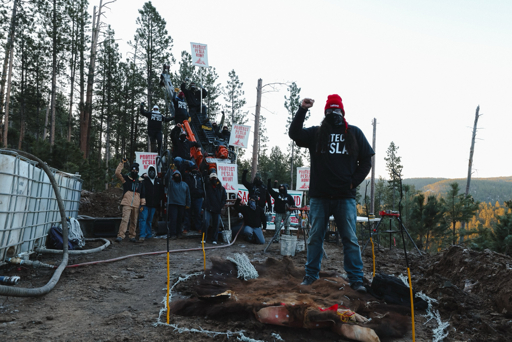
RAPID CITY, South Dakota – Roughly a dozen Indigenous treaty defenders gathered near Pe’ Sla, a sacred site in the Black Hills, early Thursday morning to show their opposition to drilling near the site. Treaty defenders conducted ceremonial activities near two drill pads in response to recent exploratory graphite drilling within the two-mile buffer zone around Pe’ Sla.
Lakota youth “locked down” to drilling equipment, by taping their arms to machinery, and organizers constructed a prayer altar nearby. As of Thursday morning, organizers were informed law enforcement was en route but had not yet arrived.
Indigenous people in South Dakota concerned, alarmed at potential drilling project at sacred site
Treaty defenders said they fear that mining activity could threaten the nearby Rapid Creek Watershed, which supplies water to several tribal communities as well as local municipalities like the Ellsworth Air Force Base. Drilling also could disrupt ceremonies regularly held at Pe’ Sla, tribal leaders told ICT in May 2025.
For Oceti Sakowin (Lakota, Dakota and Nakoda) people, Pe’ Sla is sacred in part because it aligns with the constellations at various points in the year and is a focal point of oral history. Pe’ Sla is roughly 50 miles west of Rapid City. The area has been used by Oceti Sakowin nations for generations as a site for ceremony and gathering.
Exploratory drilling for graphite, in this case, involves drilling up to 18 holes that are 3 to 3.5 inches in diameter 1,000 feet into the earth.
Currently, all of the United States’s graphite comes from China, representatives from the South Dakota Mineral Industries Association told ICT in May 2025. With new tariffs from President Donald Trump, companies are looking for a domestic solution. That solution could come in the Black Hills, but not without threatening hard fought for tribal sovereignty over an area already promised to the Oceti Sakowin.

A man sits in prayer near a piece of drilling equipment used for exploratory graphite drilling near Pe’ Sla in the Black Hills. Credit: Courtesy Angel White Eyes, NDN Collective
The U.S. Forest Service granted local mining company Pete Lien & Sons a permit allowing for exploratory drilling near the site on Feb. 27. The permit was deemed to be exempt from the federal environmental review process required under the National Environmental Policy Act.
At least 10 drill pads are operating within the two-mile buffer zone surrounding Pe’ Sla, according to NDN Collective, a nonprofit Indigenous advocacy organization headquartered in Rapid City. The buffer zone was created following the purchase of portions of Pe’ Sla by several Oceti Sakowin tribes, after which it was placed in federal trust.
Treaty defenders placed signs and banners on mining equipment and sang and drummed at the site.
NDN Collective and two environmental advocacy groups, Black Hills Clean Water Alliance and Earthworks, filed a lawsuit against the U.S. Forest Service on April 2 in response to its decision to permit drilling. The lawsuit cites violations of the National Environmental Policy Act and potential threats to lands recognized for religious and cultural importance.
In late April, the three plaintiffs filed for a temporary restraining order to stop drilling, NDN Collective organizers said.
“Pe’ Sla is our sacred land, and we are doing everything we can to protect it,” said Valeriah Big Eagle, Ihanktonwan Dakota and the director of He Sapa Initiatives at NDN Collective in an April 30 press release. “We will not cease our ceremony in the face of destruction, disrespect, and illegal drilling.”
The post Treaty defenders demonstrate against drilling near sacred site appeared first on ICT.
From ICT via This RSS Feed.